
Article Contents
Plug-in Voltage Relay: Overview, Suitable Appliances, and How to Connect


Key takeaways
A plug-in voltage relay is a compact protective device that connects between a household socket and the appliance plug and cuts power when the voltage leaves the safe range. This form factor delivers point protection for one expensive appliance without touching the electrical panel and without calling an electrician.
Key point: the main advantage is the plug-and-use principle - the device simply plugs into the socket, and the appliance is then connected to it. The main limitation is the load current, usually up to 16 A, which makes it a solution for a single piece of equipment rather than for the whole apartment.
Secrets and verified facts
Below are gathered technical facts that help correctly assess the capabilities of the plug-in form factor. Each of them relies on standards or the specifications of real devices. These nuances are often overlooked when buying. Taking them into account will save you from typical disappointments.
- The relay's own consumption is only 2-5 W, that is 1.5-3.6 kWh per month, so continuous 24/7 operation barely affects the electricity bill.
- As of July 1, 2025, Ukraine switched to a rating of 230/400 V instead of 220/380 V, and the thresholds of modern relays are set against the 207-253 V norm per DSTU EN 50160:2023.
- The relay switches off the load at the upper threshold in 0.02-0.05 s, and at the lower one more slowly, in 0.2-2 s, because a short sag in voltage does not harm equipment.
- The relay does not catch a microsecond pulse from lightning - to protect against lightning overvoltage a separate SPD per DSTU EN 61643-11:2015 is needed.
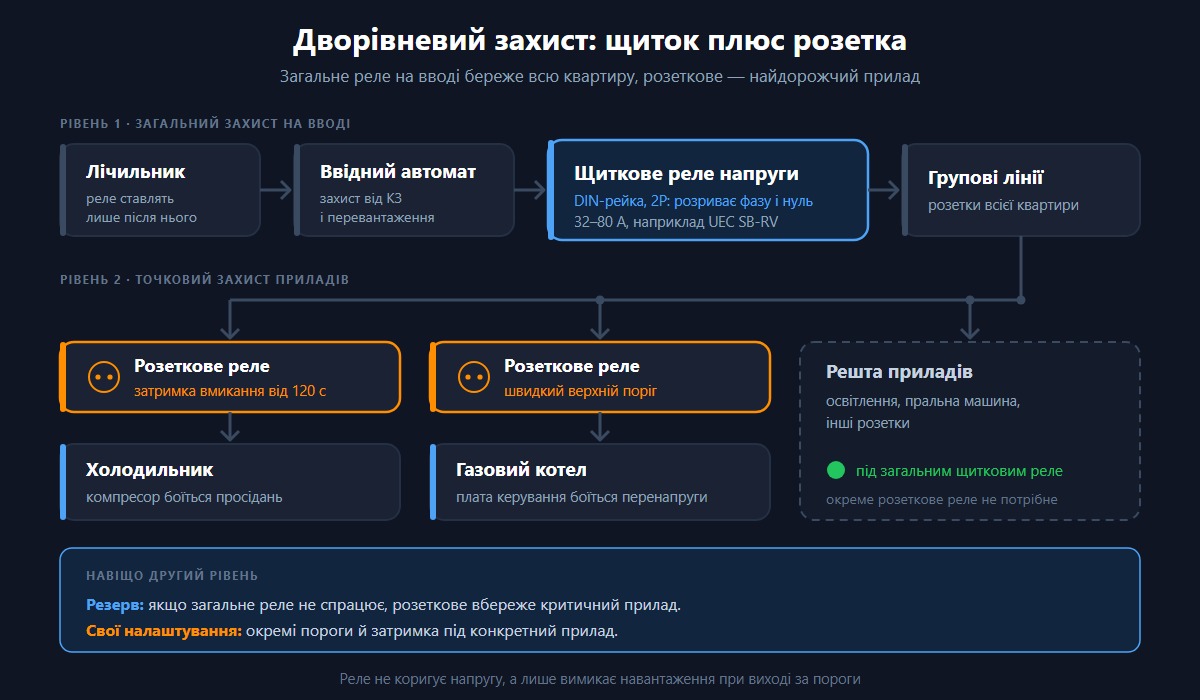
- Installing any voltage relay ahead of the meter is not allowed, so a panel relay is always placed after the input circuit breaker.
A different view: a plug-in relay is redundant, a panel one is enough
A common counterargument goes like this: if a stationary DIN-rail relay is already installed on the apartment input, it protects all appliances, and a plug-in one becomes a waste of money. This view is right in one scenario - when the panel relay is sound, correctly set, and the grid is stable, it really does cover the whole apartment with a single device. However, it does not take into account the principle of redundancy: with only one line of protection, its failure leaves an expensive refrigerator or boiler defenseless. A plug-in relay is inexpensive and adds a second independent line specifically for the critical appliance, and it also allows individual thresholds and a delay to be set, which the general relay does not provide. So for an ordinary apartment with a stable grid the argument is fair, while for expensive compressor equipment two-level protection is justified.
The first expert opinion concerns the choice between form factors.
«I recommend a plug-in relay as a quick first step for rented housing or for one expensive appliance, when you cannot or do not want to get into the panel. But to apartment owners I always explain: full protection begins with a stationary double-pole relay on the input, while a plug-in adapter is already point reinforcement for a refrigerator or boiler.»
- Oleh Lukianchuk, electrical engineer at UEC
The second opinion reveals the most frequent mistake of users.
«People often confuse a relay with a stabilizer and expect it to level out low voltage. The relay only switches off the appliance when the voltage goes outside the limits - it saves against damage but does not raise the level. If in your village the voltage constantly drops to 190 V, the plug-in relay will switch off the equipment every hour, and here a stabilizer is already needed.»
- Oleh Lukianchuk, electrical engineer at UEC
We examined the difference between these two classes of devices in detail in the article voltage relay or stabilizer, so the choice between them should rely precisely on it.
Frequently asked questions (FAQ)
❓ Can a refrigerator be connected through a plug-in voltage relay?
Yes, a refrigerator is one of the most typical appliances for a plug-in relay. It is only important to set a reconnection delay of at least 120 s, so that the compressor does not start immediately after a voltage sag. For an expensive model it is better to choose a relay with an adjustable delay up to 600-900 s.
❓ What maximum power can a plug-in relay handle?
A plug-in relay is limited by the household socket current of 16 A, which corresponds to a power of about 3.5 kW. For appliances at 25 A (5.5 kW) or 32 A (7 kW) the plug-in form factor is not suitable, and a stationary DIN-rail relay is needed. Exceeding the limit leads to overheating of the contacts.
❓ Is an electrician needed to install a plug-in relay?
No, a plug-in relay works on the plug-and-use principle: it plugs into a sound grounded socket without dismantling the panel. However, before connecting it is worth making sure that the socket itself is sound, has grounding, and a reliable contact. If the wiring is old or ungrounded, first put the electrical network in order.
❓ Does a plug-in relay raise low voltage to the norm?
No, the relay does not correct the voltage but only switches off the appliance when the thresholds are exceeded. To raise chronically low voltage a voltage stabilizer is needed. A relay and a stabilizer solve different tasks and in difficult conditions often work together.
❓ Which is better - a plug-in or a panel voltage relay?
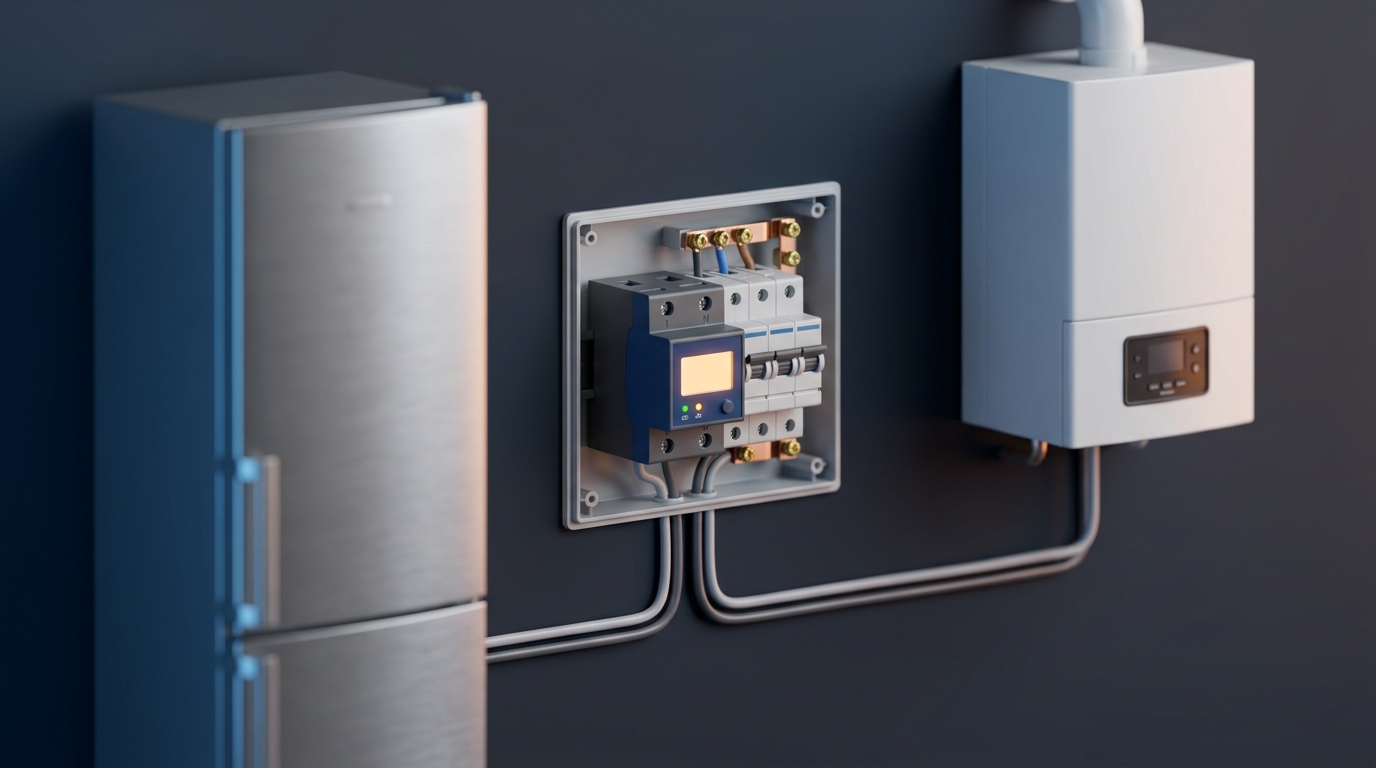
It depends on the task: a panel relay protects the whole apartment and a powerful load, while a plug-in one provides point protection of a single appliance without an electrician. The optimal strategy is to combine both: a stationary UEC SB-RV on the input plus a plug-in adapter on critical equipment. Such two-level protection provides redundancy.
❓ Can a voltage relay be kept switched on continuously?
Yes, the relay is designed for around-the-clock operation, and its own consumption is only 2-5 W, that is 1.5-3.6 kWh per month. The mechanical life of quality models reaches 1,000,000 switching cycles. Continuous operation is the standard mode of a protective device.
Hi, I'm Oleh Lukianchuk, an electrical engineer at UEC. I specialize in electrical network protection - voltage relays, RCDs, and automation.
In this article I'll explain what a plug-in voltage relay is, how it differs from a panel relay, which appliances it's worth installing for, and how to connect it yourself without an electrician.

Warning! Working with electrical equipment is life-threatening!
Work in the electrical panel requires a qualification of at least electrical safety group III. Entrust installation to a licensed electrician. A plug-in relay does not require installation in the panel, but before installing it make sure the socket itself is sound and the grounding is reliable.
| Parameter | Value | Why it matters |
|---|---|---|
| Form factor | Socket adapter / socket block / extension cord | No panel or electrician needed |
| Maximum current | up to 16 A | Limits appliance power to ~3.5 kW |
| Safe voltage range | 207-253 V (230 V +-10% per DSTU EN 50160:2023) | The norm the thresholds are set against |
| Trip time (upper threshold) | 0.02-0.05 s | Protects against an overvoltage spike |
| Trip time (lower threshold) | 0.2-2 s | Ignores brief sags |
| Reconnection delay | from 5-15 s up to 600-900 s | Protects the compressor of a fridge and air conditioner |
| Protection zone | One appliance (point) | Does not cover the rest of the apartment |
What is a plug-in voltage relay and how does it differ from a panel one?
A plug-in voltage relay performs the same function as a panel one: it continuously measures the mains voltage and breaks the power supply when it exceeds the upper or lower threshold. The difference is purely structural - it is built into an adapter housing with a plug and its own socket, rather than on a DIN rail inside the panel. This moves the point of protection from the apartment's input directly to a specific appliance.
The plug-in form factor in simple terms
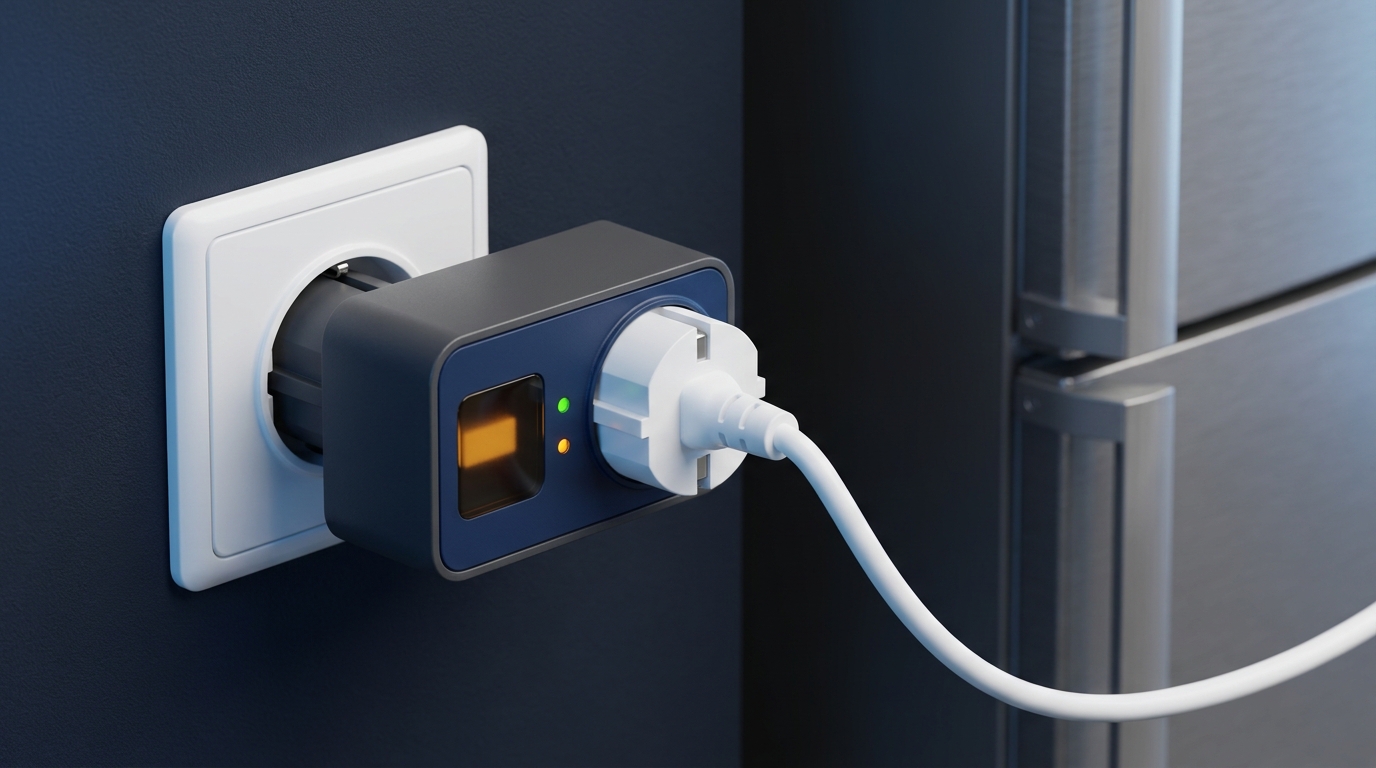
A plug-in relay is an intermediate link between the fixed wiring and the appliance. The device plugs into a fixed socket, and the plug of a fridge or boiler goes into the relay's own socket. All the measurement electronics and the power switching element are hidden inside a compact housing about as thick as a charger. The basic True RMS measurement principle and the threshold logic are covered in detail in the article the complete guide to voltage relays, so here we do not repeat the theory but focus on the specifics of the plug-in form factor.
How does a plug-in relay differ from a DIN-rail one?
The key difference is the area of responsibility and the load current. A panel DIN-rail relay is fitted on the whole input and protects all groups at once, handling 32, 40, 63, or 80 A. A plug-in relay is physically limited by the household socket rating, that is 16 A and a power of about 3.5 kW. The second difference is the double-pole design: serious panel models break both the phase and the neutral, which is critical in the event of a neutral break, whereas simple plug-in adapters often switch the phase only. Because of this, a plug-in relay should be viewed as a supplement rather than a replacement for panel protection.

What subtypes of plug-in voltage relay exist?
Plug-in relays are divided into three structural subtypes by the number of appliances they serve: an adapter for one appliance, a block of several sockets, and an extension cord with a built-in relay. They all work with the same measurement logic but differ in placement convenience and the number of protected consumers. The choice of subtype depends on how many pieces of equipment stand nearby and whether mobility is needed.
A relay adapter for one appliance
A relay adapter is the simplest form: one plug, one output socket, a minimal housing. It is intended for point protection of a single valuable appliance, most often a refrigerator or a gas boiler with electronics. The advantage of such a solution is compactness and full autonomy: it can be moved to a new location together with the appliance in seconds. The drawback is that it protects exactly one consumer, so for several appliances you will have to buy several adapters.
A socket block and an extension cord with a built-in relay
A socket block with a built-in relay lets you connect several appliances standing nearby under a single protective module - for example, a TV, a receiver, and a game console. An extension cord with a relay adds mobility to this and protection where the fixed socket is inconveniently located. It is important to remember that the total power of all appliances in the block must not exceed the relay's limit, that is the same 16 A or about 3.5 kW. If you connect a powerful heater together with other equipment to the block, the relay will either trip from overload or its contacts will work at the limit.
Which appliances is a plug-in voltage relay worth installing for?
A plug-in relay is most appropriate for expensive appliances with sensitive electronics or a compressor that stand separately and are rarely moved. These are refrigerators, freezers, air conditioners, gas and electric boilers, TVs, computers, and network equipment. For such consumers, a sudden spike or deep sag in voltage means an expensive repair, so point protection pays for itself quickly. For a load over 3.5 kW the plug-in form factor is already insufficient.
Refrigerator, freezer, and compressor equipment
Compressor equipment is the most vulnerable to voltage fluctuations, because the compressor motor's inrush current is several times higher than the operating one. A voltage sag forces the compressor to work under overload, which overheats the winding and shortens its life. This is exactly where the reconnection delay is critical: after tripping, the relay must not restore power immediately, because starting the compressor on an unstable grid finishes it off. Detailed recommendations for this category are set out in a separate article on a voltage relay for a refrigerator and household appliances, which examines start-up modes in depth.
Boilers, TVs, computers, and expensive equipment
Gas boilers with a control board and a circulation pump fail even from a short-term overvoltage, and their repair is often more expensive than the relay itself. TVs, monitors, and computers have switch-mode power supplies that degrade from chronically elevated voltage. For such equipment a plug-in relay trips quickly at the upper threshold, within 0.02-0.05 s, so it manages to break the circuit before damage occurs. It is worth understanding the limit of its capabilities: the relay saves against mains voltage spikes but does not catch a microsecond pulse from lightning - for that you need a separate SPD per DSTU EN 61643-11:2015.
How to connect a plug-in voltage relay without an electrician?
Connecting a plug-in relay does not require dismantling the panel and is done by yourself: the device plugs into a sound grounded socket, and the appliance is connected to the relay's output socket. After power is applied, the relay runs a self-test, measures the voltage, and, if necessary, switches on the load with a time delay. The whole procedure takes a minute, but it requires checking that the socket is sound and following the rules of electrical safety.
Step-by-step plug-and-use connection
First, make sure the fixed socket is sound, has grounding, and provides a reliable contact without scorching or plug play. Next, plug the relay into the socket, wait for the self-test to complete and for the voltage indication to appear on the display. After that, connect the appliance plug into the relay's output socket - power will be supplied automatically once the reconnection delay elapses. If the display shows a voltage beyond the set thresholds, the relay will keep the load switched off, and this is normal protection operation rather than a fault.
Why does YMYL matter even for a plug-in relay?
The simplicity of plug-and-use does not cancel the requirements of electrical safety, since the device operates under mains voltage and switches a real load current. A faulty or overheated socket with poor contact remains dangerous regardless of whether a relay is present - it controls the voltage, not the quality of the mechanical connection. You absolutely must not plug a plug-in relay into an extension cord of dubious quality or into a network without grounding. If the apartment has old aluminum wiring or ungrounded sockets, you should first put the electrical network itself in order and only then add protective devices.
How to set the thresholds and delay of a plug-in relay?
Plug-in relays come in two types: with fixed factory thresholds and with adjustable ones. Factory models come with thresholds set by the manufacturer (listed in the datasheet) and require no intervention, while adjustable ones let the user set the upper and lower thresholds and the reconnection delay themselves. The optimal values depend on the appliance type and the stability of the grid in your building. The general principle is not to narrow the range excessively, so that the relay does not trip from minor fluctuations.
The upper and lower voltage threshold
The upper threshold protects against overvoltage and is usually set within 250-253 V; the trip here must be fast, since elevated voltage damages equipment instantly. The lower threshold guards against a deep sag and is set within the 190-200 V range with a slower reaction of 0.2-2 s, because a short-term sag does not harm equipment. Thresholds set too narrowly lead to frequent false trips, while too wide ones reduce the quality of protection. A detailed table of recommended values for various scenarios is given in the article on optimal voltage relay settings.
The reconnection delay for compressor equipment
The reconnection delay is the pause between the restoration of normal voltage and the re-supply of power to the appliance. For ordinary electronics a short pause of 5-15 s is enough, whereas for a refrigerator, air conditioner, or heat pump at least 120 s is needed, and preferably more, so that the pressure in the compressor has time to equalize. Some models allow the delay to be set up to 600-900 s for especially sensitive compressors. If you switch the compressor on immediately after a sag without a delay, the inrush current on a still-unstable grid sharply shortens the motor's life.
| Appliance type | Recommended delay | Priority threshold |
|---|---|---|
| TV, computer | 5-15 s | Upper (overvoltage) |
| Refrigerator, freezer | from 120 s, preferably more | Both thresholds |
| Air conditioner, heat pump | from 120 up to 600-900 s | Both thresholds |
| Gas boiler | 120 s | Upper (overvoltage) |
What limitations does a plug-in voltage relay have?
The main limitations of a plug-in relay are a current of up to 16 A, the point nature of the protection, and switching of predominantly one phase. It is ideal for a single appliance but is not able to protect the whole apartment or a powerful load. Understanding these limits protects against the mistaken expectation that a single adapter will solve all the problems of an unstable grid. For full home protection the form factor will have to be changed to a panel one.
The 16 A / 3.5 kW limit
A household socket is rated for a current of 16 A, so a relay in this form factor cannot switch more. In the list of ratings this corresponds to a power of about 3.5 kW, whereas 25 A gives 5.5 kW, and 32 A already gives 7 kW, and such values are not available to a plug-in relay. An attempt to connect an electric stove, a powerful water heater, or an instantaneous water heater through it will lead to overheating of the contacts. For a load above the rating of a panel relay, a contactor is needed, and that is already an exclusively panel solution.
Point protection or protection of the whole apartment?
A plug-in relay sees the voltage only at the point where it is plugged in and switches off only its own appliance. The rest of the equipment in the apartment - the washing machine, lighting, other sockets - is left without protection. If an overvoltage occurs in the network, the plug-in relay will save the connected refrigerator but will not protect the TV in another room. Because of this, point protection is logically viewed as a first step rather than a complete solution for the whole home.
When is a plug-in relay not enough and a stationary DIN-rail relay is needed?
A plug-in relay is not enough when you need to protect the whole apartment, a powerful load over 3.5 kW, or several consumer groups at once. In these cases a stationary DIN-rail relay on the input is needed, which controls the voltage for all lines and handles a large current. A stationary solution also provides double-pole breaking, critical in the event of a neutral break. The optimal strategy is to combine a panel relay for the whole home with a plug-in one for the most expensive appliances.
UEC SB-RV as a stationary alternative
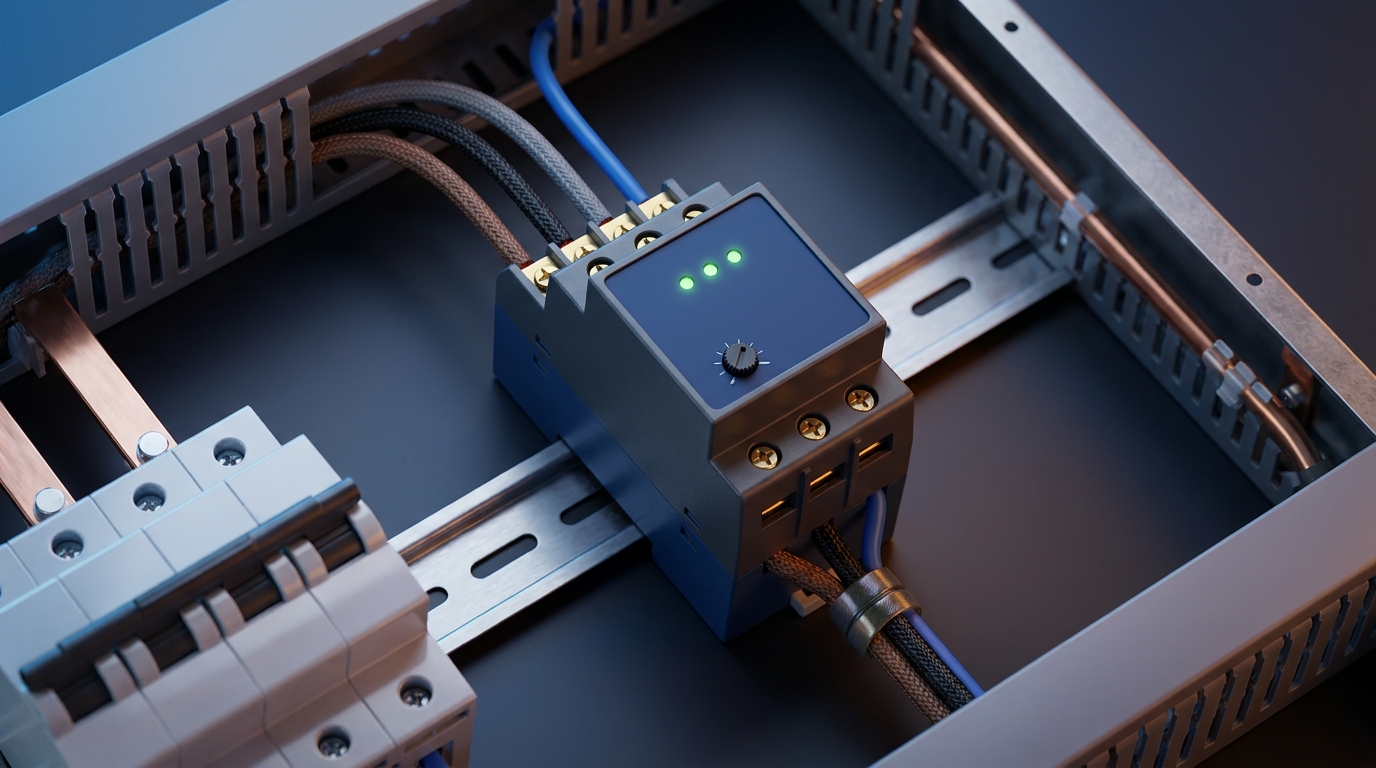
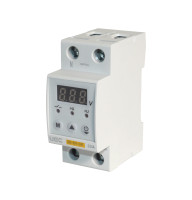
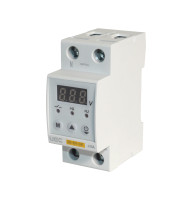
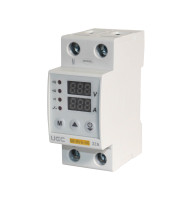
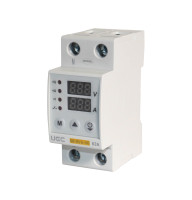
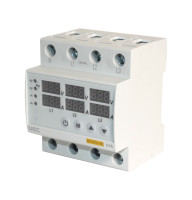
The UEC SB-RV line consists of double-pole DIN-rail voltage relays for installation on the input of an apartment or house. The series covers the 32, 40, 63, and 80 A ratings, that is, it covers the power levels unavailable to the plug-in form factor. All models are double-pole and break the phase and neutral simultaneously, have a mechanical durability of 1,000,000 cycles, withstand an impulse voltage of 6 kV, and come with a 2-year warranty. It is an affordable domestic alternative from UAH 650 for the 32 A model to about UAH 900 for the 80 A one; you can review the specifications on the SB-RV voltage relay page. If you also need overcurrent (overload) protection, the UEC range includes the SB-RVA voltage and current relay rated 32-80 A.
GEWISS GW96908: an undervoltage relay
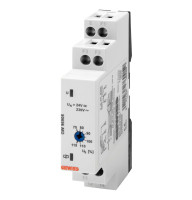
Where undervoltage monitoring is specifically needed, the GEWISS single-phase undervoltage relay GW96908 is suitable. It mounts on a DIN rail, takes up one 18 mm module, is powered from 24 V AC/DC or 230 V AC, and disconnects the load through its 1CO changeover contact when the voltage drops. Its mechanical endurance is 20 million cycles, its rated impulse withstand voltage is 4 kV, and its protection class is IP20. Keep the limitation in mind: the GW96908 responds only to a voltage drop and does not protect against overvoltage, so it is not a replacement for a two-pole SB-RV voltage relay on the apartment input. Detailed specifications are given on the GEWISS single-phase relay page.
How to get the maximum result from plug-in protection?
The maximum result comes not from a standalone plug-in relay but from a well-thought-out two-level scheme: a panel DIN-rail relay on the input for general protection plus plug-in adapters on the most expensive and most sensitive appliances. This approach provides redundancy - even if the general protection for some reason does not trip, the point relay will save the critical consumer. In addition, it is important to correctly set the thresholds and delays for the specific equipment. And to remember that the relay only switches off the voltage rather than correcting it.
Combining point and general protection
A two-level scheme is built as follows: a stationary relay is fitted on the input, which switches off the whole apartment in the event of an emergency voltage, while a separate refrigerator or boiler additionally gets its own plug-in relay with individual settings. The general relay responds to global network emergencies, and the plug-in one - to the local specifics of a particular line, providing a reserve. This approach eliminates the main flaw of point protection - incomplete coverage of the apartment. The sequence of installing devices in the panel itself is covered in the article on the wiring scheme of a relay in the panel.
What operating mistakes occur most often?
The most common mistake is to expect voltage correction from a plug-in relay: it only breaks the circuit when the thresholds are exceeded but does not raise low voltage to the norm. If the voltage in your area is chronically low, the relay will switch off the appliance too often, and the real solution will be a stabilizer rather than a relay. The second mistake is thresholds set too narrowly, which cause constant false trips of sound equipment. The third is connecting a load greater than 16 A through the relay, which overheats the contacts and leads to sticking.