Article Contents
How Many Kilowatts Can a Circuit Breaker Handle: A Table Matching Rating to Power


Key takeaways
The question comes up after installation: the miniature circuit breaker (MCB) is in the panel, C16 is marked on it, and you need to understand what load can be put on that circuit. Tables on the internet give different figures, because some calculate from 220 V and others from 230 V, and they do not always explain where the difference between one phase and three comes from. This article gives the numbers both ways: from rating to kilowatts and from kilowatts to rating, with an explanation of the assumptions behind each calculation.
It also looks separately at why the device tolerates short overloads and why raising the rating when the breaker trips is the worst of all possible fixes. If the device has not been chosen yet and you need to match it to the existing wiring, that task is covered in the table for selecting a breaker by cable cross-section.
Hi, I'm Oleh Lukianchuk, an electrical engineer at UEC. I specialize in circuit breakers, panel equipment and protection of electrical networks.
In this article I will explain how many kilowatts a breaker of each rating can handle, why the table gives only an upper limit, how to select the rating from the power, and why you must not fit a rating higher than the calculated one.

Warning! Working with electrical equipment is life-threatening!
Replacing a circuit breaker and any work in the panel must be carried out with the power off, after checking with a voltage indicator that no voltage is present. Selecting the rating for existing wiring and replacing the device must be done by an authorized electrician with electrical safety qualification group III or higher. Raising a breaker's rating on your own without checking the cable cross-section creates a direct fire hazard.
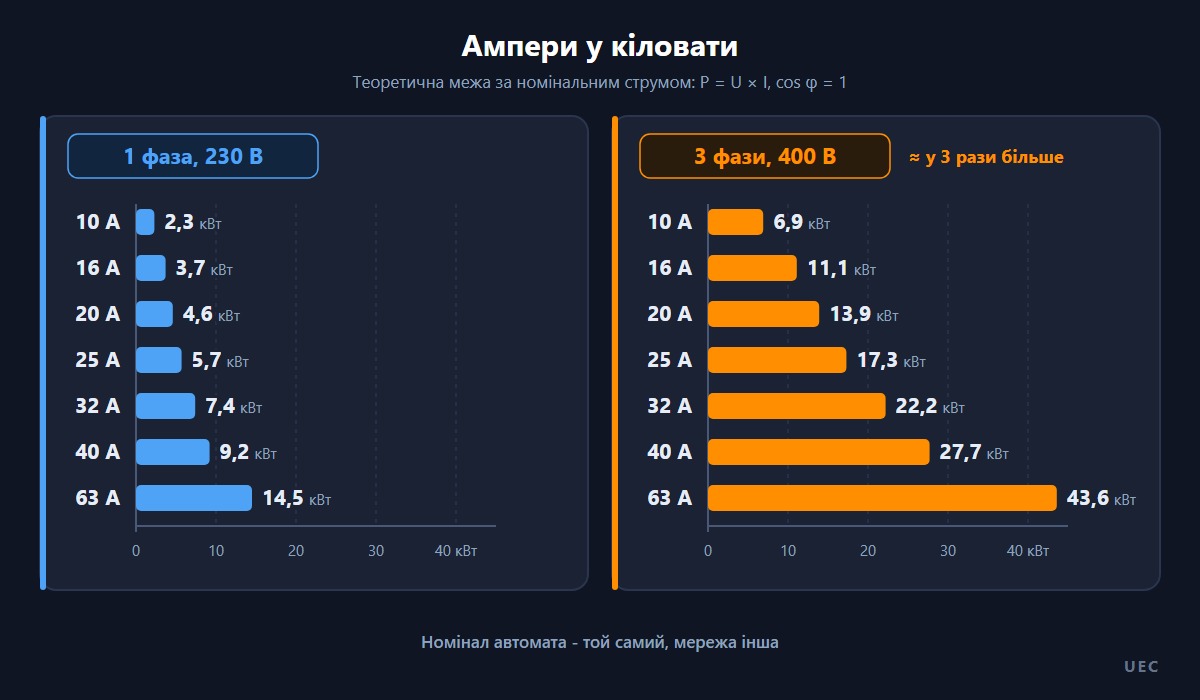
| Breaker rating | Single-phase supply 230 V | Three-phase supply 400 V | Minimum copper conductor |
|---|---|---|---|
| 10 A | up to 2.3 kW | up to 6.9 kW | 1.5 mm2 |
| 16 A | up to 3.7 kW | up to 11.1 kW | 2.5 mm2 |
| 20 A | up to 4.6 kW | up to 13.9 kW | 2.5 mm2 |
| 25 A | up to 5.7 kW | up to 17.3 kW | 4 mm2 |
| 32 A | up to 7.4 kW | up to 22.2 kW | 6 mm2 |
| 40 A | up to 9.2 kW | up to 27.7 kW | 6 mm2 |
| 63 A | up to 14.5 kW | up to 43.6 kW | 10 mm2 and more |
How many kilowatts a circuit breaker handles: summary table by rating
A 16 A breaker at 230 V carries about 3.7 kW, a 25 A breaker about 5.7 kW, a 32 A breaker about 7.4 kW. In a 400 V three-phase network the same ratings give roughly three times higher values.
The figures given are a theoretical upper limit based on the rated current of the device. They hold under two conditions: the load is resistive, that is, the power factor equals one, and the cable of the circuit is rated for at least the same current. If the second condition is not met, the real limit is no longer the breaker but the conductor. That is why the question "what load does a 16 amp breaker handle" is correctly worded as "what load does a circuit with a 16 amp breaker handle", and the answer to it always has two parts.
Values for a single-phase 230 V network
In a single-phase network, power equals voltage multiplied by current, so each ampere of rating corresponds to roughly 0.23 kW.
The full series looks like this: 6 A gives up to 1.38 kW, a 10 A breaker up to 2.3 kW, 16 A up to 3.68 kW, a 20 A breaker up to 4.6 kW, 25 A up to 5.75 kW, a 32 A breaker up to 7.36 kW, a 40 A breaker up to 9.2 kW, 50 A up to 11.5 kW, 63 A up to 14.49 kW. This is the standard series of ratings in which all household modular equipment is made, including the circuit breakers in the catalog. These figures are a theoretical limit, so it is not advisable to keep a circuit permanently at the limit of its rating: the thermal release of the device heats up gradually, and under a prolonged load close to the rated one, tripping becomes only a matter of time and of the temperature in the panel. A practical guideline for continuous load is no more than 80 percent of the table value.
Values for a three-phase 400 V network
In a three-phase network, power is calculated using the line voltage of 400 V and the square root of three, so one ampere of rating corresponds to roughly 0.69 kW.
For the three-phase series this gives the following values: 10 A - up to 6.93 kW, 16 A - up to 11.09 kW, 20 A - up to 13.86 kW, 25 A - up to 17.32 kW, 32 A - up to 22.17 kW, 40 A - up to 27.71 kW, 50 A - up to 34.64 kW, 63 A - up to 43.65 kW. This is exactly where the confusion arises: seeing in the table that a 16 A breaker handles 11 kW, the owner of a single-phase supply draws a wrong conclusion about their own network. The condition for using these figures is a balanced three-phase load, for example an electric motor or a three-phase cooker. The specifics of selecting a device for such a network are covered separately in the article on a circuit breaker for 380 volts.
Why the question "how many kilowatts does a breaker handle" is only half right
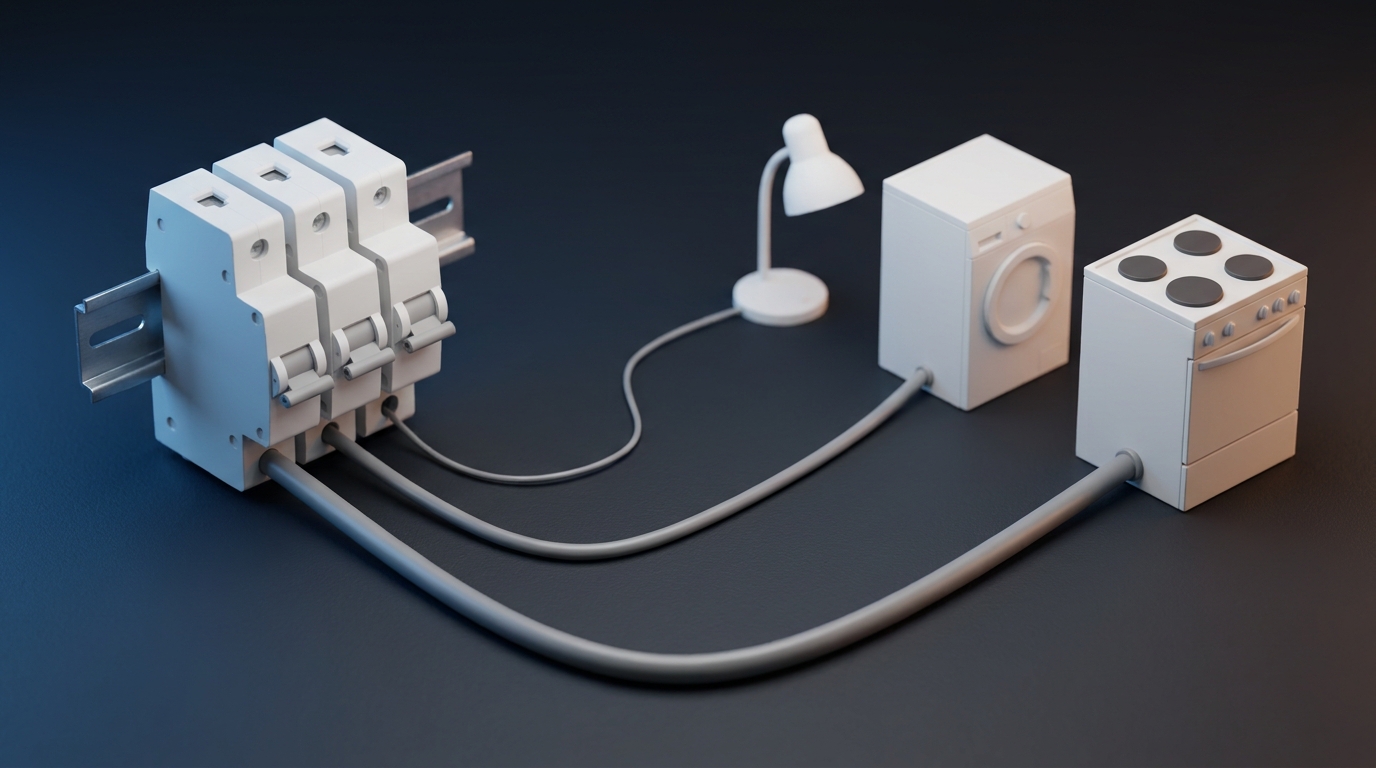
A circuit breaker protects neither the appliance nor an abstract power figure, but the cable it is connected to. The answer is therefore always capped from above by the characteristics of the conductor, not by the figure in the table.
This is the main misunderstanding on the subject. The device does not know what has been plugged into the socket; it reacts to the current in the circuit. Its task is to break the circuit before the cable overheats to the point of insulation damage. The appliance in this arrangement is merely the load that draws the current, while what is always being protected is the conductor laid in the wall, because it is the one that cannot be quickly replaced.
What sets the real power limit of a circuit
The limit is set by the weakest element of the chain, and this is almost always the cable, not the breaker.
The correct sequence is as follows: first the cross-section of the installed conductor is known, then the maximum permissible current of the circuit is determined from it, and only then is the rating of the device chosen so that it does not exceed this value.
If a 2.5 mm2 copper conductor is run in the wall, the circuit will not become more powerful because a 32 A breaker is fitted instead of a 16 A one. Only one thing will change: the cable will overheat, and the device will not notice. This is exactly why the last column in the table at the beginning of the article, the one with the minimum cross-section, is restrictive rather than informational.
Why the table gives only an upper theoretical limit
The table figures show what the device will let through, not what is safe to connect to a specific circuit.
Between the table value and the real permissible load there are at least three corrections. The first is the cross-section and the installation method of the cable: a conductor in a conduit under plaster cools worse than one laid openly. The second is the ambient temperature: in a panel on an unheated veranda in summer the device trips earlier than in a cool room. The third is the nature of the load: motors produce starting surges, which are formally not an overload. The table therefore answers the question "what will the device let through", while the decision on the actual load of the circuit is made taking all three corrections into account.
Where the kilowatt figure comes from: the formula and its assumptions
The power of a single-phase load equals voltage multiplied by current: P equals U multiplied by I multiplied by cos φ. For a household resistive load, cos φ is taken as one.
The formula is simple, but each of its factors carries a caveat, and it is because of these that tables from different sources differ by 5-10 percent. The first caveat concerns the voltage: 220 and 230 volts give different results at the same current. The second concerns the power factor, which equals one for far from all consumers. The third concerns simultaneity of operation, because the total power of an entire house is never drawn in a single moment.
Why the formula uses 230 V and not 220 V
The nominal voltage of a single-phase network under DSTU EN 50160:2023 is 230 V, and this is the value built into the markings of modern equipment.
The habit of counting at 220 V remains from the previous standard, and in everyday conversation it has not gone anywhere. The difference in the final figures is small but noticeable: a 16 A breaker gives 3.68 kW at 230 V and 3.52 kW at 220 V. The devices of the SB-M9 series in the UEC catalog are marked with a rated operational voltage of 230/400 V and a rated insulation voltage of 415 V, and are designed for the current standard. The practical conclusion is simple: calculate at 230 V and treat the 4 percent difference as part of the margin that is built in anyway when choosing the rating.
When cos φ is below one
For heating appliances and incandescent lamps the power factor equals one, while for motors, welding machines and transformers it is lower.
This means that for the same useful power such consumers draw more current from the network. For a household panel this matters in two cases: a circuit with a pump, compressor or air conditioner, and a circuit with a welding machine in a workshop. If the appliance rating plate states cos φ, for example 0.8, the current is calculated with this factor taken into account, and the required rating comes out higher. For ordinary socket circuits with household appliances such a refinement is redundant, because modern equipment with power factor correction operates close to one.
What the diversity factor is
The diversity factor takes into account that not all the appliances in a house ever run at full power at the same time.
The sum of the ratings of all branch breakers in a typical apartment panel easily exceeds 100 A, although the main breaker is rated 40 A or 50 A, and that is enough. The reason is precisely simultaneity: the refrigerator, washing machine, kettle and oven do not all reach their maximum in the same second. The main breaker is therefore selected not by the sum of the circuits but by the design load of the facility and by the permitted power under the electricity distribution agreement with the DSO and the distribution point passport. A step-by-step selection algorithm with a ready-made tool is given in the article on calculating the breaker rating from power and current.
How many amperes are needed for a given power: the reverse table
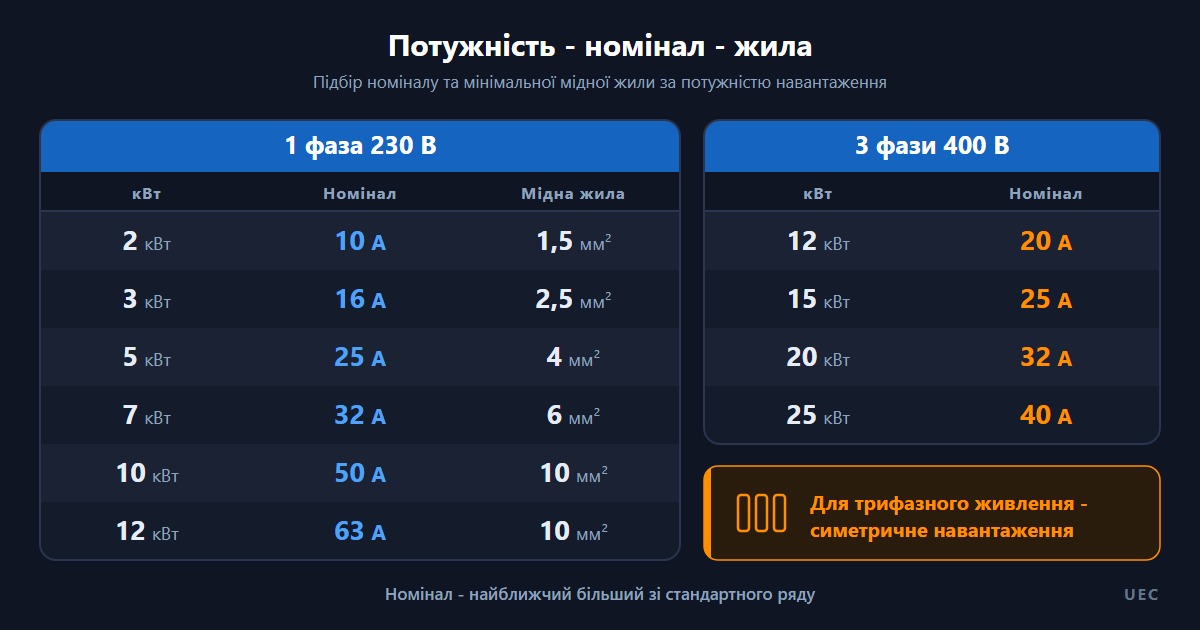
For 5 kW in a single-phase network a 25 A breaker is needed, for 7 kW - 32 A, for 10 kW - 50 A. Each rating has a minimum copper conductor, below which the device must not be installed.
This direction of calculation is needed when the power of the appliance is known and you need to understand which circuit to run for it.
The rating is always chosen as the nearest higher one from the standard series, and the cable cross-section is chosen for the selected rating, not the other way round.
The order is exactly this because a cable is laid once and for a long time, while a device in the panel is changed in ten minutes. A mistake here means that in a year the circuit will have to be rewired together with chasing the wall.
Single-phase supply: from 2 to 12 kW
For a single-phase network the current is calculated by dividing the power by 230 and then rounding up to the nearest higher rating.
The practical values are as follows: 2 kW gives 8.7 A, rating 10 A, conductor 1.5 mm2. 3 kW is 13 A, rating 16 A, conductor 2.5 mm2. 5 kW is 21.7 A, rating 25 A, conductor 4 mm2. 6 kW is 26.1 A, rating 32 A, conductor 6 mm2. 7 kW is 30.4 A, rating 32 A, conductor 6 mm2. 10 kW is 43.5 A, rating 50 A, conductor 10 mm2. 12 kW is 52.2 A, rating 63 A, conductor 10 mm2. Starting from roughly 15 kW, single-phase supply becomes impractical: the current exceeds 60 A, and the facility is moved to three phases.
Three-phase supply: from 12 to 25 kW
For a three-phase network the current is calculated by dividing the power by the product of the square root of three and 400 V, that is, by roughly 693.
For typical values this gives: 12 kW - 17.3 A, rating 20 A. 15 kW - 21.7 A, rating 25 A. 20 kW - 28.9 A, rating 32 A. 25 kW - 36.1 A, rating 40 A. That is why the question "20 kW three phases, which breaker" has the answer 32 A, although in a single-phase network such power would need a device of almost 90 A. An important caveat: these ratings hold for a balanced load. If different single-phase circuits are connected to the three phases and the imbalance is significant, the most heavily loaded phase must be calculated separately.
Why 16 A is both 3.7 kW and 11 kW at once
In a three-phase network the same current flows through three phases, so the power is multiplied by the square root of three and by the line voltage of 400 V.
This is the most frequent source of mistakes when working with tables. The same number of amperes means a different power depending on how many phases feed the load. The reason is purely mathematical: in a three-phase circuit a current of the same magnitude flows simultaneously through three conductors, and the voltage between them is 400 V instead of 230 V. That is why tables are always labelled with the network they belong to, and it is this label that is most often overlooked.
Formula for a three-phase load
The power of a three-phase consumer equals the square root of three multiplied by the line voltage, the current and the power factor.
The square root of three is approximately 1.732, the line voltage is 400 V, hence the factor of 693 per ampere at cos φ equal to one. For a three-phase motor with cos φ of 0.85, the same 16 A current corresponds to only about 9.4 kW, not 11.1 kW. For motors one therefore always consults the rating plate rather than the general table. Another common situation is a three-phase supply with single-phase circuits inside: there each phase is counted as a separate single-phase circuit, and the three-phase formula does not apply.
Typical mistake when converting to three phases
It is a mistake to assume that a three-phase 16 A breaker allows connecting 11 kW of single-phase load to one of the phases.
Each pole of such a device is rated for the same 16 A, that is, 3.7 kW for that particular phase. If the load is distributed unevenly and 8 kW ends up on one phase, that pole will trip, even though the total power over the three phases will be far from 11 kW. That is why, in design, single-phase circuits are spread across the phases roughly equally. Such imbalance is also the most frequent reason a three-phase main breaker trips at an apparently small total load.
"Most often people come to me with the wording 'put in a breaker that will handle the cooker, the water heater and the washing machine together'. But a breaker does not handle appliances, it protects the cable. If a 'two-and-a-half' (2.5 mm2) cable is run in the wall, the circuit will stay a sixteen-ampere one, whatever device is fitted there. The question always comes down to which conductor has been laid, not how much equipment you want to switch on."
- Oleh Lukianchuk, electrical engineer at UEC
Why a breaker does not trip immediately when the rating is exceeded
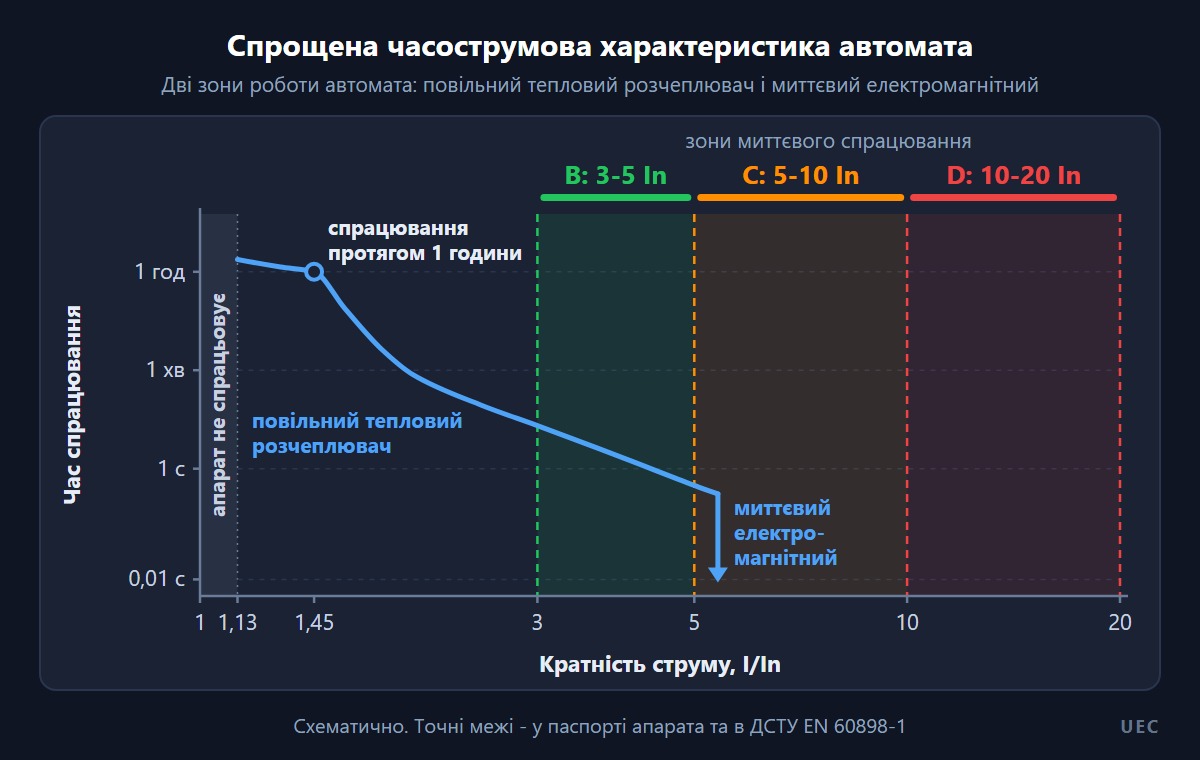
Under DSTU EN 60898-1, within the conventional time (one hour for devices up to 63 A), the device is guaranteed not to trip at 1.13 times the rated current and guaranteed to trip at 1.45 times the rated current.
This explains a situation that looks like a fault: a circuit with a 16 A breaker carries 18 A and does not disconnect. The device is working exactly to the standard. This delay is built into the design: instant tripping at the slightest excess would make operation impossible, because short current surges occur when almost any appliance is switched on. The price of this convenience is the zone between the rating and 1.45 times the rating, in which the cable is already heating while the device does not yet react.
Thermal and magnetic releases
A breaker has two independent mechanisms: the thermal one responds to prolonged overload, the magnetic one - instantly to short-circuit current.
The thermal release is built on a bimetallic strip that bends when heated by current. The greater the excess, the faster it operates: at 1.45 In it takes up to an hour, at double the current tens of seconds, at five times the current fractions of a second. The magnetic release, by contrast, has no time delay and trips instantly when the current exceeds the threshold set by the characteristic of the device. For devices rated above 63 A, the conventional time increases to two hours. It is precisely the two-stage design that allows one device to protect against both slow cable overheating and short circuit.
What this means for the real load
A short-term excess of the rating by 10-20 percent the device tolerates, a prolonged one it does not.
Practical conclusion: a 16 A breaker does not prohibit putting a 3.9 kW load on the circuit for five minutes, but it does prohibit holding such a load permanently. The second circumstance is more important: all this time the cable heats up together with the device. If the conductor is chosen correctly, it will withstand hours of overload without damage. If the breaker rating is too high relative to the cross-section, the situation becomes dangerous precisely in this window, because the cable reaches a critical temperature before the device decides to disconnect.
Inrush currents: when the rating is not enough and a different characteristic is needed
Motors, compressors and transformers draw a current several times higher than the running current at the moment of starting. Characteristics B, C and D, with different instantaneous trip limits, exist for this.
If a breaker trips precisely at the moment equipment is switched on, and not under load, the problem is almost always not the rating but the characteristic. This case is easy to recognize: the device trips in the first fractions of a second after starting and never trips once the equipment has reached its running mode. The starting current of a motor can exceed the running current five to seven times, and for transformers and welding machines the multiple can be even higher. The duration of such a surge is measured in fractions of a second, so the cable has no time to heat up in that period.
Trip limits of B, C and D
Characteristic B trips instantly at a current of 3 to 5 times the rating, C at 5 to 10, D at 10 to 20.
These limits are set by DSTU EN 60898-1 and are the same for all manufacturers working to the standard. For a C16 device this means an instantaneous trip threshold in the range of roughly 80 to 160 A: a refrigerator's starting surge does not fall into this range, while a short circuit always does. UEC breakers of the SB-M8, SB-M9 and SB-M9H series are made in B, C and D versions across the whole range of ratings, and among the GEWISS circuit breakers the same characteristics are offered by the MT60 series. The difference between the curves and the selection algorithm are covered in detail in the article on B, C and D breaker characteristics.
What to fit for a refrigerator, a pump and a welding machine
For household appliances characteristic C is enough, for equipment with a heavy start D is needed, for lighting circuits B is optimal.
A refrigerator, washing machine and air conditioner work with C devices without problems. A borehole pump, compressor or welding machine produce an inrush ratio at which a C16 may trip already on switching on, and here characteristic D is appropriate. LED lighting circuits are the opposite case: the constant load is small, but on switching on the drivers give a short current surge, so B10 or C10 is fitted for lighting, and this choice is explained in the article on breakers for lighting and sockets.
It is important that the characteristic does not change the permissible power of the circuit: C16 and D16 carry the same 16 A continuously, and only the instantaneous trip threshold differs.
Household appliances and their ratings
For most household appliances ratings of 10-16 A are enough. Separate circuits of 25-32 A are needed for an electric cooker, an instantaneous water heater and a powerful storage water heater.
This part answers the question in its most practical form: what exactly can be connected to a circuit with a particular device. The guideline for household appliances is simple: the power of the appliance is stated in the data sheet and on the rating plate, and it is taken as the basis. The difficulty arises when several appliances fall on one circuit, because then their simultaneous operation must be counted. That is why the kitchen and bathroom get more separate circuits than the other rooms.
How many kilowatts a circuit with a 16 A breaker carries
A circuit with a 16 A breaker and a 2.5 mm2 copper conductor is rated for roughly 3.7 kW, and for continuous operation for 3 kW.
A typical socket circuit of a room fits within these limits: TV, computer, chargers, vacuum cleaner, iron. An electric kettle together with a heater on one circuit goes beyond them, as do modern ovens. That is why the kitchen always gets several separate circuits rather than one common one. For comparison: a circuit with a 25 A breaker and a 4 mm2 conductor carries about 5.7 kW, which is enough for a mid-power hob.
When an appliance needs a separate circuit
Any stationary appliance of 2 kW or more gets a separate circuit, as does all equipment in wet rooms.
| Appliance | Typical power | Breaker rating | Copper conductor |
|---|---|---|---|
| Room lighting, LED | up to 0.5 kW | 10 A | 1.5 mm2 |
| Room sockets | up to 3.5 kW | 16 A | 2.5 mm2 |
| Refrigerator | 0.2-0.5 kW | 10-16 A | 2.5 mm2 |
| Washing machine | 2-2.5 kW | 16 A | 2.5 mm2 |
| Dishwasher | 2-2.2 kW | 16 A | 2.5 mm2 |
| Storage water heater | 1.5-2.5 kW | 16 A | 2.5 mm2 |
| Household air conditioner | 1-2.5 kW | 10-16 A | 2.5 mm2 |
| Oven | 2.5-3.5 kW | 16-20 A | 2.5 mm2 |
| Hob | 5-7 kW | 25-32 A | 4-6 mm2 |
| Instantaneous water heater | 6-8 kW | 32-40 A | 6 mm2 |
This category includes the electric cooker, oven, water heater, washing machine and dishwasher, air conditioner, pump and underfloor heating. There are two reasons. The first is technical: the total power of such equipment exceeds the capacity of a shared socket circuit. The second is operational: a fault in one machine must not de-energize half the apartment, and a separate circuit makes it possible to fit individual residual current protection on it. The general approach to forming circuits for housing is covered in the guide on how to choose a circuit breaker for a house and apartment, and the design of the devices themselves for the panel is covered in the article on modular circuit breakers for DIN rail.
Why you must not fit a rating higher than the calculated one
An oversized rating removes protection from the cable: the conductor overheats before the device trips. This is one of the main causes of fires in building wiring.
The temptation is understandable: the breaker trips, and replacing it with a bigger one solves the symptom in five minutes. The problem is that by tripping, the device was reporting precisely that the circuit is loaded beyond its capacity. After the replacement the message disappears, but the overload remains and starts to work unnoticed. This is the situation where eliminating the symptom directly increases the risk instead of reducing it.
What happens to the cable with an oversized rating
A cable heats in proportion to the square of the current, and under prolonged excess the insulation loses its properties long before the device trips.
Consider a typical case: a circuit with a 2.5 mm2 copper conductor, rated for a current of up to 27 A, receives a 32 A breaker instead of a 16 A one. The device is now not required to trip until 46 A, since for it that is only 1.45 times the rating. The cable meanwhile works with an overload of almost double. The insulation degrades gradually: first it loses elasticity, then it cracks at bends, then a short circuit between the conductors occurs inside the wall. The most dangerous thing here is that the process is stretched in time and shows nothing until the moment of the accident. The consequences of such a selection are summarized in a separate article on the consequences of choosing the wrong breaker.
Alternative viewpoint: what if the breaker trips because of inrush currents
The argument sounds reasonable: if a device trips when a pump is switched on, and not under load, then the problem is not overload of the circuit, and raising the rating seems a logical solution.
This position has some merit. A trip caused by inrush current is formally not an overload: a second after starting, the current returns to the running value, and the cable has no time to heat up. So the diagnosis here is made correctly - the circuit is not overloaded. It is the conclusion that is wrong. Inrush currents are solved by changing the characteristic, not the rating: a C16 device is replaced with a D16, and the instantaneous trip threshold rises from roughly 80-160 A to 160-320 A, while the continuously permissible current remains the same 16 A. The cable is protected exactly as before. Raising the rating from 16 to 25 A solves the same problem at the price of removing protection from the conductor, that is, it solves a narrow problem while creating a wider one. There is one exception: if the check has shown that the circuit was installed with a margin and is in fact rated for a higher current, then raising the rating is legitimate, but that is a conclusion from checking the cable, not a way to get rid of tripping.
Typical mistakes with the rating
Four mistakes occur regularly and have the same consequences.
The first is replacing the breaker with a bigger one after every trip, without finding out the cause. The second is choosing the rating by the power of the appliance without checking the cross-section of the installed cable: for a new circuit this works, for old wiring it does not. The third is the same rating at the input and on the branch breakers, so that in the event of a fault the whole installation is disconnected instead of one circuit, which can be avoided by following the rules of selectivity of circuit breakers. The fourth is fitting characteristic D in an apartment "just in case", which makes the instantaneous trip threshold too high for a household circuit.
What these four cases have in common is that none of them shows itself at once. A circuit with an oversized rating works for years until the load reaches its design maximum, and the wrong characteristic makes itself felt only at the inrush currents of a particular appliance. For this reason the mistake is almost impossible to detect at the acceptance stage, and the only reliable method remains checking that the ratings match the cross-sections against the panel documentation. The causes of regular disconnections and the order of diagnosing them are covered in the article on nuisance tripping of a circuit breaker, and the topic of an oversized rating separately in the article on why you should not fit a more powerful breaker.
"When a breaker trips, it has exactly one reason for doing so, and that reason is always in the circuit, not in the device. Replacing the rating with a bigger one without checking the cable is not a repair but switching off the alarm. After that the device will faithfully stay silent, only there will be no protection anymore."
- Oleh Lukianchuk, electrical engineer at UEC
Frequently asked questions about rating and power
Short answers to the most common questions about converting amperes to kilowatts.
❓ How many kilowatts is a 16 amp breaker?
At a single-phase voltage of 230 V this is about 3.7 kW, and for a balanced three-phase load at 400 V - about 11.1 kW. For continuous operation, aim for 80 percent of this value, that is about 3 kW for one phase. The actual limit of the circuit is additionally constrained by the cross-section of the installed cable.
❓ How many kilowatts does a 25 amp breaker handle?
About 5.7 kW in a single-phase network and about 17.3 kW in a three-phase one. This rating requires a copper conductor of at least 4 mm2. If the circuit has 2.5 mm2, a 25 A device cannot be fitted, regardless of the power of the connected appliance.
❓ Which breaker is needed for 5 kW?
The design current is 21.7 A, so the nearest higher rating from the standard series is chosen - 25 A, with a 4 mm2 copper conductor. For a three-phase supply, 5 kW gives only 7.2 A, and a rating of 10 A is enough there.
❓ 20 kW on three phases - which breaker?
The design current is about 28.9 A, so a three-phase device of 32 A is fitted. This holds for a balanced load. If different single-phase circuits are connected to the phases, the most heavily loaded phase is checked separately.
❓ How many kilowatts can a 2.5 mm2 copper cable carry?
A 2.5 mm2 copper conductor is rated for a continuous current of about 27 A, which corresponds to about 6.2 kW at 230 V. However, the breaker for such a circuit is rated 16 A or at most 20 A depending on the installation method, so the practical limit of the circuit is 3.7-4.6 kW.
❓ Why does a 16 A breaker not trip at a load of 18 A?
That is how the standard works: within the conventional time of one hour, the device is guaranteed not to trip at a current of up to 1.13 times the rating and guaranteed to trip at 1.45 times the rating. For a 16 A rating that is 18 A and 23 A respectively. A prolonged load in this zone is dangerous for the cable even if the device stays silent.
❓ Can a 16 A breaker be replaced with a 25 A one if it trips often?
No, if the cable cross-section has not been checked. Frequent tripping means either a real overload of the circuit or an unsuitable characteristic for inrush currents. In the first case the circuit is unloaded, in the second the characteristic is changed from C to D, keeping the rating the same.