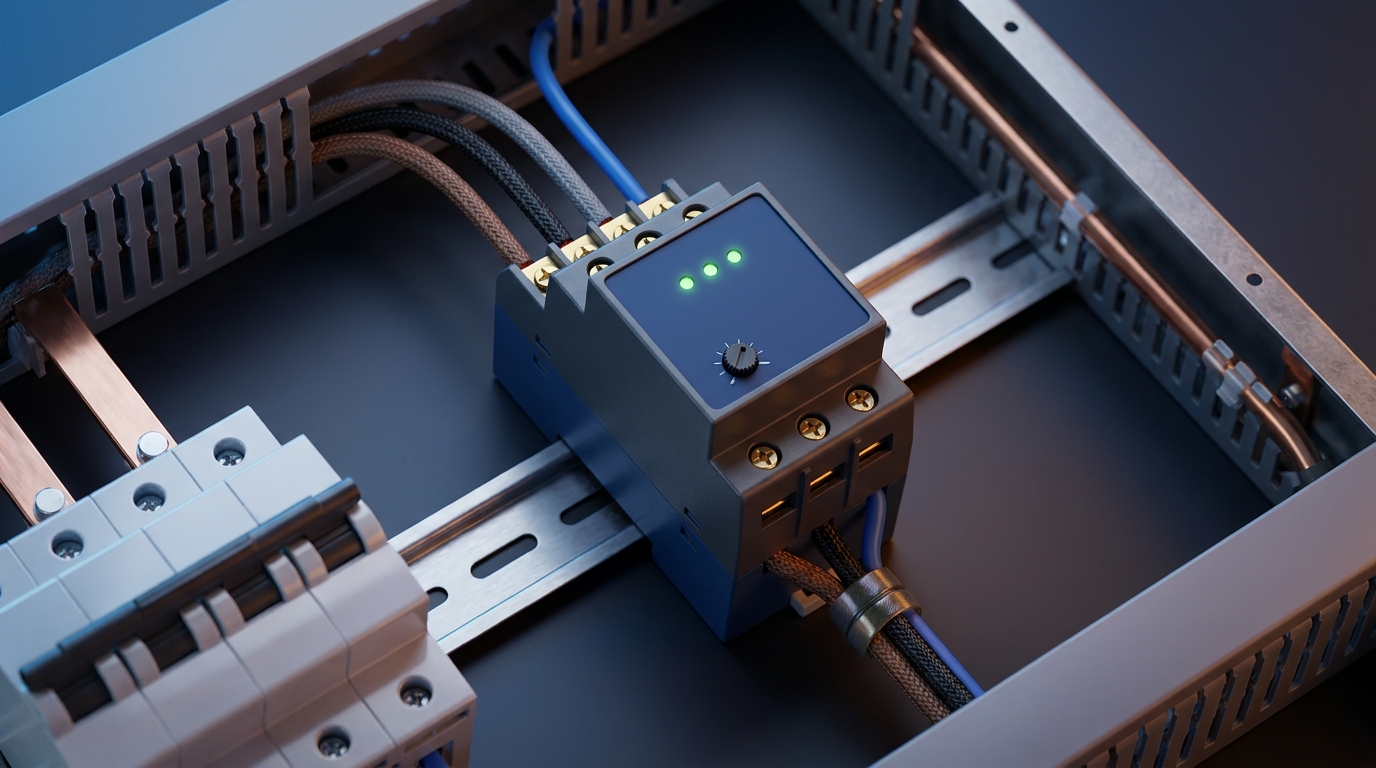

Article Contents
Circuit Breaker Selectivity — Coordination & Selection Guide


Key takeaways
Circuit breaker selectivity is a principle where only the breaker closest to the fault trips during an emergency, while the rest of the network remains energized.
Three levels: total (up to max Isc), partial (up to a specific Is), and none (curves overlap). For residential use, partial selectivity is acceptable if the Isc doesn't exceed the limit.
Key tool: manufacturer selectivity tables (maps) — the only 100% verification method. "Just different ratings" is a dangerous myth.
Hi, I'm Oleh Lukianchuk, an engineer with experience in railway automation systems and electrical protection. At UEC, I work on projects where selectivity is not "nice to have" but mandatory.
In this article, we'll break down how to properly coordinate circuit breakers: from residential panels to industrial main distribution boards.
What is circuit breaker selectivity and why is it needed?
Circuit breaker selectivity (or discrimination) is a fundamental principle of electrical network protection where, in the event of a fault (short circuit or overload), only the device installed directly near the damage location trips, while all upstream breakers remain energized. My experience in railway automation systems taught me: proper circuit breaker selectivity is critically important for uninterrupted operation, as it isolates the problem.
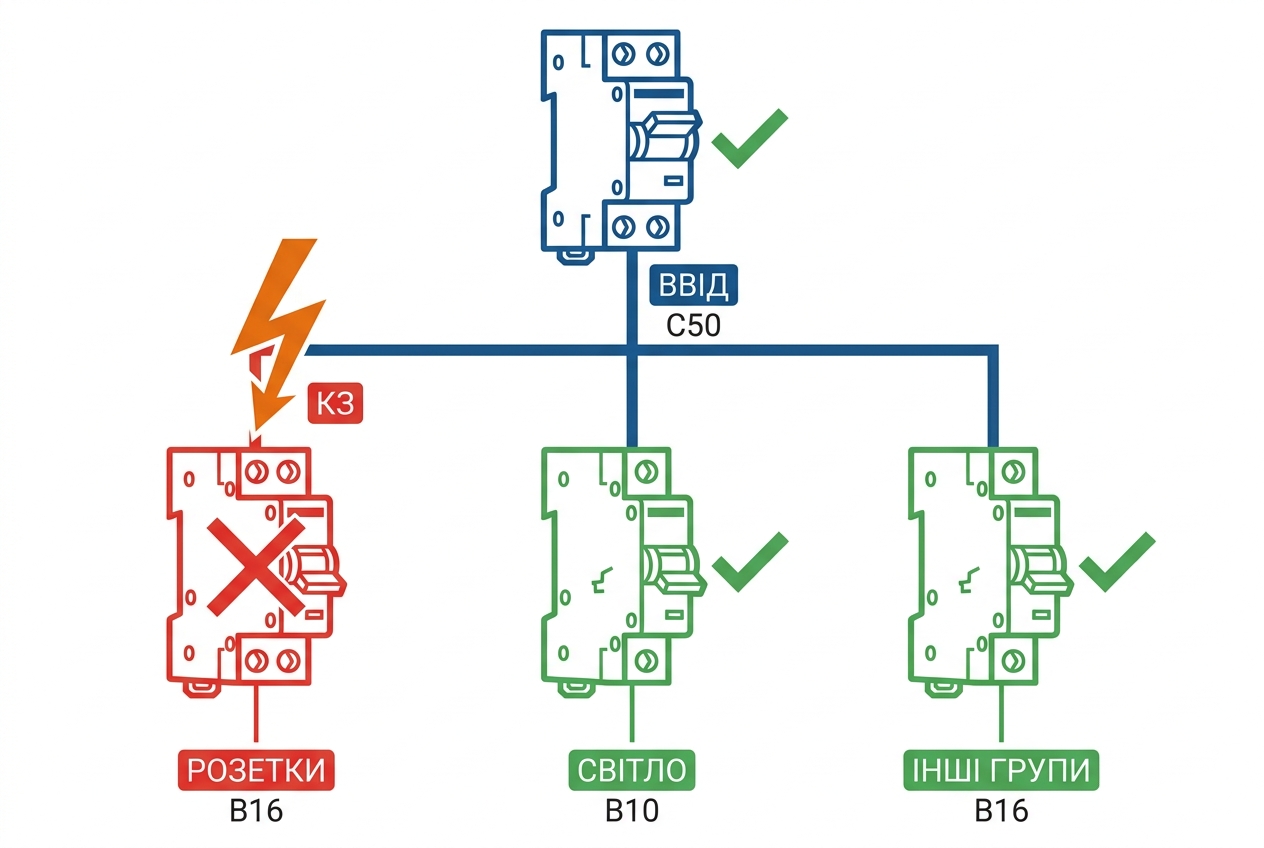
In residential settings, this means that a short circuit in a bedroom outlet trips only the 16A group breaker, not the main breaker in the hallway or on the pole, keeping the lights on in the rest of the rooms. This is the foundation of safety and comfort. If selectivity is not maintained (which we at UEC often see in amateur panels), the slightest fault de-energizes the entire facility, increasing downtime and the risk of equipment damage from cyclic voltage surges.
Proper setup requires more than just different ratings. You need to consider the breaking capacity, the expected short-circuit current at the installation point, and the time-current characteristics.
Key terms to know:
In (Rated current): the working current a breaker can carry indefinitely. Icu / Ics: ultimate and service short-circuit breaking capacity (maximum fault current the device can withstand without failure). Isc (Short-circuit current): peak fault current at a specific point in the network. t (total clearing time): full time to disconnect the circuit.
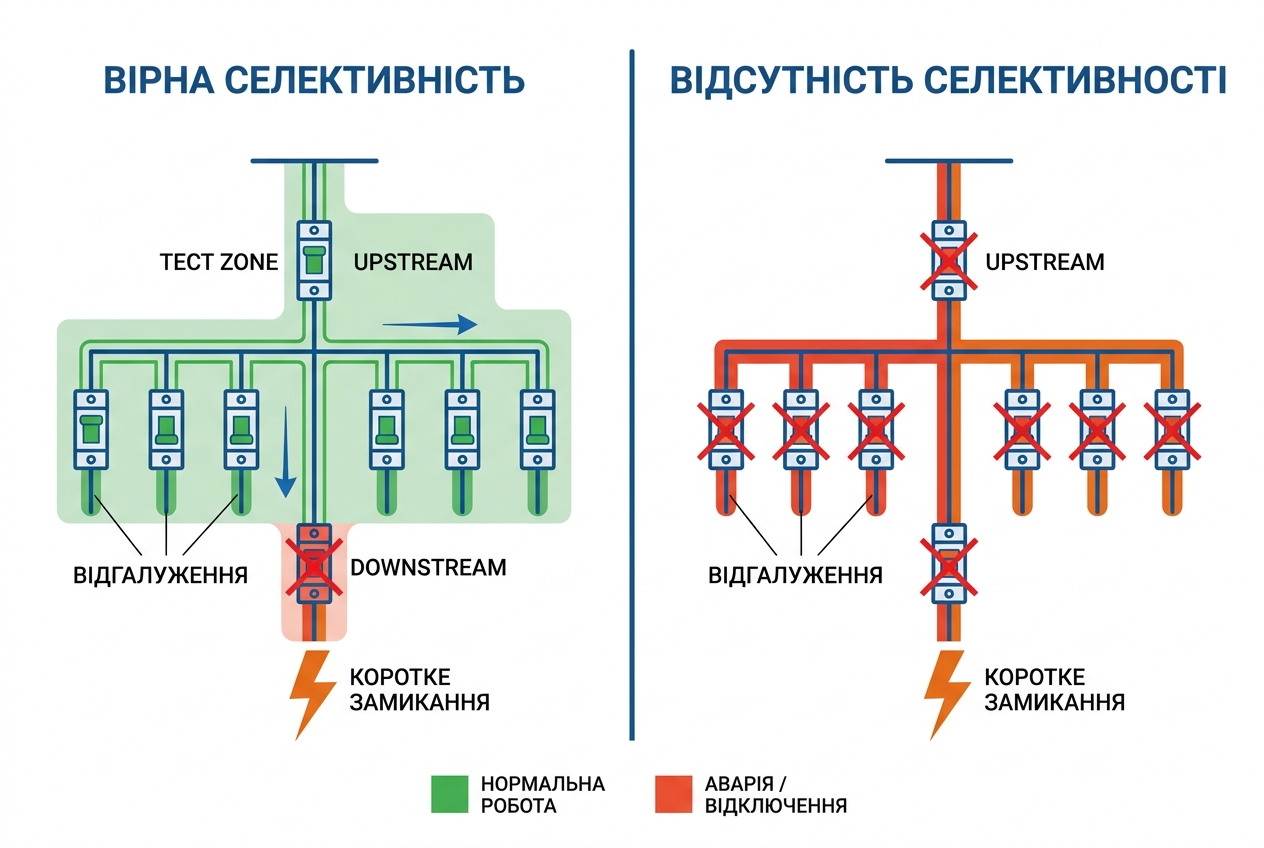
Selectivity vs "just different ratings": what really needs to be checked
Many novice electricians believe: "If the input is C40 and the group is B16, selectivity is ensured." This is a dangerous myth. Selectivity depends not so much on the rating, but on the speed of the tripping mechanisms at very high currents.
When selectivity is considered total, partial, or absent
Engineers distinguish three levels of protection coordination. When selecting a circuit breaker for your home, it's important to understand these differences:
| Type | Meaning | How it manifests | Risk/consequence |
|---|---|---|---|
| Total | The downstream device always trips first across the entire current range (up to max Isc). | The main breaker "holds" the load during any short circuit. | No risks. Ideal for hospitals and data centers. |
| Partial | Selectivity is guaranteed only up to a specific current (Is) shown in the table. | For small faults (at end of line), downstream trips. For high faults (near panel), both trip. | Acceptable for residential use if the calculated Isc does not exceed the Is limit. |
| Absent | Trip curves overlap without any gap. | During a short circuit, the main breaker always trips (or both simultaneously). | Complete de-energization of the facility. Critical design error. |
"Reference: Selectivity (discrimination) requirements are governed by IEC/EN 60947-2 (for industrial MCCB breakers) and the appendix to IEC/EN 60898-1 (for residential MCBs). According to NEC 2014, selective coordination is mandatory for emergency power systems [2]."
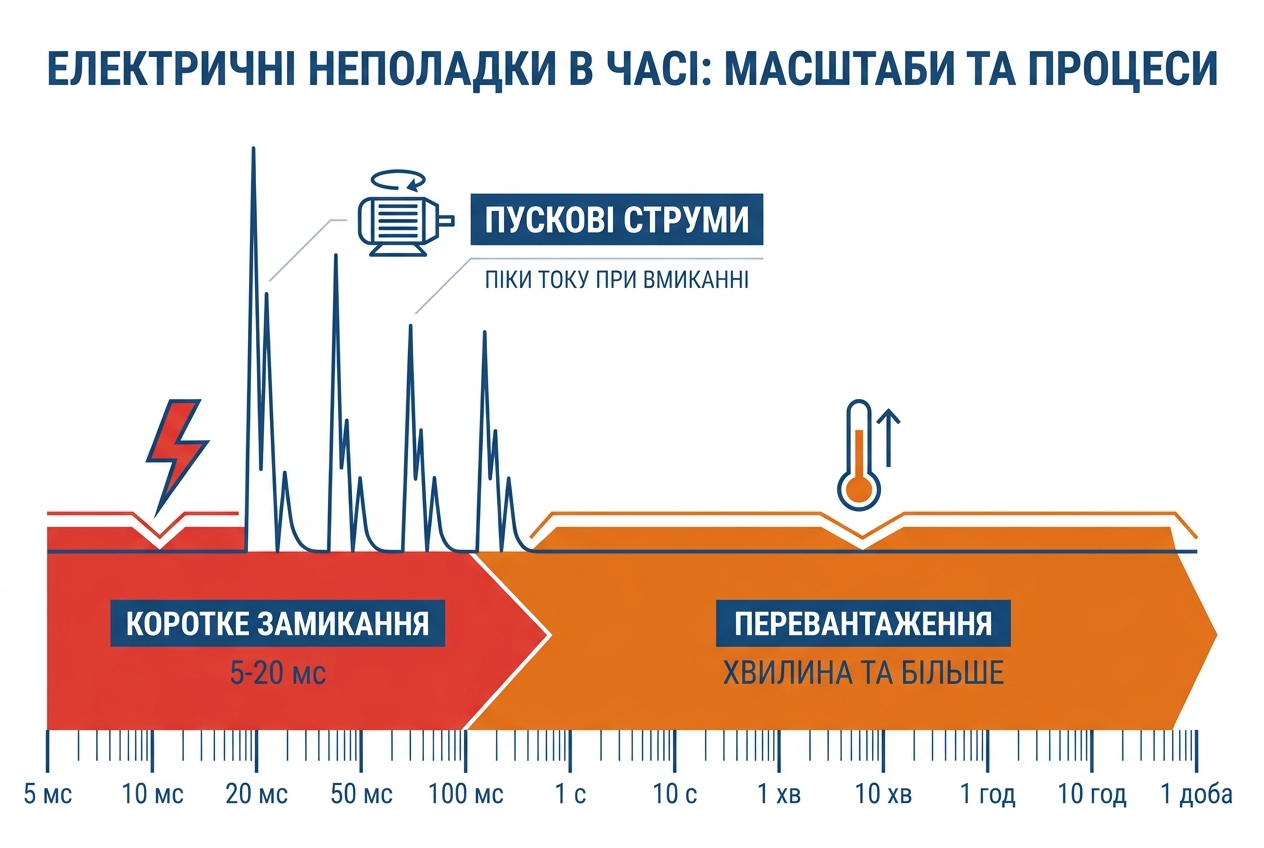
Which fault modes need to be distinguished (and why it affects selectivity)
Overload (thermal release)
This is where the bimetallic strip operates. Response time is measured in seconds or minutes. Achieving selectivity here is easy: the breaker ratings just need to differ by at least one step (e.g., 25A and 16A).
Short circuit (electromagnetic/electronic release)
The most challenging zone. Current rises to thousands of amps in milliseconds. The electromagnetic coils of both breakers (main and group) may receive the trip command almost simultaneously. This is where simple schemes like "C25 + C16" fail. To avoid this, you need to analyze the time-current characteristic (B, C, D).
Motor inrush currents / impulse loads
When starting pumps or powerful power supplies, peak currents occur that a breaker may mistake for a short circuit. Selectivity here is ensured by choosing the right curve (e.g., D for motors) to prevent false tripping of either the group or the main breaker.

Warning! Working with electrical equipment is life-threatening!
All work in the electrical panel must be performed only by qualified electricians with the power disconnected. Before starting work, be sure to de-energize the line and verify the absence of voltage with a measuring device.
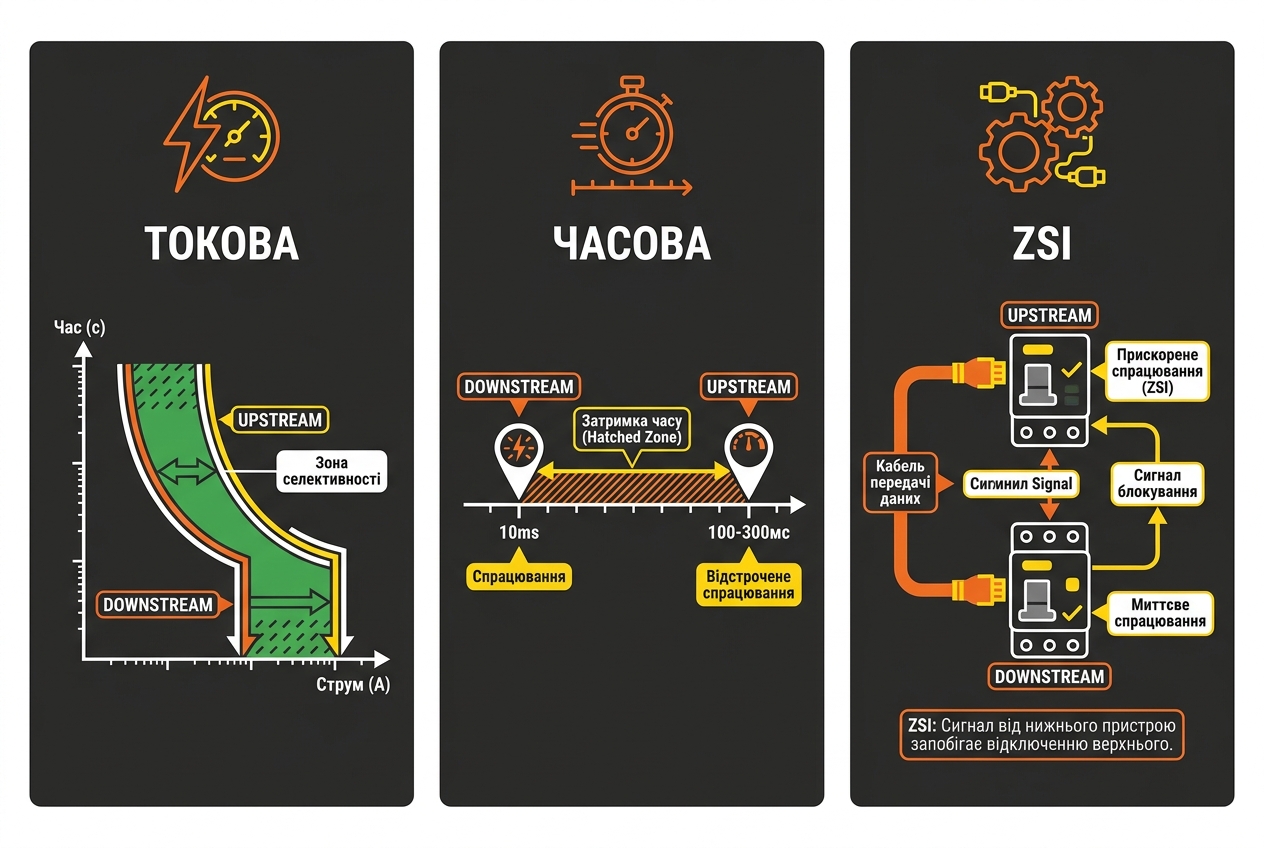
Main types of circuit breaker coordination (selectivity) — brief overview
Current selectivity (by trip thresholds)
Based on the difference in instantaneous trip currents. Works when the fault current at the end of the line is significantly lower than the upstream breaker's trip threshold.
- When it works: On long lines where cable resistance "dampens" the fault current.
- Limitations: In modern networks with low impedance (short wiring), current selectivity is often insufficient. As Schneider Electric research notes, current selectivity between modular breakers is often limited by the magnetic release threshold of the upstream device [1].
Time selectivity (S-type, time delay)
The most reliable method. The logic is simple: the main breaker has a physical trip delay (e.g., 100-300 ms). During a fault, it "waits," giving the downstream breaker a chance to disconnect the damaged section immediately.
- Where applied: On main distribution boards (MDBs), cottage inputs. This is where selective circuit breakers are commonly used.
Energy / logic selectivity (I²t, ZSI)
This is advanced engineering, which we at UEC apply for industrial facilities.
- Energy-based: Based on arc energy limitation. The downstream breaker is so fast that it extinguishes the arc before the upstream one has time to heat up/react.
- Logic-based (ZSI - Zone Selective Interlocking): Breakers are connected by a data cable. The downstream one "tells" the upstream: "The fault is mine, don't trip!" According to ABB documentation, ZSI technology achieves total selectivity even at very high fault currents (up to 100 kA) without unnecessary time delays [6].
⚠ Important: ZSI and electronic releases are typically available in industrial series (MCCB). For standard modular breakers in apartments, we rely on energy selectivity tables.
Selectivity tables/maps — the key method of coordination verification
Selectivity map: how to analyze and use
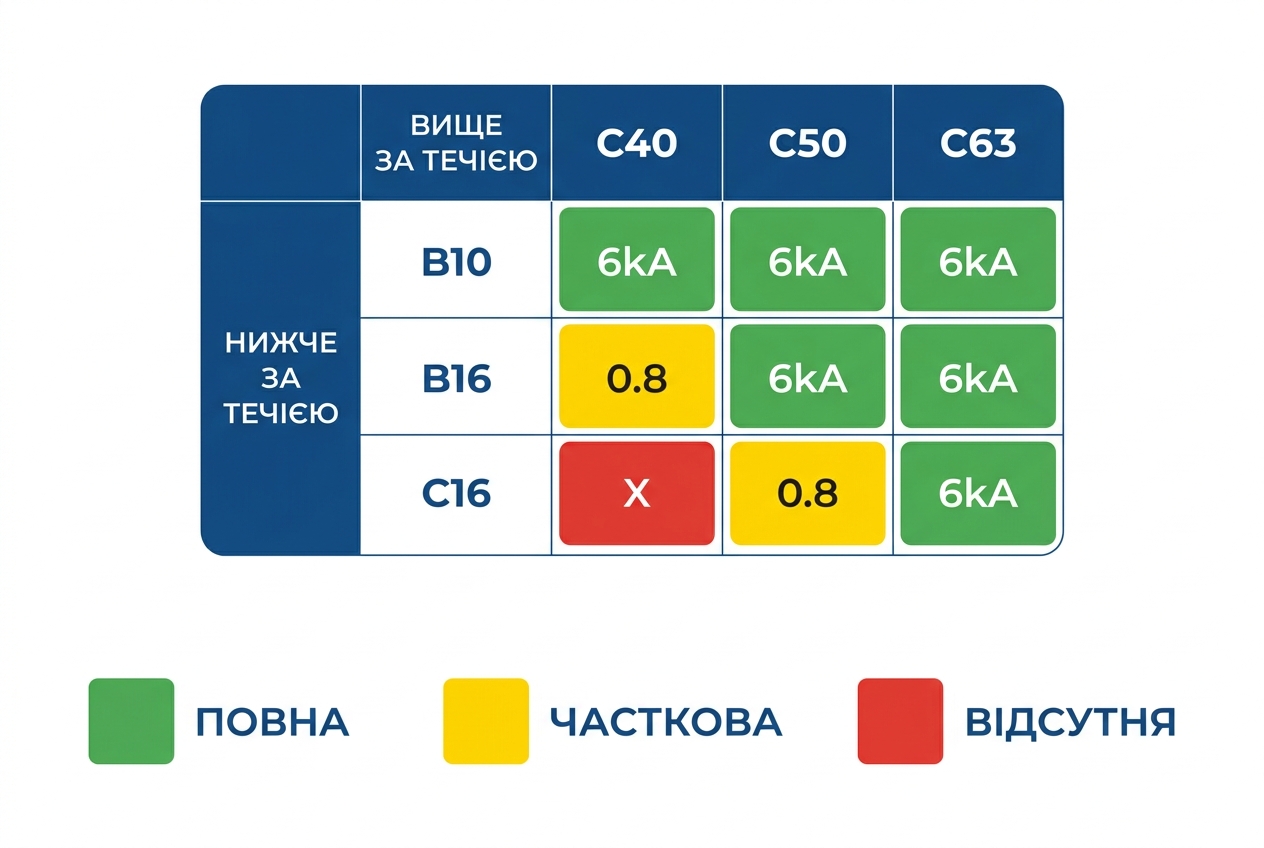
A selectivity map is an official technical document from the manufacturer (table or chart) that guarantees the behavior of a breaker pair. It is the only 100% verification method, as formulas often don't account for design features of specific series. In such a table, the manufacturer (e.g., Gewiss, Eaton, or Schneider) cross-references "Upstream" (input) and "Downstream" (load) models. The cell value shows the selectivity limit in kiloamperes (kA). If your calculated short-circuit current is lower than this figure, circuit breaker selectivity is ensured.
Official resources:
Always look for current manufacturer catalogs in the "Coordination Guide" or "Selectivity Tables" sections. Don't rely on old PDFs from forums.
How to read a selectivity table — 5-step algorithm
To avoid mistakes when calculating a breaker by power and current and selectivity, follow this plan:
- Step 1. Identify the downstream breaker type (e.g., Gewiss MT60 B16).
- Step 2. Identify the upstream breaker type (e.g., Gewiss MT100 C40).
- Step 3. Calculate or measure the expected Isc at the downstream breaker installation point.
- Step 4. Find the intersection of these models in the manufacturer's table.
- Step 5. Ensure the table value (selectivity limit) is higher than your actual Isc.
Ready-made selectivity tables by brand (for quick start)
Below are examples (data may vary by series, always check catalogs!):
| Brand | Scenario | Upstream (Input) | Downstream (Group) | Result |
|---|---|---|---|---|
| Schneider Electric | Apartment | iC60N C40 | iC60N B16 | Total (up to downstream Icu) |
| Hager | House | MCB C50 | MCB B16 | Partial (up to ~6 kA) |
| ABB | Small office | S200 C63 | S200 B16 | Total (provided Isc < 6kA) |
⚠ Disclaimer: This data is illustrative. Full selectivity guarantee is only possible when using equipment from a single manufacturer and verifying against current selectivity tables for specific series.
Practical examples (understanding why "C25 + C16" is often not selective)
Example 1 — apartment panel: input C50 → group B16
This is a classic setup for modern apartments with electric stoves.
- Scenario: Short circuit in a coffee maker.
- Logic: The B16 breaker has instantaneous tripping in the 3-5 In range (48-80A). The input C50 trips instantaneously at 5-10 In (250-500A).
- Result: If the fault current is 300A (typical for an apartment), the B16 will trip while the C50 won't even enter the magnetic release zone. Selectivity works.
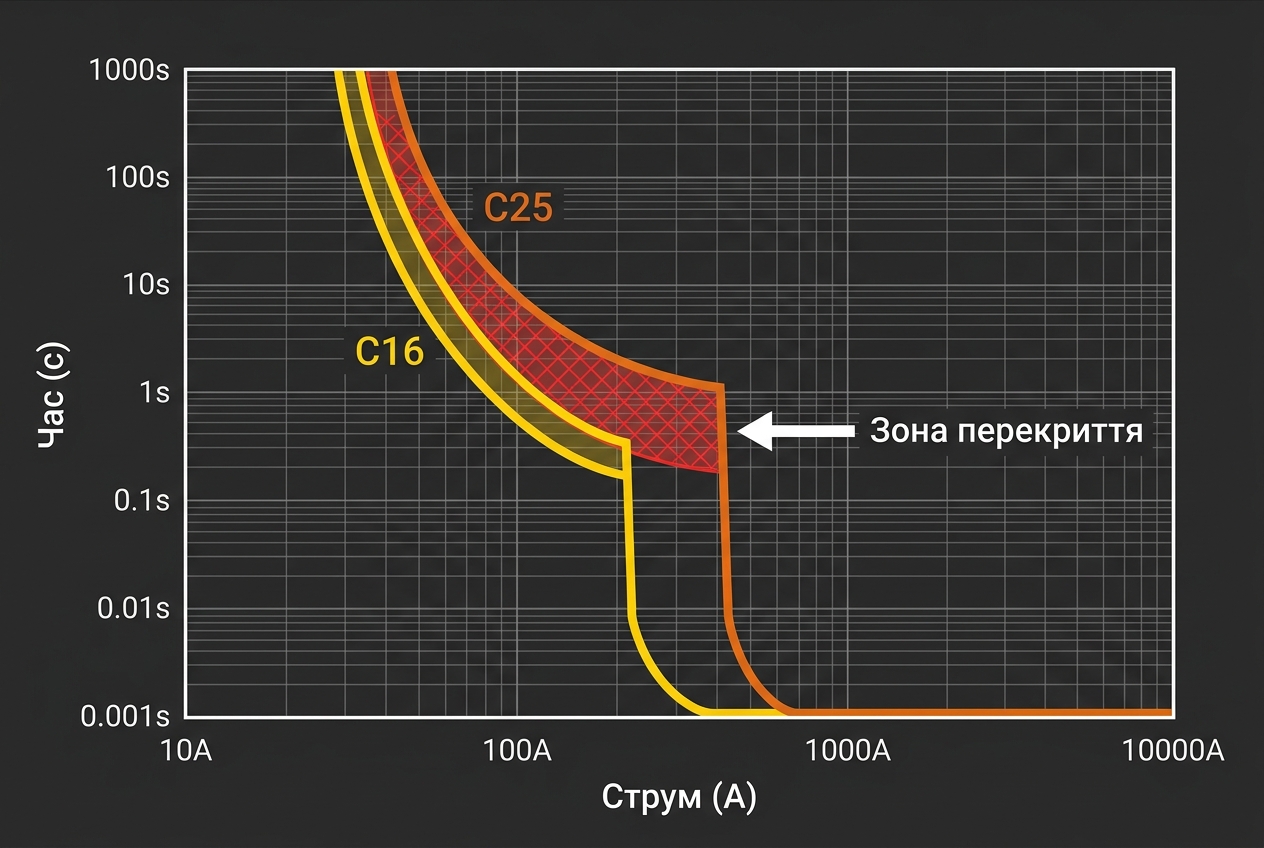
Example 2 — why a C25 and C16 combination can "trip the main" during a short circuit
A common mistake in older buildings where the input is limited to 25A.
- Problem: Instantaneous trip zones overlap. For C25, the minimum threshold is ~125A. For C16, it's ~80A.
- Reality: During a "solid" short circuit, current easily reaches 400-500A. This is well above the thresholds of both breakers. The electromagnets of both devices trip simultaneously. The main breaker "trips" together with the group breaker.
- Solution: In such cases, consider installing a D-curve breaker at the input (if the phase-neutral loop allows) or switching to double-pole breakers for faster fault isolation.
| Error | Symptom | Solution |
|---|---|---|
| Close ratings (C25/C20) | Both breakers trip | Increase the gap (C25/B10) or check manufacturer's map |
| High fault current | Main trips even with B16 | Install S-type or MCCB at input |
Example 3 — industrial section: MCCB with electronic release + ZSI
In manufacturing, we cannot afford to stop a conveyor due to a fault in one motor. ZSI (Zone Selective Interlocking) or time delay settings on electronic releases of industrial breakers save the day here. Standard modular "automatics" are powerless in this situation.
"In complex projects, we often see attempts to save money by installing a standard modular C125 breaker at the main input of an office building. This guarantees total blackout throughout the building when a short circuit occurs in a coffee machine. Selectivity is confirmed not by intuition, but by Isc calculations and tables."
— Oleh Lukianchuk, UEC Experience
How to ensure selectivity in practice: methods that actually work
Selecting B/C/D characteristics and ratings: what works and what's a myth
There's a "folk method": install B on groups and C on the input. This works, but it's not a panacea.
- B downstream, C upstream: Indeed helps to "spread" the trip thresholds. The input C-breaker is less sensitive to current surges.
- Simply increasing the main breaker rating: Dangerous! The input breaker rating is selected to protect the input cable, not for selectivity. If you install a C63 on a 6 mm² cable, you'll burn the wiring for the sake of illusory selectivity.
Be sure to pay attention to compatibility when choosing a breaker for sockets and lighting.
| Method | Works when | Risks |
|---|---|---|
| Changing characteristics (C -> B) | In residential networks with moderate fault current | False tripping of B-breakers on vacuum cleaners |
| S-type (Selective) | At the input of a private house | Higher cost, larger dimensions |
Selective S-type breakers: when are they needed
These are specialized devices (often series like ABB S750DR or equivalents) that have a built-in mechanical time delay. They are designed to be "the main."
- Pros: Guaranteed selectivity with any standard breaker downstream.
- Cons: Price (3-5 times more expensive) and the need for space in the panel.
Additional devices and adjacent coordination
Don't forget about other protection elements.
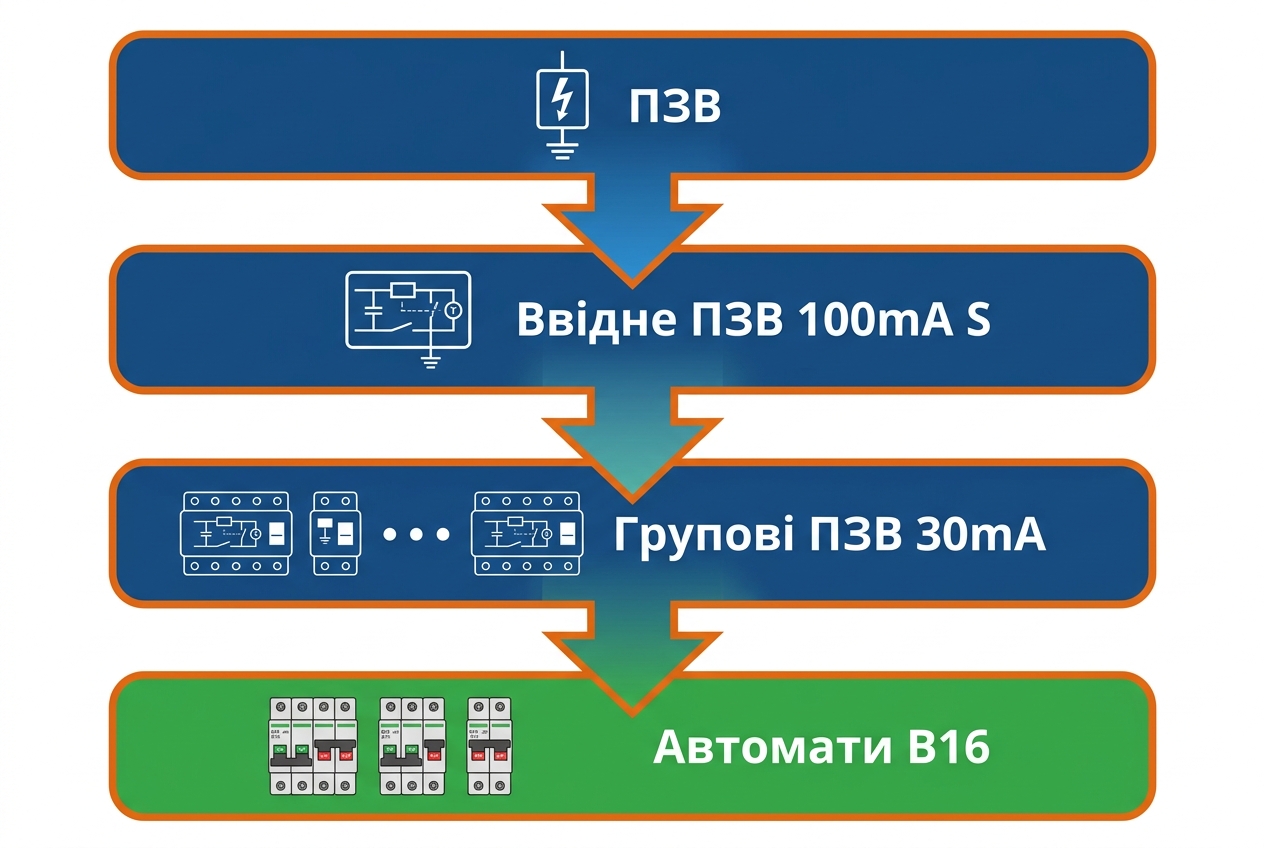
- RCD: Selectivity by leakage current. The input RCD should be type S (selective) and have a leakage current 3 times higher than the group one (e.g., 100mA vs 30mA). More on this in the article: whether you need to break the neutral with a breaker.
- Cascading (Back-up protection): Sometimes the input breaker helps the downstream one "survive" a fault current that exceeds its Icu.
Design and engineering: minimum formulas, maximum practice
What data is needed for selectivity verification
To avoid guessing, prepare the following data:
- Isc (Short-circuit current): Minimum (at end of line) and maximum (near the panel).
- Line parameters: Length, cross-section (copper/aluminum).
- Breaker specifications: Series, Icu (e.g., 6kA or 10kA).
Network type: 1 phase/3 phase. Allocated power (kW). Line length to consumer (m). This data is needed by the engineer for correct selection.
How to estimate Isc without "magic" and when an engineer is needed
If you live "next to" a transformer substation, your fault current may be 2-3 kA or higher. In this case, installing standard modular breakers rated at 4.5 kA is dangerous — you need at least 6 kA or 10 kA, and this critically affects selectivity. Read more about choosing between 4.5 kA, 6 kA, or 10 kA in a separate article.
For apartments far from the substation, you can use manufacturer tables.
For a private house with a new input, it's better to measure the phase-neutral loop.
Industrial facilities, office buildings, multi-apartment inputs.
Software for selection and coordination verification
Professionals don't calculate on paper. Specialized utilities exist.
| Tool | Purpose | Link |
|---|---|---|
| E-Design / DOC (ABB) | Panel calculation, coordination verification | ABB website |
| EcoStruxure Power Design (Schneider) | Network modeling and selectivity | SE website |
| Simaris Design (Siemens) | Comprehensive calculation | Siemens website |
How to choose breaker(s) for selective protection — selection criteria
Key parameters: what affects coordination the most
| Parameter | Impact on selectivity | How to verify |
|---|---|---|
| Rated current (In) | Basic threshold gap. Recommended step x2 (e.g., 16A and 32A). | Marking on the housing. |
| Trip curve (B, C, D) | Determines response time to moderate faults. | Time-current characteristic charts. |
| Breaking capacity (Icu) | Affects the ability to pass fault energy downstream. | Value in rectangle (6000, 10000). |
| Manufacturer/Series | Critical! Selectivity is guaranteed only within a single brand. | Manufacturer coordination catalog. |
It's important to remember the consequences of an incorrectly selected rating, which can be fatal for the cable.
Common selection mistakes (and how to avoid them)
- ❌ "Mixing" brands: No selectivity map covers this. The result is unpredictable.
- ❌ Oversizing the main breaker: Installing C63 just for selectivity when 10 kW is allocated. This violates the utility agreement and poses a fire risk.
- ❌ Ignoring Isc: Installing a breaker with low Icn (4.5kA) at the input of a high-power facility. During a fault, the contacts may weld together [1].
Micro case study:
A client's main C25 breaker kept tripping when light bulbs burned out. Cause: high fault current near the substation. Solution: replacing the main with a selective S-type (after approval) solved the isolation problem.
Buy circuit breakers for selective protection (catalog + filters)
- Brand: Gewiss, UEC, others
- Type: Modular (MCB), Molded case (MCCB)
- Selective (S-type): Yes
- Rating: 16A, 25A, 32A, 40A...
At UEC, we recommend using proven solutions. For apartments, reliable GEWISS or UEC modular series are suitable; for cottage input panels, series with enhanced breaking capacity are recommended.
Input breakers for high Isc (10 kA+)
If the facility is close to a substation, this section is for you.
| Scenario | Recommendation |
|---|---|
| Private house (input) | Modular 10-15 kA |
| Office building/Manufacturing | Molded case MCCB (up to 50 kA) |
Selective breakers (S-type / selective MCB)
A specialized line for guaranteed trip delay. Typically available to order for specific projects.
Industrial breakers MCCB/ACB
For currents over 100A and when ZSI coordination is needed. They allow flexible LSIG (Long, Short, Instantaneous, Ground) setting adjustment.
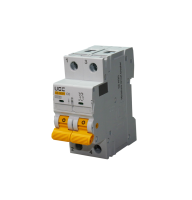
- Modular circuit breakers for residential use
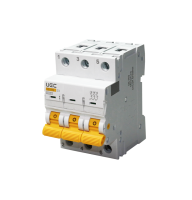
- Three-pole and four-pole breakers
- Selective breakers (detailed)
FAQ — quick answers to common questions
❓ Will there be selectivity between B and C?
Yes, often partial, if the curves are separated by rating (e.g., C40 and B16). However, during a short circuit near the panel, there's no guarantee without checking the tables.
❓ Why does the main breaker trip during a short circuit?
Due to overlapping electromagnetic release characteristics. The fault current exceeds the trip threshold of both devices.
❓ Can you mix breaker brands and expect selectivity?
No. Manufacturers test coordination only for their own product lines. Mixing brands is a gamble.
❓ What's more important for selectivity — the B/C/D curve or the manufacturer's table?
The table takes priority, as it's based on actual compatibility testing of specific mechanisms.
❓ Selectivity and RCDs: why sometimes "everything" trips
Because standard RCDs trip instantaneously. The input needs a selective RCD type S with a time delay.
Conclusion: how to act so selectivity is confirmed, not "hoped for"
As an engineer, I advise against relying on luck. Selectivity is a calculation. Use quality equipment and verified data.
Checklist before assembling the panel:
Click an item to mark it as completed:
"Sources: 1. Circuit breaker selectivity for power availability, Schneider Electric Blog, 2020. [1] 2. Selective Coordination: What the Inspector Needs to Know, IAEI Magazine, based on NEC 2014. [2] 3. IEC/TR 60909-4:2008 & IEEE 1015-2006 Standard. 4. Techniques for Selective Coordination of Low Voltage Circuit Breakers, ABB Technical Paper. [6] 5. Selective Coordination between LV Circuit Breakers, Electrical Engineering Portal. [5] Last source review: January 2025."