
Article Contents
Voltage Relay for a Refrigerator, Boiler and Home Appliances: Protecting the Compressor and Electronics


Key takeaways
A refrigerator, an air conditioner and a gas boiler are appliances whose repair costs from several thousand hryvnias, yet the cause of the breakdown is often not the appliance itself but the grid outside the window. A voltage relay for a refrigerator and other home appliances solves two different tasks at once: it protects the compressor from sags and inrush overloads and shields the sensitive electronics from overvoltage.
In this article we do not retell the general theory (for that there is a complete guide to voltage relays); instead we break down the applied side: which thresholds and delay to set for a specific appliance, when a socket relay is enough, and when a modular device with a contactor is required.
Hi, I'm Oleh Lukianchuk, an electrical engineer at UEC. I specialize in protecting electrical networks - voltage relays, RCDs and automation - and every day I deal with the consequences of grid faults for home appliances.
In this article I show the applied side of appliance protection: how a dedicated voltage relay guards a refrigerator's compressor and the sensitive electronics of a boiler and a TV, which thresholds and delay to set for a specific appliance, and when a powerful group needs a contactor.

WARNING: Work in an electrical panel requires a qualification of no lower than electrical safety group III. Entrust the installation to a licensed electrician. On your own you may install only socket relays that plug into an existing outlet without opening the panel.
| Parameter | Value | Why it matters |
|---|---|---|
| Restart delay (compressor) | 120 to 600 s | Lets the pressure in the compressor equalize, reduces the starting load on the motor |
| Upper disconnection threshold | 250-253 V | Upper limit per DSTU EN 50160 (230 V +10%), saves the boiler and TV electronics |
| Lower disconnection threshold | 190-200 V | Protects the compressor from running on sagged voltage and winding overheating |
| Trip time (upper threshold) | 0.02-0.05 s | Overvoltage is instantly dangerous, the relay breaks the circuit almost at once |
| Trip time (lower threshold) | 0.2-2 s | A short sag does not harm appliances, so the reaction is slower |
| Group load current | within the relay rating (32-80 A) | Above the rating the relay contacts overheat, a contactor is required |
| Relay's own consumption | 2-5 W | 1.5-3.6 kWh per month, runs around the clock without noticeable cost |
Why do a refrigerator and home appliances need a dedicated voltage relay?
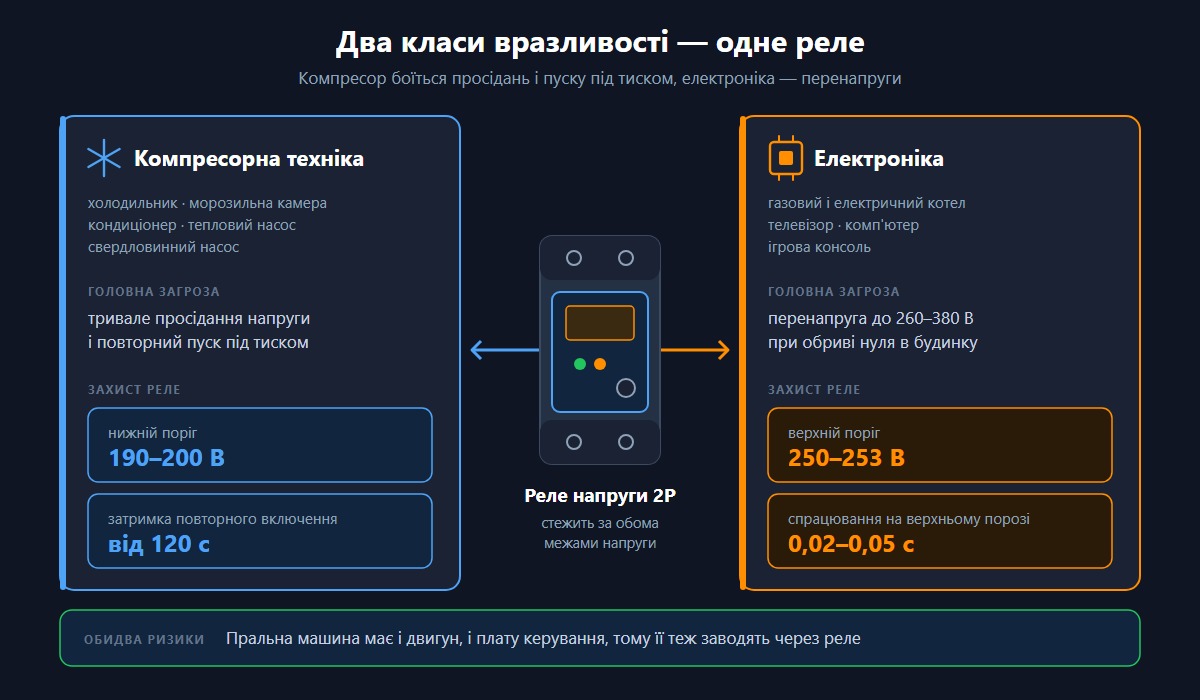
Home appliances split into two vulnerability classes: compressor appliances fear sags and frequent starts, while electronics die from overvoltage. A single voltage relay closes both risks, because it monitors both the upper and the lower limit and controls the pause before a restart. Without it, the refrigerator restarts under pressure, and the boiler's board receives 260-380 V during a broken neutral in the building. That is exactly why a dedicated relay is justified even when the rest of the apartment is protected only by circuit breakers.
What actually kills the compressor: overvoltage or a sag?
The compressor of a refrigerator and an air conditioner suffers first of all from a prolonged voltage sag rather than from a short spike upward. When the voltage drops below 190-200 V, the compressor motor cannot develop the required torque, the windings overheat, and the inrush current rises several-fold. The protective thermal relay inside the appliance trips, switches off the compressor, and after a few minutes the cycle repeats - the so-called short-cycling mode that kills the motor within weeks. An external voltage relay breaks the circuit earlier than the internal protection and does not let the compressor start on unsuitable voltage.
Which appliances are the most vulnerable to voltage spikes?
The largest risk group is formed by appliances with a compressor and appliances with a microprocessor board. The first includes the refrigerator, the freezer, the air conditioner, the heat pump and the borehole pump. The second includes the gas and electric boiler, the TV, the computer, the game console and charging stations. A washing machine combines both vulnerabilities: it has both a motor and a control board, so it is also worth wiring through a relay. Simple heating appliances without electronics (a heating element, an iron) tolerate fluctuations more easily, but a shared protection group is still advisable.
Why is the restart delay critical for compressor appliances?
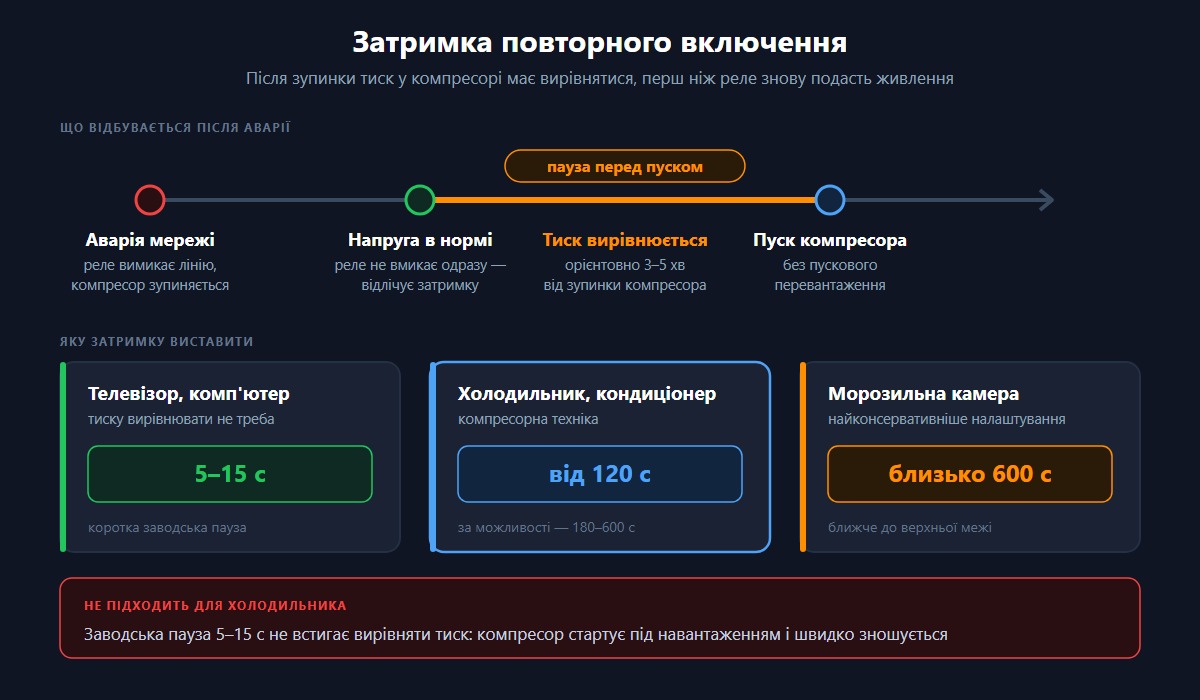
The restart delay is the pause the relay holds after normal voltage is restored, before it supplies power again. For compressor appliances this pause is vitally important, because after the compressor stops, high pressure remains in the discharge line. If you start the motor immediately, it starts against this pressure, draws excessive inrush current and wears out quickly. The minimum factory pause of 5-15 seconds suits only electronics, while for a refrigerator or an air conditioner it is set much longer.
What is pressure equalization in a compressor and how long does it take?
After a hermetic compressor stops, the refrigerant under pressure gradually flows from the discharge side to the suction side, equalizing the pressure in the system. Until the pressure equalizes, the motor physically cannot easily turn the shaft, and an attempt to start causes an overload. Compressor manufacturers allow roughly three to five minutes for this process, although the exact figure depends on the model and is usually not stated on the appliance's page. That is why the engineering rule is simple: it is better to give the compressor an extra minute of rest than to start it under pressure.
How many seconds or minutes to set for a refrigerator and an air conditioner?
For compressor appliances the restart delay is set to no less than 120 seconds, and where possible - in the range of 180 to 600 seconds. The standard value of 120 seconds is the minimum safe one, while a longer pause of up to 600-900 seconds protects the motor even better in some models. The short factory pause of 5-15 seconds is categorically unsuitable for a refrigerator, because it does not manage to equalize the pressure. We moved the detailed step-by-step method for setting all the figures into a separate article about the optimal voltage relay settings, and here we give ready applied benchmarks.
Which voltage to set for a refrigerator: practical thresholds
For a household refrigerator it makes sense to set the upper disconnection threshold at 250-253 V, and the lower one within 190-200 V, with a restart delay from 120 seconds. The upper threshold stays within the DSTU EN 50160 standard (230 V plus/minus 10 percent, that is 207-253 V), while the lower one is deliberately set below 207 V so that the compressor rides through a short sag without unnecessary trips. The relay measures voltage using the True RMS method with an accuracy of about 1-2 V, so the thresholds trip predictably. The specific factory thresholds depend on the relay model, so they are always checked in the device settings.
Upper and lower thresholds for a household refrigerator
The upper threshold is the main line of defense for the electronics of the refrigerator's control unit, and it is set as close as possible to the upper limit of the standard, but not above 253 V. The lower threshold for the compressor can be dropped to 190 V, because a short sag to this mark does not harm the motor, whereas frequent false trips at a higher threshold do more harm. Hysteresis (the difference between the disconnection threshold and the return voltage) keeps the relay from chattering at the trip point. If the mains voltage is chronically low, the relay alone will not solve the problem - it only disconnects, but does not correct the voltage.
How the settings differ for a freezer and a heat pump
A freezer needs an even more conservative delay than a refrigerator, because defrosting the food costs more than a simple shutdown. For it, the delay is set closer to the upper limit of the range (up to 600 seconds) and the lower threshold no higher than 195 V. A heat pump and a borehole pump have more powerful motors with a large inrush current, so the delay and the lower threshold are as critical for them as for a refrigerator. And if the voltage sags constantly rather than occasionally, then the relay must be supplemented with a stabilizer - we broke down the choice between them in the material about what is better to choose - a relay or a voltage stabilizer.
How does a voltage relay protect the electronics of a boiler, TV and PC?
For appliances with electronic boards the main threat is overvoltage, and the relay handles it almost instantly - within 0.02-0.05 seconds at the upper threshold. When a broken neutral or an emergency rise occurs in the mains, the voltage at the appliance can jump to 260-380 V, and the control board burns out within fractions of a second. The relay breaks the circuit earlier than the overvoltage can break through the capacitors and microchips. For electronics the restart delay can be left short, because there is no pressure to equalize.
Gas and electric boiler: why the control board fears overvoltage
A modern gas and electric boiler is controlled by a microprocessor board that costs a significant part of the whole boiler's price. This board is powered from the mains and has no serious protection of its own against prolonged overvoltage, so a broken neutral in the building often kills exactly it. A voltage relay installed ahead of the boiler removes this risk and stops the power before the electronics are damaged. Since a boiler belongs to life-support systems, for it a dedicated relay is not an option but a basic safety measure.
Computer, TV, game console - what to add to the relay
A TV, a computer and a game console react to overvoltage the same way as a boiler board, but additionally suffer from impulse surges during a thunderstorm. A voltage relay catches slow mains faults, yet does not keep up with a microsecond lightning impulse - for that a separate surge protection device per DSTU EN 61643-11:2015 is needed. That is why the full protection of expensive electronics consists of two levels: a relay against voltage faults and an SPD against lightning. For a personal workstation a socket relay is often more convenient than a modular one, because it does not require intervention in the panel.
A socket or a DIN-rail relay to protect an appliance?
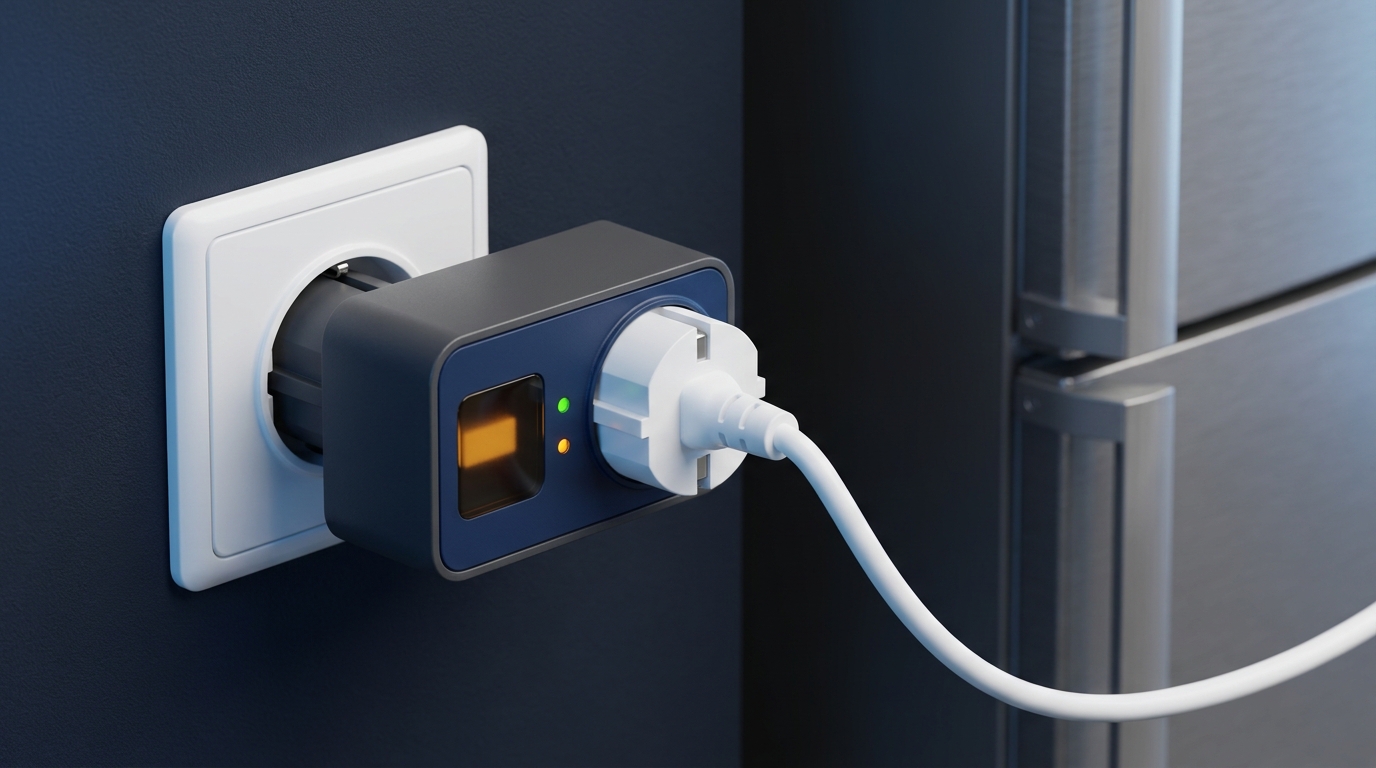
The choice between a socket and a modular relay depends on how many appliances you are protecting and whether you are ready to work in the panel. A socket relay plugs into an ordinary outlet and protects a single appliance or an extension cord, and its installation does not require an electrician. A modular DIN-rail relay is mounted in the panel and protects a whole group of outlets or the entire house. For a single refrigerator a socket version is enough, the nuances of which we broke down in the review of a plug-in voltage relay.
When a plug-in relay is enough for a single refrigerator
A socket relay is justified when you need to protect one or two appliances in a rented apartment or where there is no access to the panel. It protects only what is plugged in through it, so a refrigerator in a socket relay stays protected, while the rest of the apartment does not. The current of such a relay is limited by the outlet's rating, so it is not suitable for powerful groups. The main advantage is instant installation without a tool and without the risk of working under voltage.
When to move to a modular relay in the panel
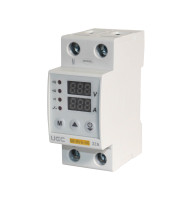
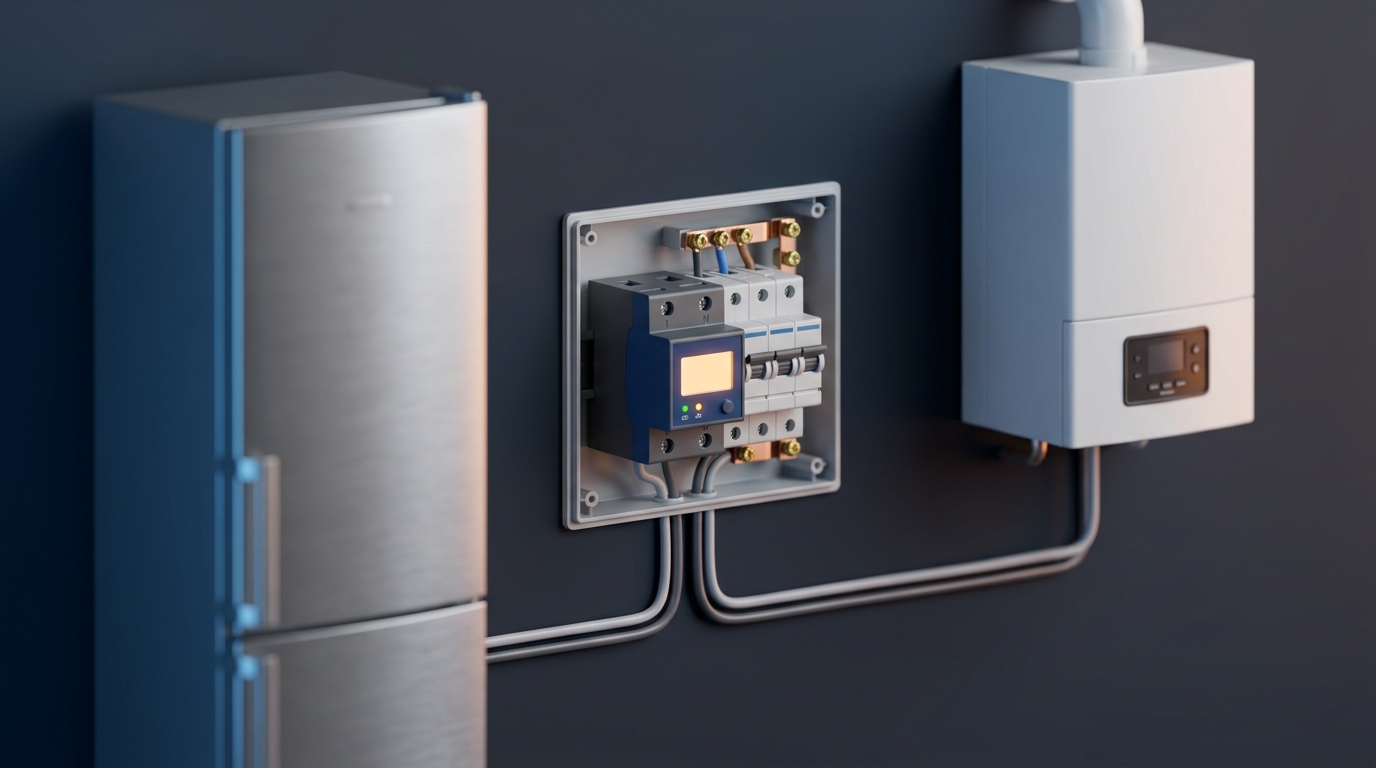
A modular relay is chosen when you need to protect the whole apartment, the house or a large group of appliances with a single device. It is mounted on the DIN rail after the incoming breaker and before the protective devices, holds a larger current and has more precise threshold adjustments. The correct sequence in the panel - meter, incoming breaker, voltage relay, RCD or RCBO, group breakers - is shown in detail in the article about connecting the relay together with an RCD and an RCBO. For a new house a modular solution is more practical, because a single device guards all the equipment at once.
How to calculate the load of an appliance group and when a contactor is needed?
To choose the relay rating, you need to add up the power of all appliances in the group and convert it into current. The relay must break a current no greater than its rating, otherwise the contacts overheat and weld together. The benchmark is simple: 16 A corresponds to a load of about 3.5 kW, while 40 A - about 8.8 kW. If the total current of the group exceeds the relay rating, the relay no longer switches the circuit directly but controls a contactor.
Table of rating-to-power correspondence
It is convenient to calculate the load using a table of correspondence between the rated current and power at a voltage of 230 V (on 1 July 2025 Ukraine switched to 230/400 V instead of 220/380 V). This table lets you quickly select the relay rating for a specific appliance group. For a kitchen with a refrigerator, an electric stove and small appliances 32-40 A is usually enough, while for a house with a pump and a boiler the count rises to 63 A. Always take the rating with a margin, so the relay does not operate at its limit.
| Relay rating | Power (230 V) | Typical appliance group |
|---|---|---|
| 16 A | about 3.5 kW | One refrigerator, TV, small appliances |
| 25 A | about 5.5 kW | Kitchen group with a microwave |
| 32 A | about 7 kW | Kitchen with an electric stove |
| 40 A | about 8.8 kW | An entire apartment |
| 63 A | about 13-14 kW | A house with a pump and a boiler |
A load above the relay rating: why a contactor is needed
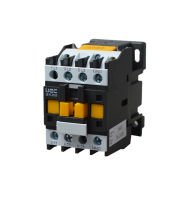
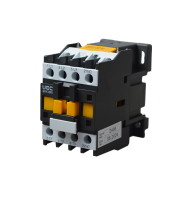
A contactor is needed when the total current of the group exceeds the relay rating, because the relay's own contacts are not rated for such a current. In this scheme the voltage relay does not switch the power circuit but only sends a signal to the contactor's coil, which then switches the load on and off. Without a contactor the relay contacts overheat at a high current, spark and eventually weld together, after which the relay stops protecting. For powerful groups we recommend UEC contactors of the SB-PC series for currents from 9 to 630 A, and for installation outside the panel there are SB-CMS contactors in an IP54 enclosure rated 9-40 A.
Which UEC and GEWISS products suit appliance protection?
For most household tasks a two-pole DIN-rail voltage relay of the in-house UEC brand is enough, while for more complex cases with a three-phase input GEWISS solutions are suitable. A two-pole relay breaks both the phase and the neutral, which is critical during a broken neutral - the most common fault in Ukrainian networks. The line covers ratings for any household group, from a single kitchen to a whole house. Below is how to navigate the choice for a specific load.
UEC SB-RV voltage relay for the household line
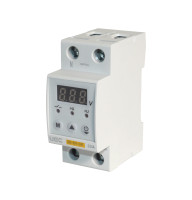
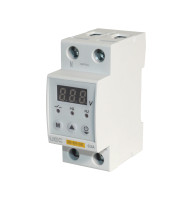
The UEC SB-RV series covers two-pole relays for 32, 40, 63 and 80 A (models SB-RV-08-2-32, SB-RV-08-2-40, SB-RV-08-2-63 and SB-RV-08-2-80). All of them have a mechanical endurance of 1,000,000 cycles, withstand an impulse voltage of 6 kV and come with a 2-year manufacturer's warranty. The price benchmark as of 2026 is from UAH 650 for the 32-amp model to UAH 900 for the 80-amp one, which makes them an affordable domestic alternative. For a kitchen with a refrigerator you take 32-40 A, for a house with a pump and a boiler - 63-80 A; you can select a specific model in the SB-RV voltage relays catalog. If the group also needs overcurrent (overload) protection, the SB-RVA voltage and current relay in the same 32-80 A ratings will do.
GEWISS solutions for more complex cases
For sites with a three-phase input the GEWISS line offers specialized DIN-rail devices. The three-phase undervoltage relay GW96909 works in a 230/400 V network and monitors undervoltage with an adjustable threshold from 160 to 240 V on each phase. The phase-monitoring relay GW96907 additionally tracks phase sequence, asymmetry and the loss of the neutral or a separate phase, which is needed for three-phase motors, pumps and compressors. The single-phase relay GW96908 is powered from 24 V or 230 V and monitors undervoltage with load disconnection. These devices have a 1CO contact, withstand 20 million cycles and operate in the range from minus 25 to plus 55 degrees.
Verified facts about appliance protection with a voltage relay
A few technical details are often lost in general reviews, although it is exactly they that determine whether your appliances are truly protected. We have gathered facts backed by standards and product specifications rather than by marketing. Each of them has a practical consequence for choosing and setting up the device. Take them into account before buying a relay for a specific appliance.
- First: a voltage relay neither raises nor lowers the voltage, it only disconnects the appliance when the thresholds are exceeded, so against a chronically low mains it is supplemented with a stabilizer.
- Second: the relay's own consumption is 2-5 W, that is only 1.5-3.6 kWh per month, and round-the-clock operation creates no noticeable cost.
- Third: the two-pole SB-RV relay breaks both the phase and the neutral, so during a broken neutral no dangerous potential remains on the disconnected appliance, as can happen with single-pole devices.
- Fourth: a short voltage sag (0.2-2 s reaction at the lower threshold) does not harm appliances, so an overly high lower threshold gives more false trips than benefit.
- Fifth: the relay does not catch a microsecond lightning impulse - for that a separate SPD per DSTU EN 61643-11:2015 is needed.
"In practice, most of the burned-out refrigerator and boiler boards we see are the result of a broken neutral in the building, not a factory defect of the appliance. A two-pole voltage relay installed ahead of the appliance removes exactly this risk, because it breaks both poles and does not leave the load under a floating potential."
- Oleh Lukianchuk, electrical engineer at UEC
A different view: is the built-in protection of modern appliances enough?
A common counterargument goes like this: modern refrigerators and boilers already have built-in protection against voltage fluctuations, so an external relay is a waste. This is partly fair, and it is worth acknowledging the conditions under which the built-in protection really works. However, for the Ukrainian mains with frequent broken neutrals this argument has substantial limits. Let us examine both sides honestly, without downplaying either.
When the internal electronics really help
Many modern appliances have a protective thermal relay of the compressor and the simplest power monitoring, which saves them from short spikes. Inverter air conditioners and refrigerators with an inverter compressor tolerate voltage fluctuations better than old models with a starting relay. In a stable urban network, where the voltage rarely goes beyond 207-253 V, this built-in protection may be enough for years. That is why in a new building with a quality input the risk of a breakdown is objectively lower.
Why this does not replace an external relay
The problem is that the built-in protection is designed for short deviations rather than for an emergency overvoltage of 260-380 V during a broken neutral. The internal thermal relay protects the compressor from overheating but does not save the control board from breakdown, and it is exactly the board that fails most often. The built-in electronics also do not always sustain the restart delay, so the compressor may start under pressure. The balanced conclusion: the built-in protection is useful, but for expensive appliances in the real Ukrainian mains it is supplemented with an external relay - this is insurance whose cost is incomparable with a repair.
"The built-in protection of the appliance and an external voltage relay work at different levels and do not compete. The relay is the first line that does not let the mains fault reach the appliance at all, while the internal electronics are the last fuse. Removing the first line to save UAH 700 while repairing a board for several thousand is economically unjustified."
- Oleh Lukianchuk, electrical engineer at UEC
For comprehensive appliance protection it is logical to combine a voltage relay with a residual current device - the relay watches the voltage, and the RCD watches for a current leak to the casing. How these devices are coordinated in a single panel we explained in the complete guide to RCDs.
Frequently asked questions (FAQ)
❓ Which voltage to set on the relay for a refrigerator?
The upper threshold is set at 250-253 V (the upper limit of the DSTU EN 50160 standard), the lower one at 190-200 V, and the restart delay at 120 seconds and more. Such a range guards both the compressor from sags and the electronics from overvoltage, while not causing frequent false trips. The exact factory thresholds depend on the relay model.
❓ Why does a refrigerator need a restart delay?
After a stop, high pressure remains in the compressor, and an immediate restart causes a motor overload. A delay of 120 to 600 seconds lets the pressure equalize, reduces the starting load and extends the compressor's service life. The factory pause of 5-15 seconds is unsuitable for a refrigerator, because it is too short.
❓ Can a single relay protect a refrigerator, a boiler and a TV all at once?
Yes, a modular relay in the panel protects a whole group of appliances at once, if the total current does not exceed its rating. For a kitchen 32-40 A is usually enough, for a house with a pump and a boiler - 63 A. If the group's current is greater than the relay rating, the relay controls a contactor that switches the power circuit.
❓ A voltage relay or a stabilizer - which to choose for appliances?
The relay only disconnects the appliance when the thresholds are exceeded, so against short faults it is enough. But if your voltage is chronically low or high, you need a stabilizer that corrects the level. Often these devices are installed together: the stabilizer levels out the voltage, and the relay insures against an emergency.
❓ Does a voltage relay protect against a thunderstorm?
No, the relay reacts to slow mains faults within 0.02-2 seconds and does not keep up with a microsecond lightning impulse. To protect against lightning a separate surge protection device per DSTU EN 61643-11:2015 is needed. The full protection of expensive electronics consists of two levels: a voltage relay and an SPD.
❓ A plug-in or a modular relay - which is better for a single refrigerator?
For a single refrigerator a socket relay is enough: it plugs into an existing outlet without opening the panel and does not require an electrician. A modular DIN-rail relay is chosen when you need to protect a whole group of appliances or the entire house with a single device. A socket relay protects only what is plugged in through it.