
Article Contents
Voltage Relay vs Voltage Stabilizer - Which to Choose for Your Home


Key takeaways
A voltage relay is a protection device that disconnects the network when voltage exceeds set thresholds. A voltage stabilizer corrects input voltage to a stable 220V. They are not competitors — they complement each other.
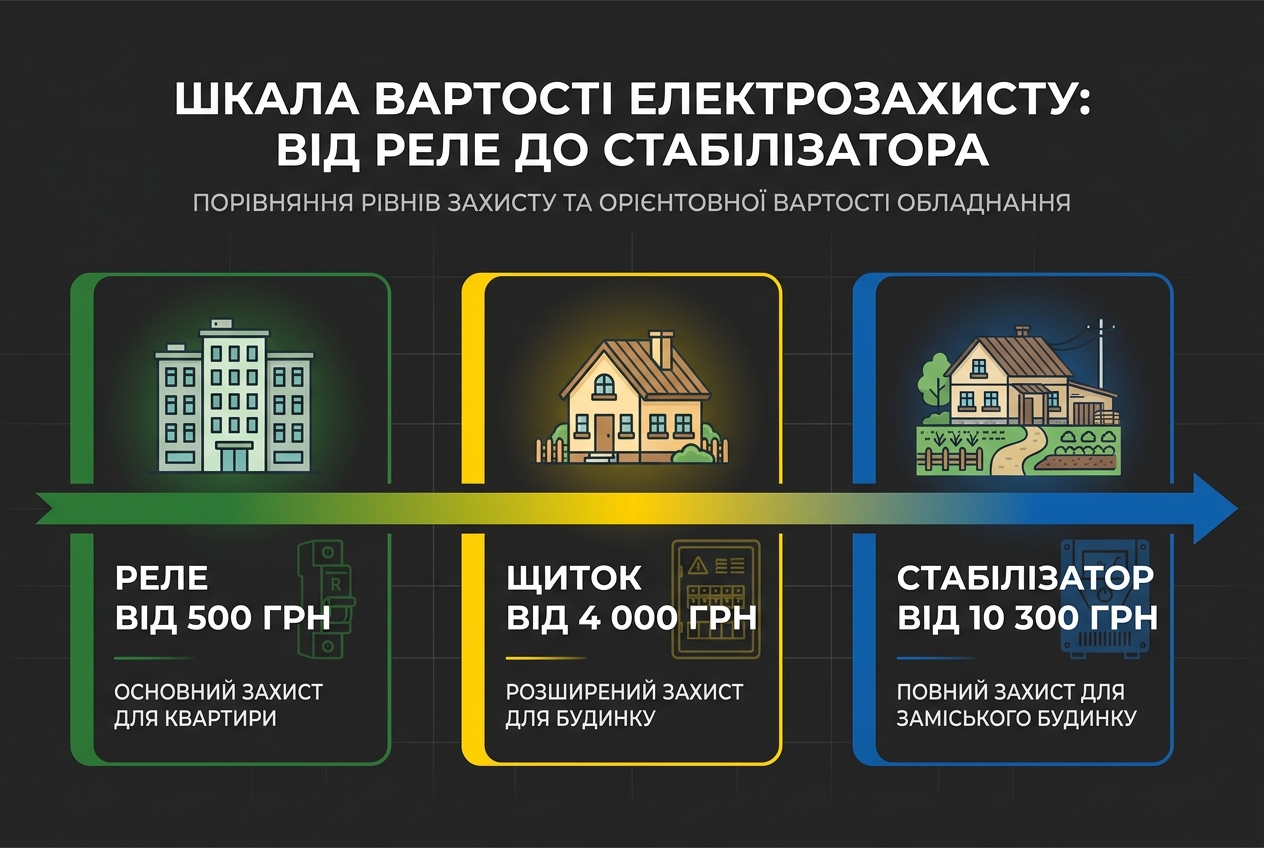
Three selection scenarios: apartment with rare surges — relay (from 500 UAH), village with daily voltage sag — stabilizer (from 10,300 UAH), cottage with gas boiler — both devices together.
Key fact: a stabilizer does not protect against neutral break (380V on the phase) — for that, you need a voltage relay specifically.
Hi, I'm Oleksiy, a technical consultant at UEC with experience in designing electrical protection solutions for residential and commercial facilities.
In this article, we'll explain the difference between a voltage relay and a stabilizer, compare them across 8 parameters, and provide three specific selection scenarios — for an apartment, a rural home, and a cottage.
What a voltage relay does vs what a stabilizer does — the difference in 1 sentence
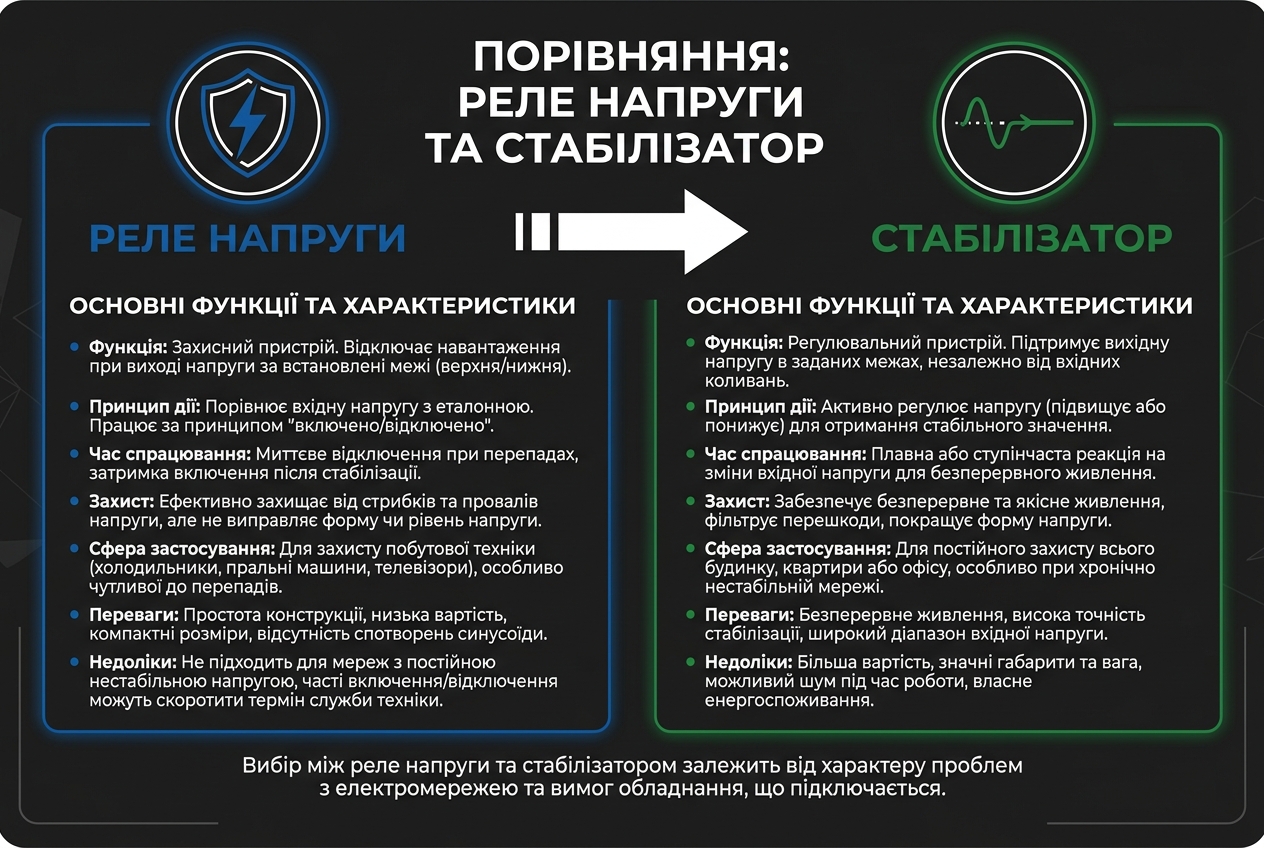
Voltage relay — protective switch
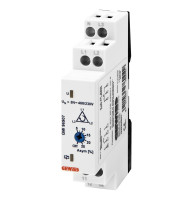
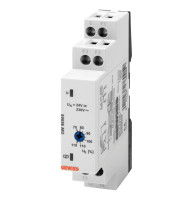
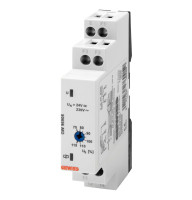
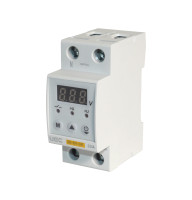
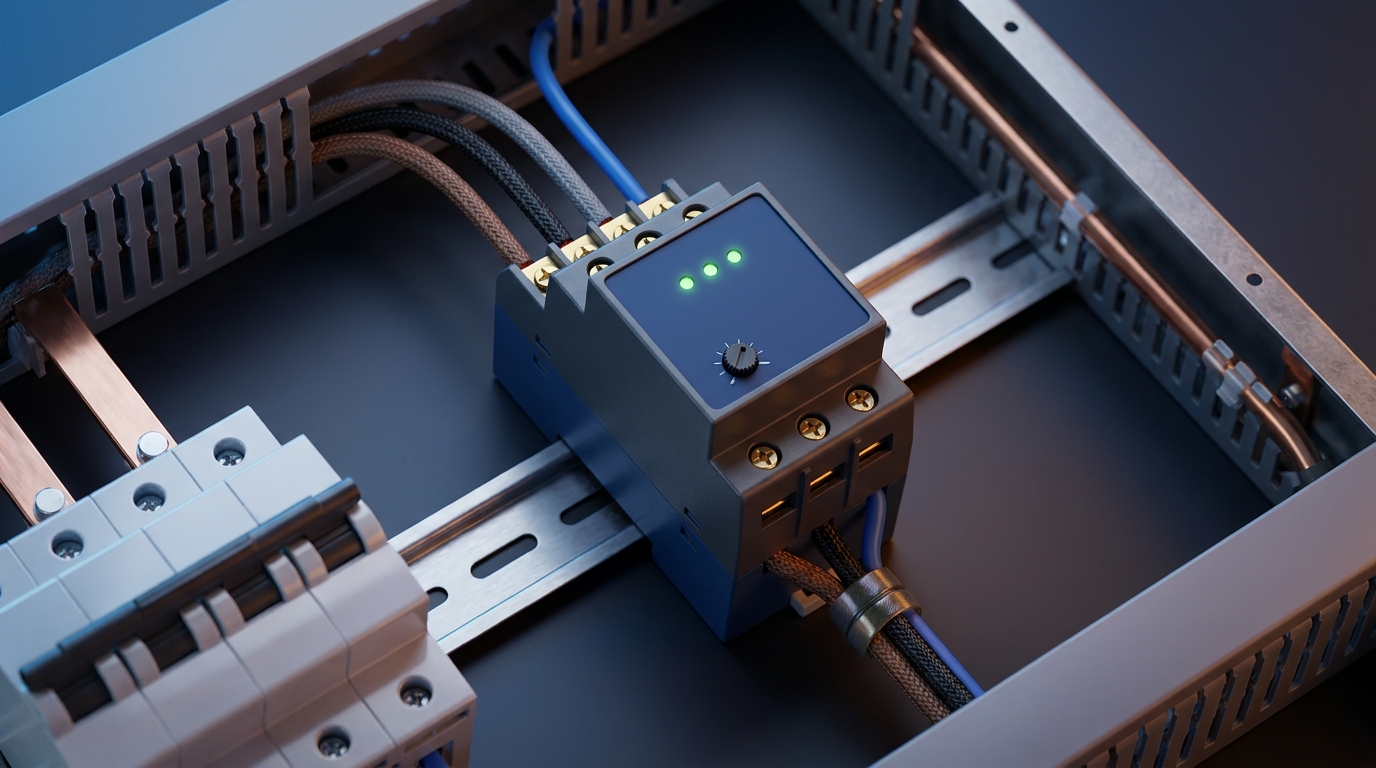
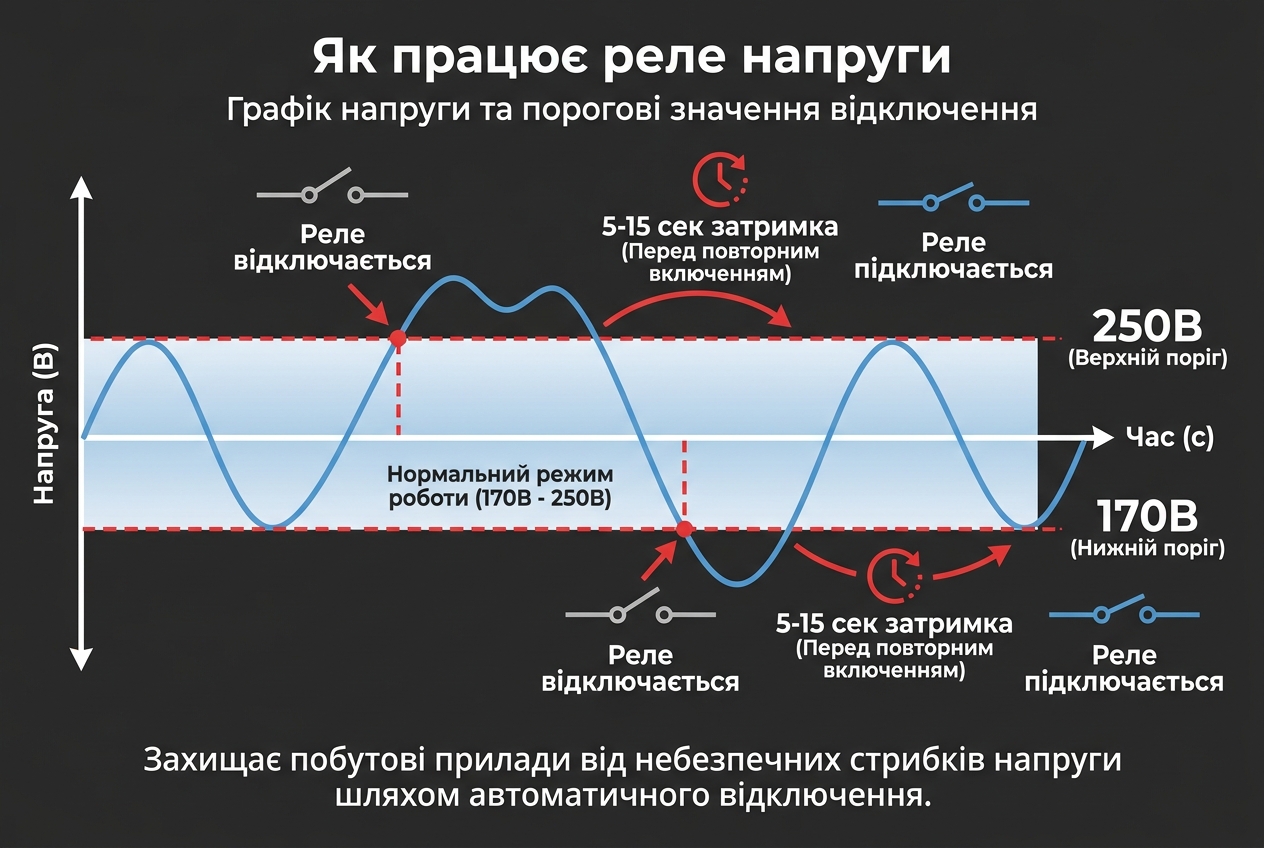
A voltage relay is a protection device that monitors the mains voltage and disconnects the load when values exceed set thresholds (e.g., below 170V or above 250V). The relay does not change the voltage — it only breaks the circuit.
Voltage stabilizer — automatic corrector
A voltage stabilizer is a device that automatically corrects the input voltage to the nominal 220/230V. If the mains delivers 180V, the stabilizer raises it to 220V; if 250V — it reduces it.
The difference in one sentence:
A relay is a switch, a stabilizer is a corrector [1].
How does a voltage stabilizer work?
A stabilizer measures the input voltage and automatically adds or subtracts the required number of volts to maintain a stable 220–230V output. This allows appliances to operate continuously even during significant mains fluctuations.
Servo-driven, relay-type, electronic — 3 types
Not all stabilizers are the same. The type determines response speed, accuracy, and price.
| Parameter | Relay-type | Servo-driven | Thyristor (electronic) |
|---|---|---|---|
| Response time | 20–50 ms | 50–100 ms (up to 3000 ms) | 10–20 ms |
| Correction accuracy | ±3.5–8% | ±3–5% | ±1–3% |
| Input voltage range | 120–275V | 135–285V | 100–295V |
| Price from (UAH) | 10,300 | 15,000–25,000 | 20,000–30,000 |
| Example models | Eleks 7 kW, LogicPower LP-5000 | Volter, StabMaster | Ukrtekhnologiya Norma Exclusive |
| Best for | Apartments, basic appliances | Houses, pump equipment | Boilers, servers, medical equipment |
A servo-driven stabilizer regulates voltage mechanically — a motor moves a slider along the transformer winding. This is the slowest type, but it operates smoothly and withstands prolonged voltage sag [2].
An electronic (thyristor/triac) stabilizer switches windings using semiconductor keys in 10–20 ms. This is the fastest and most accurate type, but also the most expensive [2].
The relay-type is a compromise: faster than servo-driven, cheaper than thyristor, but correction is stepped (in ~20V increments).
How does a voltage relay work?
A voltage monitoring relay continuously measures the mains voltage. If the value exceeds the user-set thresholds, the relay opens the contact and de-energizes the line. When voltage returns to normal, the relay reconnects the load with a delay (typically 5–15 seconds) to protect compressor-based appliances (refrigerator, air conditioner) from inrush currents.
At UEC, we often see the same mistake: people buy a voltage relay and think it will "fix" low voltage. No — the relay will simply disconnect the network. If your voltage drops to 180V daily, the relay will cut your power every day.
Typical relay specifications for an apartment: rated current 25–40A, lower threshold 170–200V, upper threshold 250–270V. For a house — 40–63A [3]. The device occupies 2–3 DIN-rail modules in the panel and consumes less than 5W.

Warning! Working with electrical equipment is life-threatening!
All work in the electrical panel must be performed only by qualified electricians with the power disconnected. Before starting work, be sure to de-energize the line and verify the absence of voltage with a measuring device.
Relay vs stabilizer — comparison table across 8 parameters
Here's the main comparison you likely opened this article for:
| Parameter | Voltage relay | Voltage stabilizer |
|---|---|---|
| Primary function | Disconnects when out of range | Corrects to 220/230V |
| Protection against neutral break | YES — disconnects in 20–50 ms | NO — may burn out itself! |
| Voltage stabilization | NO — only disconnects | YES — maintains 220V |
| Response time | 20–50 ms | 10–3000 ms (depends on type) |
| Power consumption | < 5W | 20–100W |
| Size and installation | 2–3 DIN modules in the panel | Separate unit (floor/wall) |
| Price from (UAH) | 500 | 10,300 (5 kVA) |
| Maintenance | None required | Servo-driven — brush replacement |
Key takeaway:
These are not competitors, but complements. The relay protects against emergencies (overvoltage, neutral break), while the stabilizer handles chronic issues (constant sag, fluctuations).
When is a relay enough, and when do you need a stabilizer?
Let's examine three real scenarios with specific electrical network parameters.
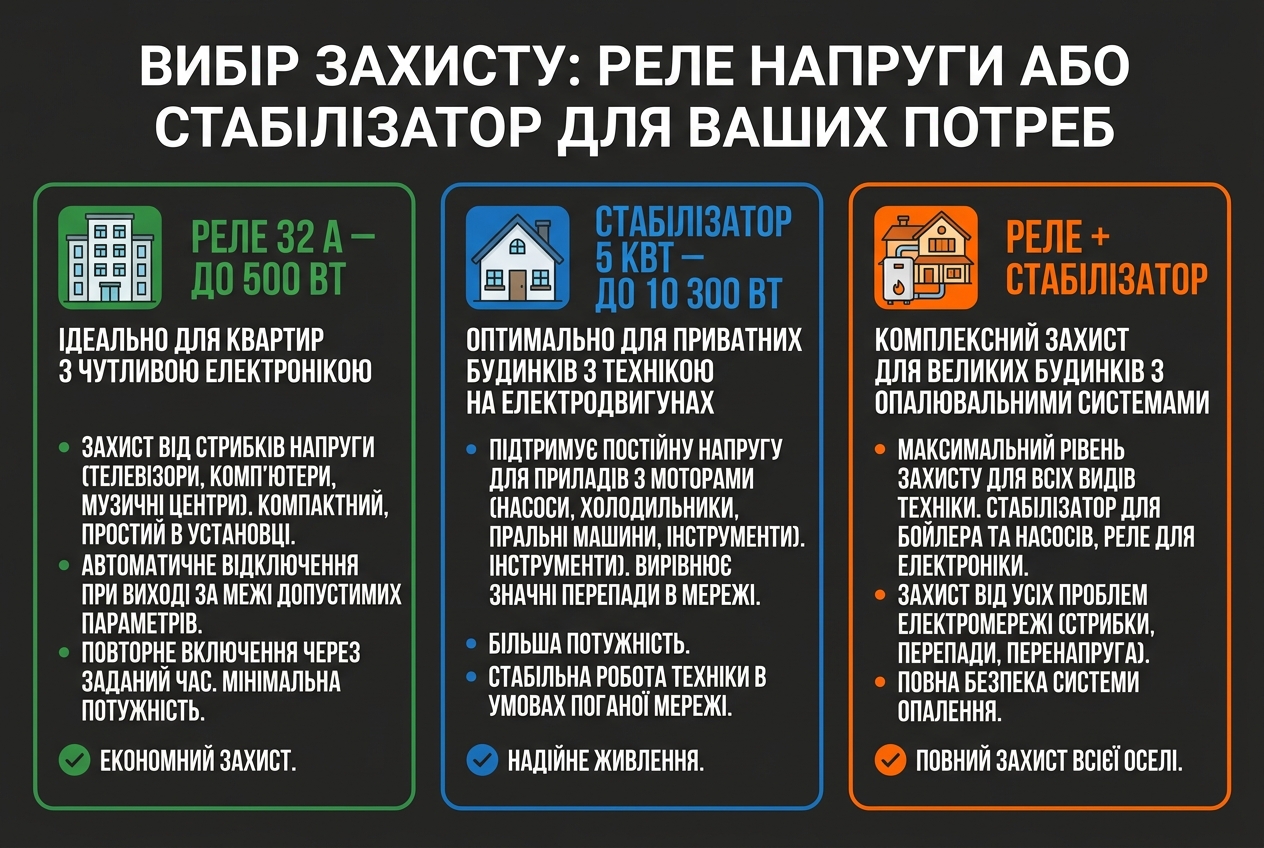
Scenario 1 — apartment with rare surges: relay
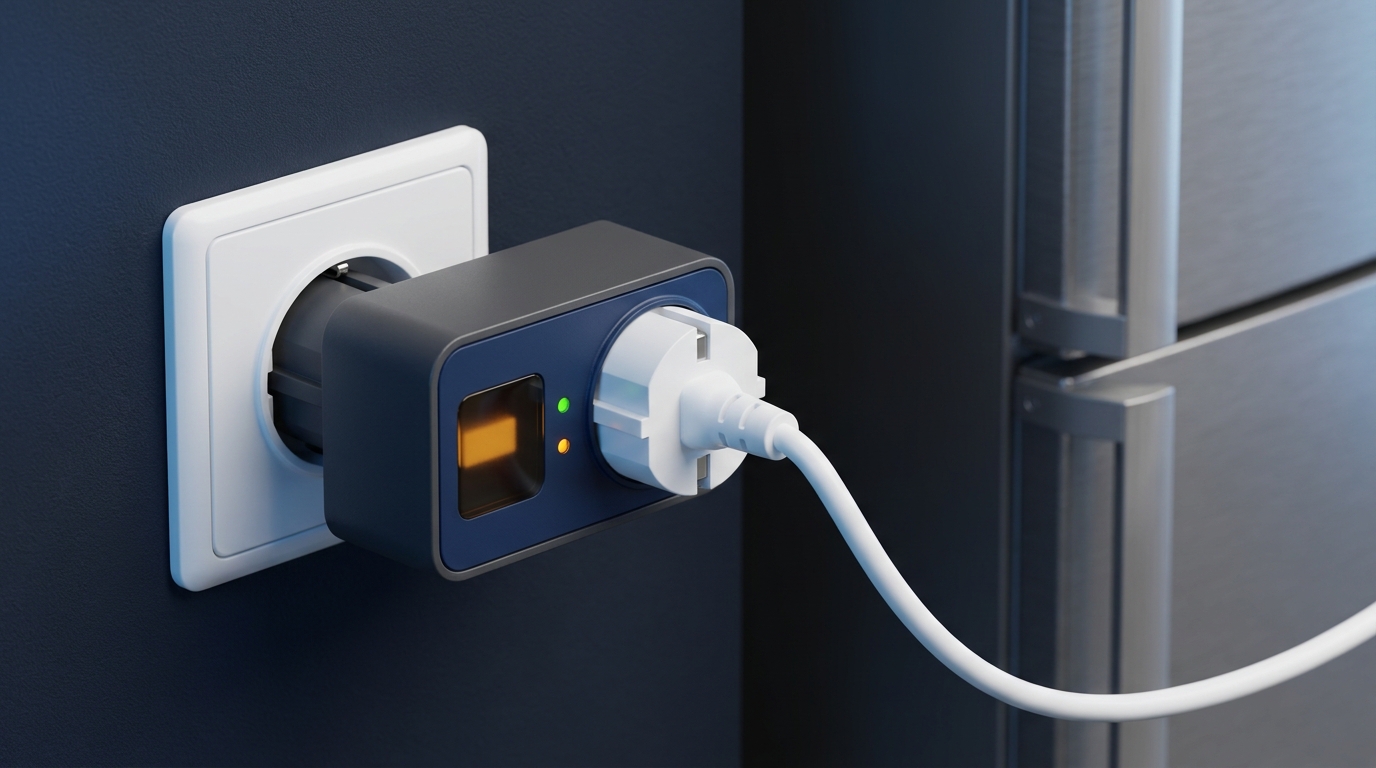
Situation: a new apartment building, voltage is typically 220–230V, but surges to 260V occur 2–3 times a month (welding in the stairwell, substation failure). Load — refrigerator, washing machine, TV.
Solution: a single-phase voltage relay rated at 32A (up to 7 kW). Cost — from 500 UAH. A stabilizer is unnecessary here: voltage is normal 98% of the time, and the relay will protect against rare emergencies.
Scenario 2 — village with sag down to 170V: stabilizer
Situation: a private house in a village, the power line is long and worn out. In the morning, voltage is 200–210V, in the evening (when everyone turns on heaters) it drops to 170–180V. Voltage sag is a daily occurrence.
Solution: a relay-type stabilizer rated at 5 kVA or more (range from 120V). Price — from 10,300 UAH. A relay won't work here — it would simply cut power every evening. You need a device that raises voltage to the norm [1].
Scenario 3 — cottage with gas boiler: relay + stabilizer
Situation: a suburban house with unstable voltage (190–250V). There is a gas boiler with an electronic control board (sensitive to power quality) and a total load of 8–10 kW.
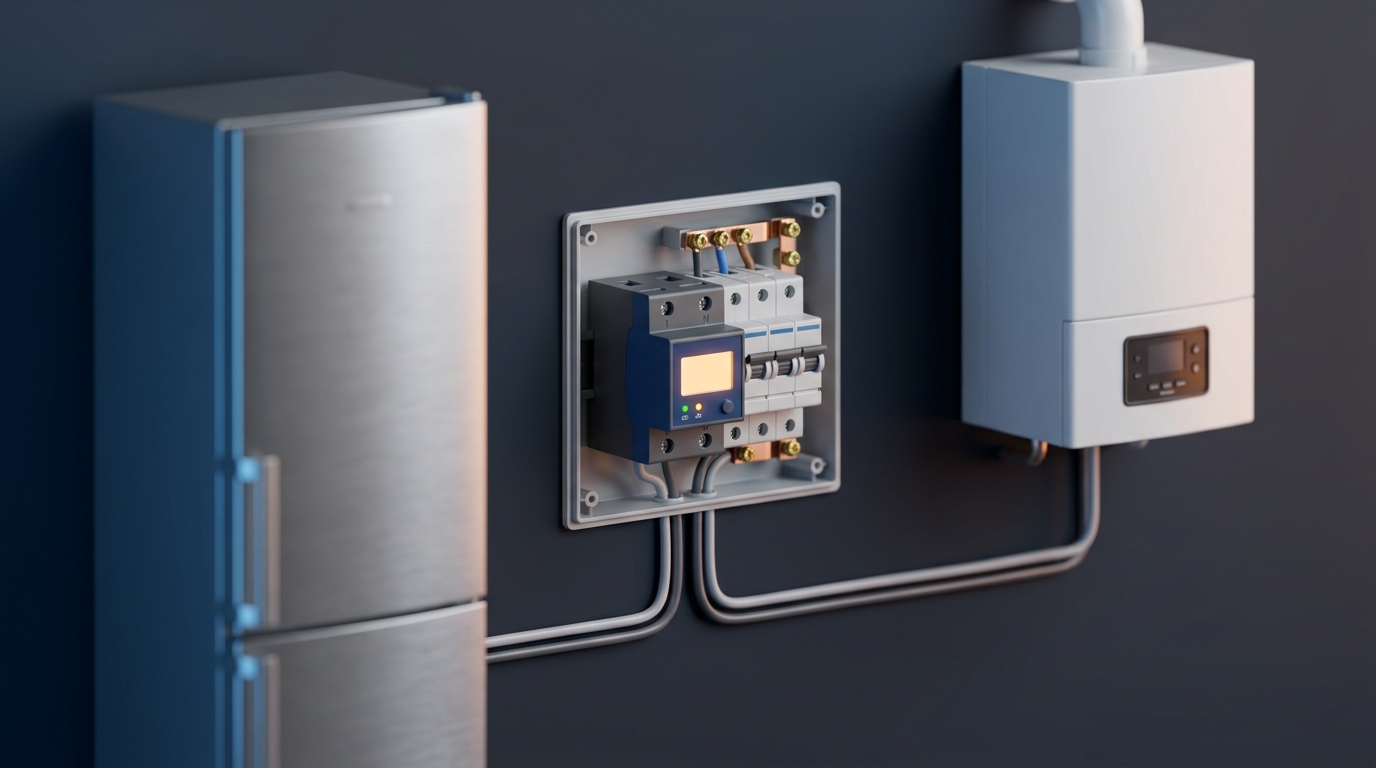
Solution: a thyristor stabilizer (±2%) on the boiler line + a general voltage relay rated at 40A at the panel input. The stabilizer provides the boiler with clean 220V, while the relay protects the entire house from neutral break and critical overvoltage.
At UEC, we recommend exactly this combination for cottages: a stabilizer on the critical line + a relay at the input. This is the optimal balance between protection and cost.
What can be used instead of a voltage relay?
This question is frequently asked in search queries. The answer: there is no full replacement, but there are alternatives with limitations.
- Voltage stabilizer — corrects voltage but does not protect against neutral break. It is a fundamentally different device, not a replacement.
- DIN-rail voltage monitoring relay + contactor — for loads exceeding 40A. The relay provides the signal, the contactor switches.
- Surge protector with varistor — protects against short-term impulses (lightning), but not against sustained overvoltage.
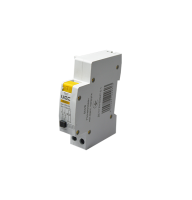
- Circuit breaker — protects against overload and short circuit, but not against overvoltage. If you are looking for comprehensive protection, voltage relay — how to choose and connect explains how a relay complements a circuit breaker in the panel.
None of these devices fully replaces a voltage relay. That's why electricians install relays as a fundamental protection element.
How much does protection cost: relay (from 500 UAH) vs stabilizer (from 10,300 UAH)
Cost is often the deciding factor. Here are approximate prices for 2026:
| Solution | Price from (UAH) | What it protects |
|---|---|---|
| Voltage relay 16–32A | 500 | Apartment up to 7 kW |
| Voltage relay 40–63A | 1,200 | House up to 14 kW |
| Stabilizer 5 kVA (relay-type) | 10,300 | House up to 5 kW |
| Stabilizer 10 kVA (relay-type) | 25,000 | House up to 10 kW |
| Relay + stabilizer for boiler line | 4,000–8,000 | Boiler + general protection |
The price difference is 20 times. That's why for apartments where voltage is generally stable, a voltage relay is the rational minimum. A stabilizer is justified only where voltage chronically exceeds the 207–253V range defined by DSTU EN 50160:2023 [4].
Note that a stabilizer also consumes electricity — from 20 to 100W constantly. Per year, that's an additional 175–876 kWh, which at a rate of ~2.64 UAH/kWh amounts to 460–2,300 UAH per year.
FAQ — relay vs stabilizer
❓ Which is better — a stabilizer or a relay?
It depends on the problem. If voltage is stable with rare surges — a relay (from 500 UAH). If voltage drops below 200V or jumps above 250V daily — a stabilizer. For a cottage with a gas boiler, the optimal solution is to install both.
❓ What can be used instead of a voltage relay?
There is no full replacement. A stabilizer does not protect against neutral break. A circuit breaker does not respond to overvoltage. A surge protector only works against short-term impulses. A relay is a fundamental protection element that complements, rather than replaces, other devices.
❓ Is it worth installing a relay if you already have a stabilizer?
Yes, and this is the recommendation of most manufacturers. A stabilizer corrects voltage within its operating range, but during a neutral break (voltage 300–380V) it can burn out itself. A relay will disconnect the network in 20–50 ms, protecting both your appliances and the stabilizer.
❓ Does a stabilizer protect against neutral break?
No. During a neutral break, phase voltage can rise to 380V. Stabilizers correct phase voltage but do not recognize a neutral break as an emergency — they try to "stabilize" 380V and fail. To protect against neutral break, you specifically need a voltage relay [1].