
Article Contents
Manual Changeover Switch 1-0-2: What It Is and How to Choose


Key takeaways
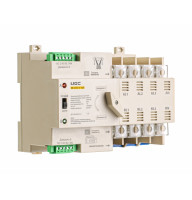
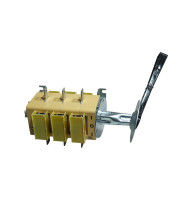
A changeover switch (also known as a three-position switch or a 1-0-2 load transfer switch) is a manual switching device with three fixed handle positions: 1 (the first source), 0 (off) and 2 (the second source). It lets you move the house supply from the grid to a generator and back by hand, while physically ruling out the simultaneous connection of two sources [1].
Key point: typical domestic ratings are 40, 63, 100 and 125 A [2]. Moving from position "1" to position "2" always passes through "0", so the grid and the generator cannot be closed at the same time even in theory.
Hello! This material was prepared by the UEC engineering department. Every day we specify main distribution panels for private houses, country homes and industrial facilities across Ukraine, so we know exactly where a manual 1-0-2 switch is the optimal solution and where you cannot manage without automation.
In this article we go through the design, the safety principle and the selection criteria of a changeover isolator in plain engineering language.

⚠ WARNING! Working with electrical equipment is life-threatening!
Connecting an ATS and a backup power supply (especially a generator input) involves the risk of backfeed and requires a qualification of at least electrical safety group III. Have the installation carried out by a licensed electrician.
What a 1-0-2 changeover isolator is and what its positions mean
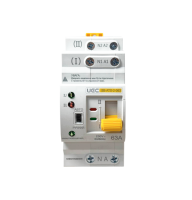
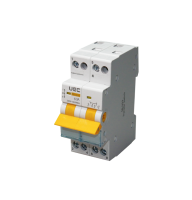
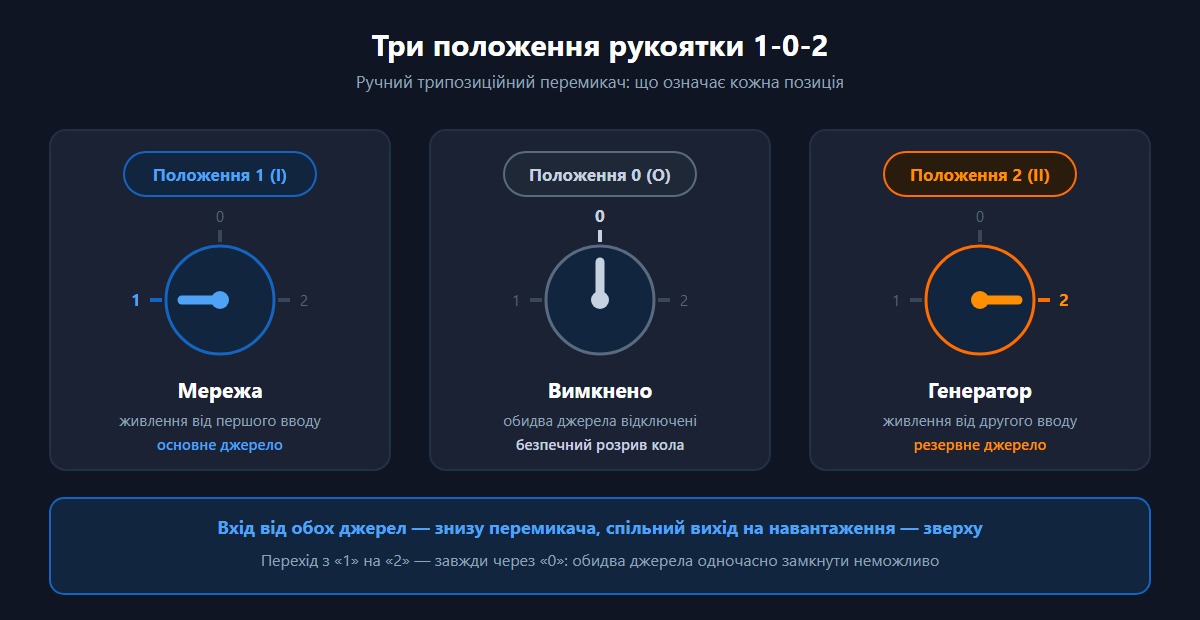
A 1-0-2 load transfer switch is a manual device that connects a line to one of two independent power sources through a mandatory intermediate "off" position. The "1-0-2" marking (or "I-0-II") is simply the three positions of its handle, not a rating or a model number.
What the handle positions mean:
| Position | Marking | State of the circuit |
|---|---|---|
| 1 | I | Supplied from the first input (usually the grid) |
| 0 | O | Supply off, both sources disconnected |
| 2 | II | Supplied from the second input (usually a generator or another backup source) |
The supply inputs from both sources (the grid and the generator) are connected at the bottom of the switch, while the common output to the house load leaves from the top [1]. The handle can never end up in a position where both sources are closed at the same time: to move from "1" to "2" it is always taken through "0".
It is exactly this mechanism that makes the device safe.
What else is a changeover switch called?
In catalogues and in everyday use the same device appears under different names, and all of them mean one type of apparatus. Reversing isolator, I-0-II switch, grid-generator switch, grid-backup switch, three-position switch, backup input switch — these are all synonyms for a manual changeover load switch. Its high-current industrial equivalent is a switch-disconnector in the "2-way" (reversing) version.
How a changeover isolator differs from an ATS
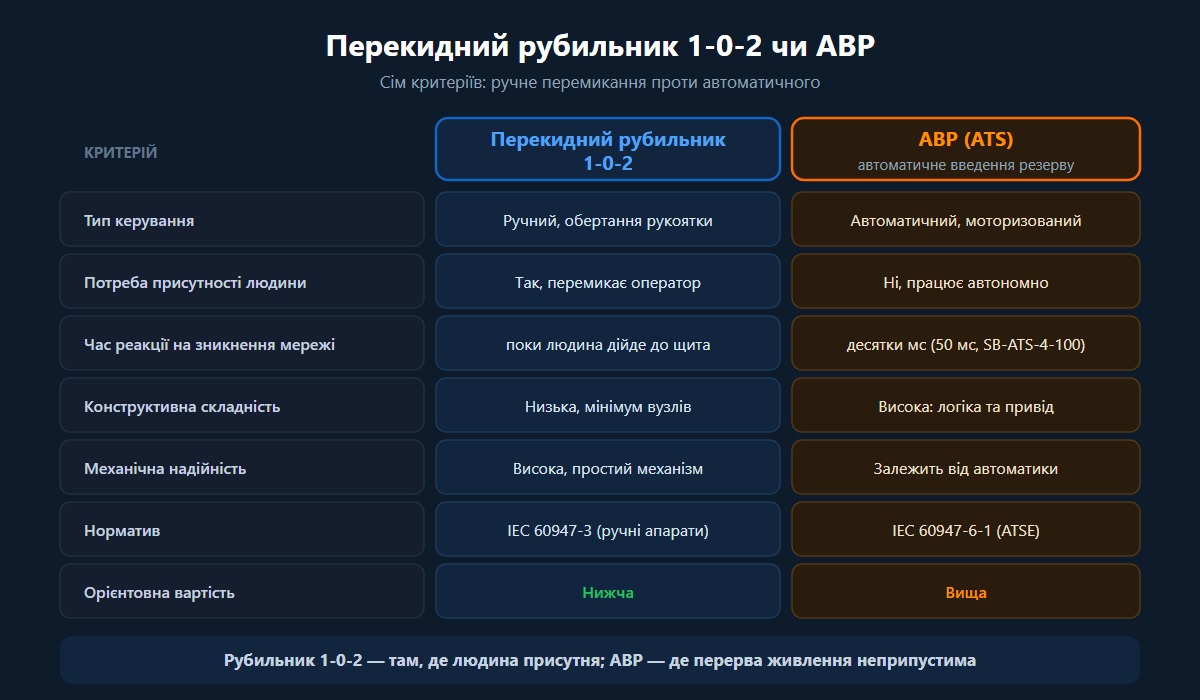
The main difference is the way the transfer happens: a 1-0-2 isolator is switched by a person, by hand, whereas an ATS (automatic transfer switch) does it automatically, without any human involvement. These are fundamentally different classes of equipment, both in terms of standards and in terms of use case.
A manual switch belongs to switching apparatus governed by IEC 60947-3 (switches, disconnectors and switch-disconnectors), while automatic source transfer systems are covered by IEC 60947-6-1 for automatic transfer switching equipment (ATSE) [3]. In other words, these are legally and technically different categories of device.
| Criterion | 1-0-2 changeover isolator | ATS (automatic transfer switch) |
|---|---|---|
| Type of control | Manual, by turning the handle | Automatic, motorised / contactor-based |
| Need for a person on site | Yes, an operator performs the transfer | No, it works autonomously |
| Reaction time when the grid fails | As long as it takes a person to reach the panel | Tens of milliseconds (e.g. 50 ms in the SB-ATS-4-100) [4] |
| Design complexity | Low, a minimum of components | High, there is control logic and a drive |
| Mechanical reliability | High, a simple mechanism | Depends on the automation and the drive |
| Standard | IEC 60947-3 (manual devices) | IEC 60947-6-1 (ATSE) [3] |
| Indicative cost | Lower | Higher |
The conclusion is simple:
a manual 1-0-2 isolator is the cheaper, simpler and mechanically more reliable solution for premises where someone is present and can transfer the supply personally (a country house, a garage, a private home). An ATS is needed where an interruption of several minutes is unacceptable, or where the site is left unattended. We compare the scenarios in detail in a separate article on the backup power transfer switch: manual or automatic.
How the switch delivers safety: the break-before-make principle
A changeover isolator implements the break-before-make principle: the contacts of the active source open completely BEFORE the contacts of the new one close. This physically rules out connecting the grid and the generator at the same time, and with it any short circuit between the two inputs [5].
Technically, it is the intermediate "0" position that delivers this principle:
the handle cannot go from position "1" straight to "2" — only through an open circuit. The result is a built-in mechanical interlock without any additional relays or logic.
Why must a generator never be plugged into a socket?
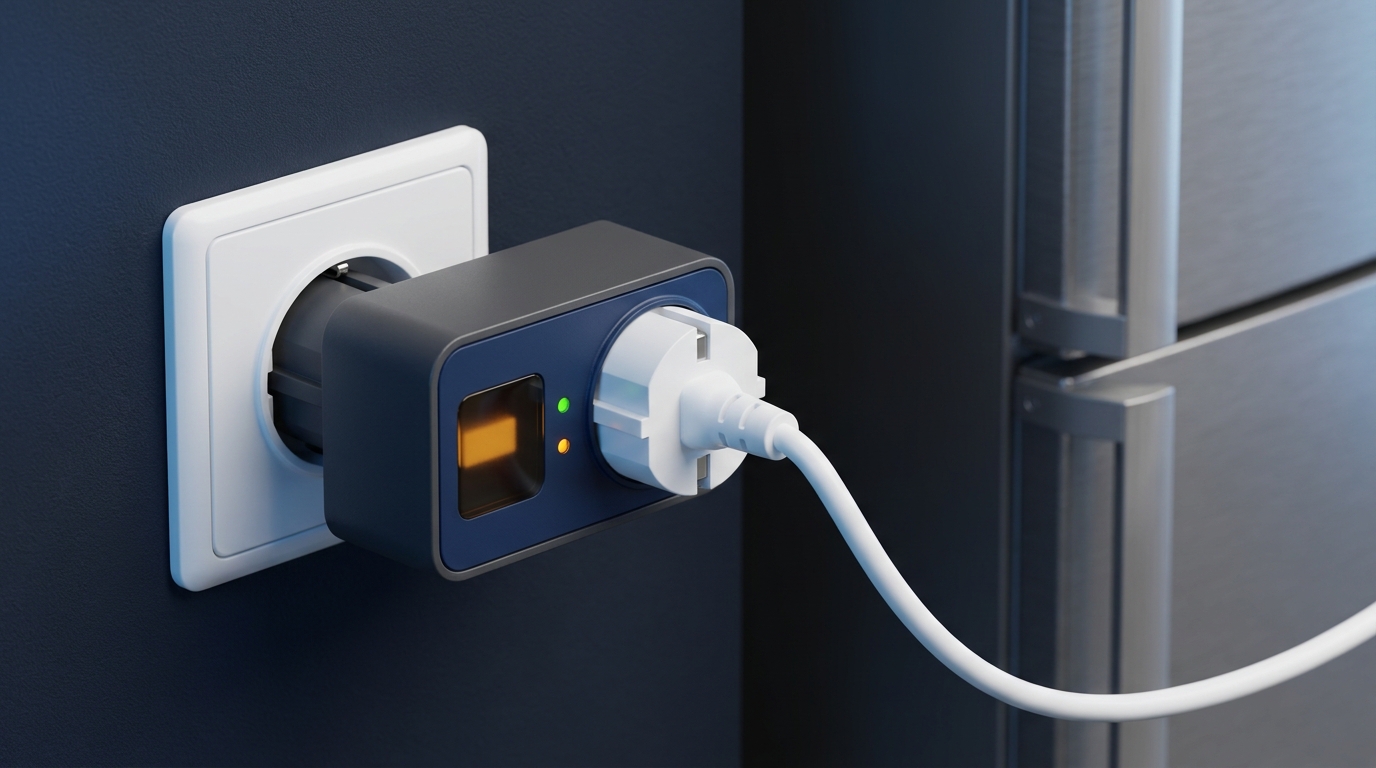
Connecting a generator with a cable into an ordinary socket, without guaranteed disconnection of the house from the grid, is prohibited: it creates backfeed into the external line. That voltage is lethal for the emergency crews of the distribution system operator (DSO), who assume the line is de-energised, and it can cause a short circuit and a fire when the grid comes back [6].
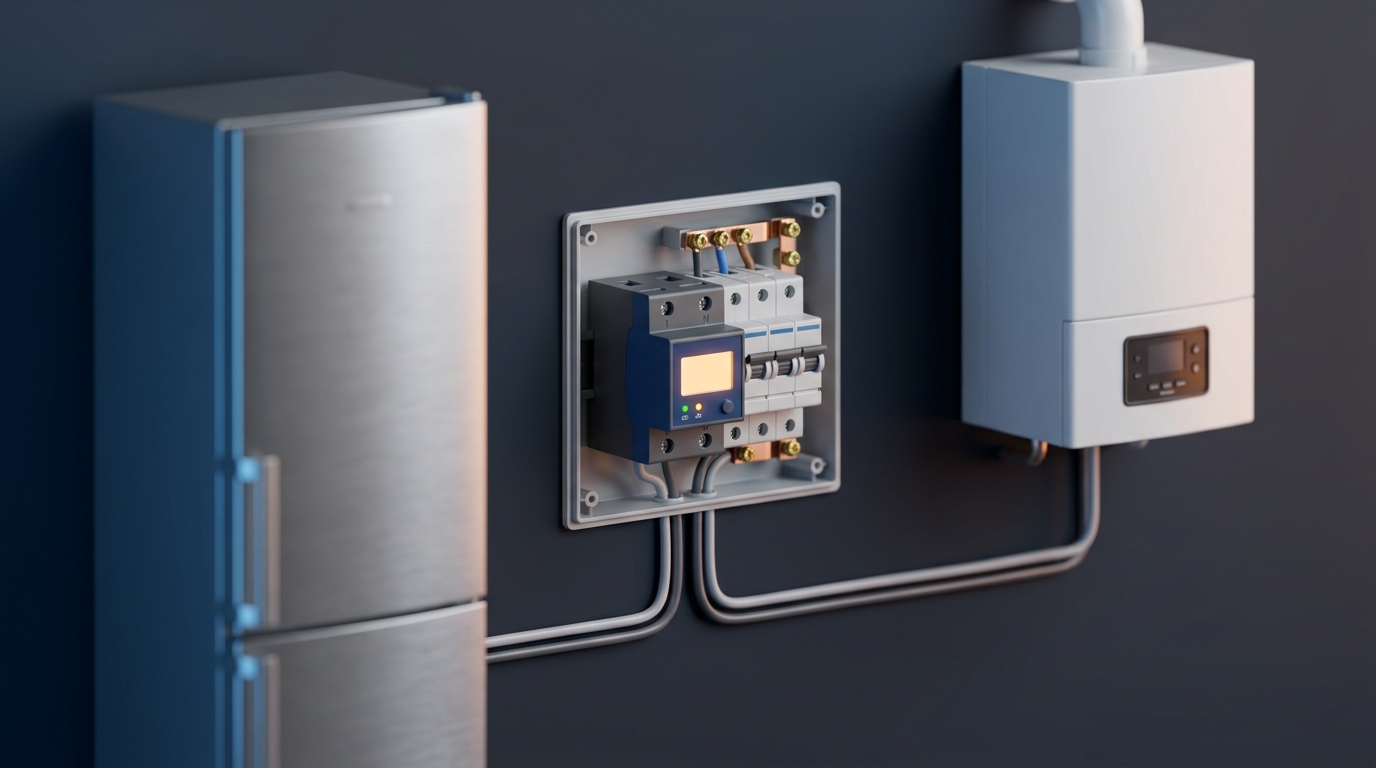
A correct backup arrangement means the generator is connected through a 1-0-2 changeover isolator or an ATS installed AFTER the meter and the main breaker. The switch reliably cuts the house off from the grid before generator voltage is fed into it. This is a requirement of the safety rules and of the Electrical Installation Code (PUE) regarding the exclusion of backfeed into the DSO network [6]. Common installation and operating mistakes are covered separately in our material on typical mistakes when operating an ATS.
How to choose a changeover switch by rated current
The rated current of a 1-0-2 switch must be equal to or higher than the rating of the main breaker; in practice one step higher is taken, with a 10-30% margin for inrush currents [2]. An undersized rating leads to overheated contacts and failure of the device.
The rough selection procedure:
- Determine the total power of the load that will be supplied from the backup source.
- Calculate the current from that power (for a single-phase supply, depending on the voltage and the power factor).
- Round up to the nearest standard rating and add a margin.
- Check it against the rating of the main breaker — the switch cannot be the "weaker" device.
| Type of property | Indicative rating | Pole configuration |
|---|---|---|
| Garage, small country house (lighting, power tools) | 40 A | 2P |
| Private house, single-phase supply | 63 A | 2P |
| Large house, three-phase supply | 63-100 A | 4P |
| Main distribution panel, industrial site | 100-630 A | 3P / 4P |
In the domestic segment 40-63 A ratings are used most often, while panel and industrial inputs call for considerably higher currents [2].
2P or 4P: how to choose the pole configuration
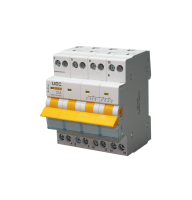
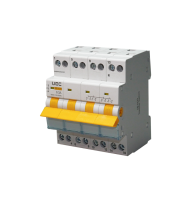
The pole configuration follows the supply arrangement: for a single-phase 230 V supply you take a double-pole (2P) switch, which switches the line conductor L and the working neutral N together; for a three-phase 400 V supply you take a four-pole (4P) device, which breaks the three lines L1/L2/L3 and the neutral N synchronously [7].
An important safety nuance: the neutral is not always broken, but if it is broken, it is done ONLY synchronously with all the lines, through a multi-pole device. This prevents a parallel link forming between the neutrals of the grid and of the generator. In a TN-C-S earthing arrangement the PEN conductor is split into PE and N ahead of the consumer, and the PEN conductor itself is not switched as a working neutral [7]. The specific earthing arrangement is always determined by the designer according to the actual conditions on site.

Where a manual 1-0-2 switch is used
A 1-0-2 changeover isolator is used wherever a human-operated manual backup input is required and where a short break in supply during the transfer is acceptable. It is the most widespread and the cheapest backup solution for private premises.
Typical scenarios:
- A private house with a generator — manual grid-to-generator transfer during outages.
- A country house, a garage, a workshop — low-power backup supply where the owner is present.
- A main distribution panel — high-current reversing switch-disconnectors acting as a manual switch between two inputs.
- Premises with rare outages — where automation is not economically justified.
For high-current panel and industrial inputs this function is performed by VR32 series switch-disconnectors made by UEC (100-630 A), specifically in the 2-way (reversing) version — that is exactly the one that works as a manual switch between two sources. An example is the reversing VR32, 100 A, "2-way" version; the full line-up and accessories are in the switches and disconnectors category. For low-current domestic scenarios (40-63 A) there is no modular 1-0-2 switch in the UEC range — there we use an automatic SB-ATS series transfer switch or contactors. A manual switch is often combined with a voltage relay, which protects the load from voltage swings of the generator.

FAQ about the 1-0-2 changeover isolator
❓ What do the digits 1-0-2 on the switch mean?
They are the three positions of the handle, not a model or a rating. 1 — supplied from the first input (the grid), 0 — off (both sources disconnected), 2 — supplied from the second input (a generator or another backup source). The move from "1" to "2" always happens through "0" [1].
❓ Can a manual 1-0-2 isolator be installed instead of an ATS?
Yes, if there is a person on site who will transfer the supply by hand and a short break is acceptable. But if you need automatic transfer within milliseconds and without any human involvement, then an ATS is exactly what you need [4]. This question is examined in detail in the article ATS — the complete guide.
❓ Which rating of changeover isolator should you choose?
No lower than the rating of the main breaker, one step higher with a 10-30% margin for inrush currents. For a garage and a small country house 40 A is typical, for a private house 63 A, and for a three-phase input 63-100 A and above [2].
❓ 2P or 4P — which pole configuration should you take?
2P is for a single-phase 230 V supply (switching the line and the neutral), 4P is for a three-phase 400 V supply (three lines and the neutral synchronously). Whether the neutral actually has to be broken is determined by the earthing arrangement of the site [7].
❓ Is it safe to switch under load?
A load transfer switch is rated for switching under current, because the transfer passes through position "0", which opens the circuit. The specific switching conditions and the sequence of operations must nevertheless be determined by a qualified electrician in accordance with the design.