
Article Contents
ATS or Manual Transfer Switch: What to Choose for Your Home


Key takeaways
There is always one device between the grid and your backup source — the transfer switch. An automatic ATS is governed by IEC 60947-6-1 and switches sources on its own within tens of milliseconds; a manual 1-0-2 changeover switch is governed by IEC 60947-3 and requires someone to move the lever.
Key point: both devices implement the break-before-make principle and physically prevent the grid from being connected to the generator. Choosing between them is not a question of quality, but of how critical your power supply is and whether anyone is at home during an outage.
Hello! This material was prepared by the UEC engineering department. We manufacture SB-ATS series automatic transfer switches and at the same time supply manual load transfer switches, so we see both sides every day — both in specifications and in our customers' real electrical panels.
In this article we do not rewrite the theory of connecting a generator; instead we answer a specific decision: when you need an automatic device, when a manual backup transfer switch is enough, and how much this costs in relative terms.

⚠ WARNING! Working with electrical equipment is life-threatening!
Connecting an ATS and a backup power supply (especially a generator input) involves the risk of backfeed and requires a qualification of at least electrical safety group III. Have the installation carried out by a licensed electrician.
What a backup transfer switch is and why the panel needs one
A backup power transfer switch (also called a source transfer switch) is a device that switches the house load between the main source (the grid) and the backup source (a generator or inverter), guaranteeing that the two sources are never connected at the same time. Without it, backup power cannot be connected safely.
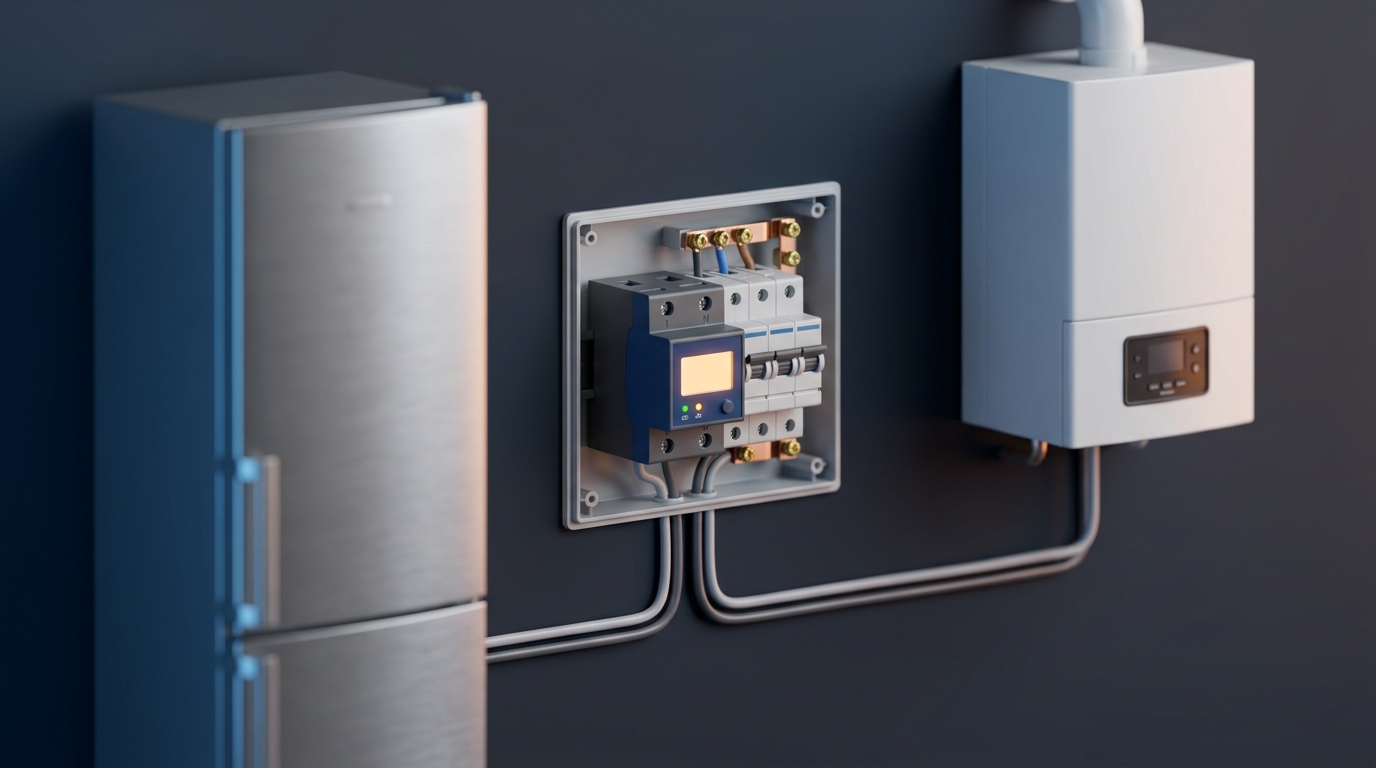
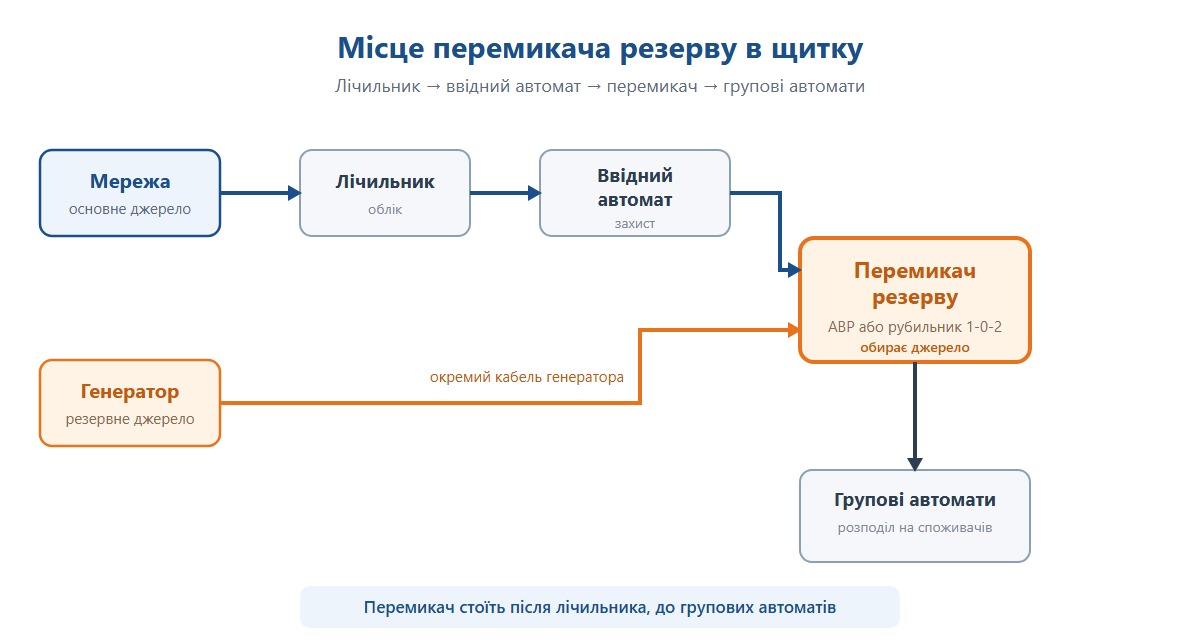
The transfer switch always sits in the panel after the electricity meter and the main circuit breaker, ahead of the group breakers: meter → main circuit breaker → transfer switch/ATS → group breakers [3]. This sequence is a requirement of the State Energy Supervision authority and of the distribution system operator. The transfer switch itself does not protect against earth leakage or short circuits — that is the job of separate devices; its only function is the safe switching of sources.
Automatic transfer of the backup supply
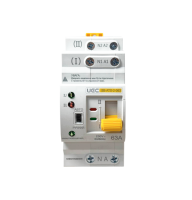
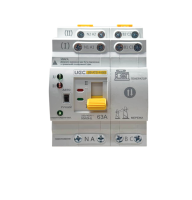
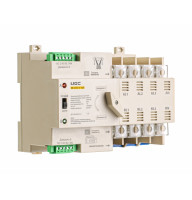
An ATS (automatic transfer switch) switches sources by itself, without a person, using contactors or a motorised drive together with a control unit.
Manual changeover switch
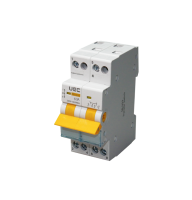
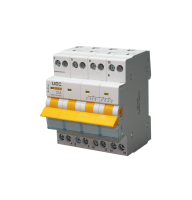
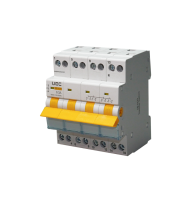
A manual changeover switch (a 1-0-2 changeover isolator) is operated by hand: position 1 — grid, 0 — everything off, 2 — generator.
There are two classes of such switches.
How an ATS differs from a manual 1-0-2 changeover switch
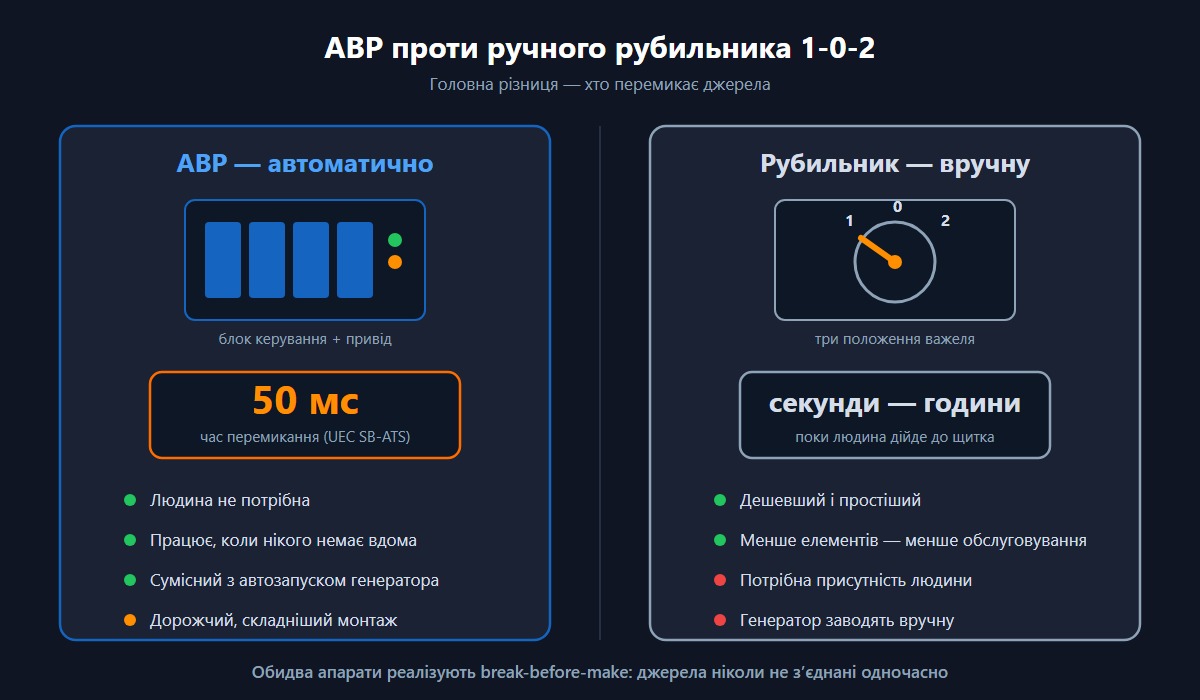
There is one main difference: an ATS switches sources automatically and without a person present, whereas a manual changeover switch requires someone to physically move the lever. Every other difference — in speed, price, complexity and use cases — follows from this.
An ATS is an active device with its own logic: it monitors the grid voltage, issues the command to start the generator (where auto-start is available), holds the stabilisation delays and returns the load to the grid once it is restored. A manual changeover switch is a passive mechanical device without any automation: reliable, inexpensive, but entirely dependent on a person. Both implement the break-before-make principle — the contacts of one source open BEFORE the contacts of the other close, so switching the grid and the generator on simultaneously is impossible [5].
What transfer time means for a home
Transfer time is the pause without voltage while the load moves from one source to the other; for a domestic ATS it is measured in tens of milliseconds. For example, the UEC SB-ATS-4-100 automatic transfer switch transfers the load in automatic mode in 50 ms [8]. For a manual changeover switch, transfer time does not exist as a technical parameter — the pause equals the time it takes a person to reach the panel and move the lever, that is, from tens of seconds to hours (if nobody is at home).
The main difference in one line:
An ATS counts the pause in milliseconds, a manual changeover switch in minutes or hours. Everything else follows from that difference.
Comparison table: ATS versus manual 1-0-2 changeover switch
Across seven practical criteria the ATS wins on speed and autonomy, while the manual changeover switch wins on price and simplicity. Everything that influences the choice for a home is summarised below.
| Criterion | ATS (automatic) | Manual 1-0-2 changeover switch |
|---|---|---|
| Transfer speed | Tens of ms (UEC SB-ATS — 50 ms) [8] | Depends on a person: seconds to hours |
| Person required | Not required, operates autonomously | Mandatory for every transfer |
| Price (relative) | Higher (automation, drive, control unit included) | Lower, simpler construction |
| Generator with electric start / auto-start | Compatible, can start the generator itself | Generator started manually only |
| Installation complexity | Higher (power section + control) | Lower (power switching only) |
| Maintenance | Periodic checks of the automation | Minimal, fewer components |
| Reliability of basic switching | High, but more components involved | High, simple contact assembly |
The overall conclusion of the table: a manual changeover switch is cheaper and simpler but requires a person on site; an ATS is more expensive, yet it switches by itself within tens of milliseconds and is needed wherever the power supply is critical or nobody is at home during an outage.
When to choose an ATS
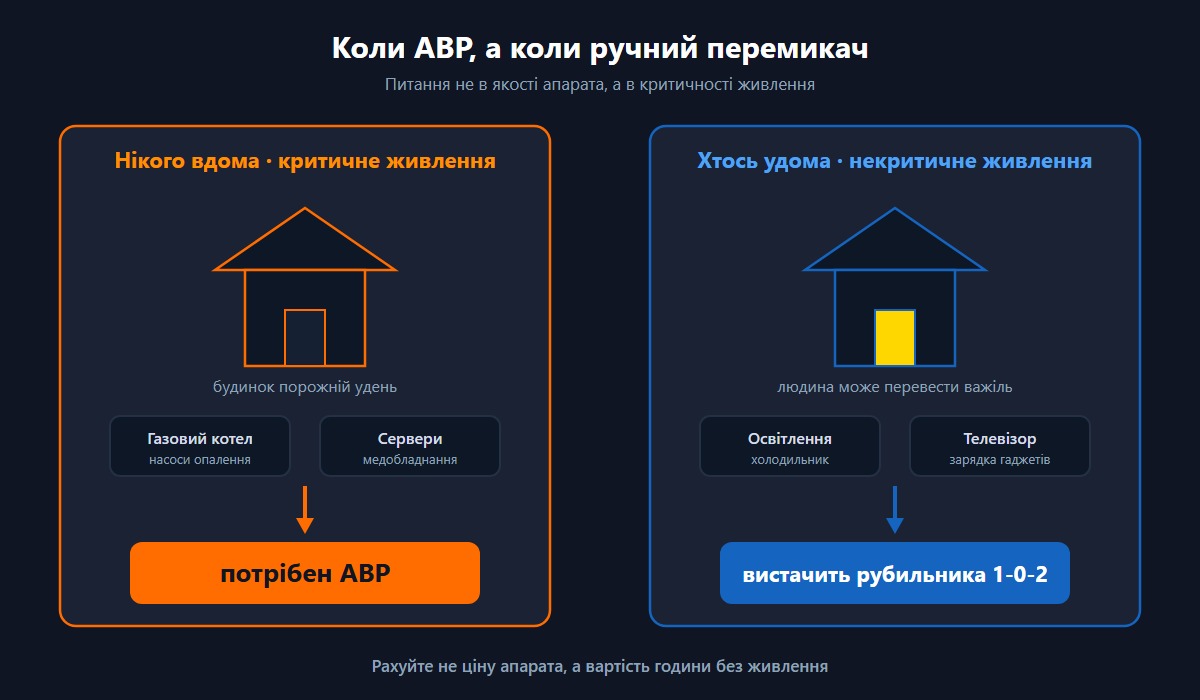
An ATS is needed where an interruption in the power supply is unacceptable, or where there is nobody to switch manually. This is the automatic scenario: the device monitors the grid itself and brings the backup source online.
Specific cases where an automatic transfer switch is justified:
- Critical loads. A gas boiler with electronics, heating circulation pumps, servers, network and medical equipment, aquariums, incubators — anything that does not forgive even a short pause without power.
- Nobody is at home during the day. If the outage happens while the family is at work or at school, a manual changeover switch is useless — the backup source will only come on in the evening. An ATS will start the generator itself.
- A generator with electric start or auto-start. The ATS integrates with the auto-start system: it monitors the voltage, issues the start command, holds the warm-up delay and returns the load to the grid once it is restored.
- Frequent and unpredictable outages. With rolling blackout schedules or during blackouts, running to the panel several times a day is inconvenient and unsafe at night.
For a three-phase supply a 4-pole ATS is typically used, for example the UEC SB-ATS-4-100 (4P, 100 A, transfer time 50 ms, DIN-rail mounting, 8 modules, IP30) [8]. For a single-phase supply a 2-pole device from the SB-ATS line is sufficient. Detailed diagrams for connecting an ATS to a generator and an inverter are covered in a separate article on the ATS wiring diagram for a generator.
When a manual changeover switch is enough
A manual 1-0-2 changeover switch is sufficient when someone is at home during the outage and can move the lever, and a pause of a few seconds or minutes is not critical. This is the cheapest and simplest solution.
A manual changeover switch is a rational choice in the following situations:
- An apartment or house where someone is present during the day. If a person is usually around, moving the switch to the "generator" position takes a few seconds.
- Non-critical loads. Lighting, a refrigerator, charging gadgets, a TV — household appliances easily survive the pause until the generator is started manually.
- A limited budget. A manual load transfer switch is substantially cheaper than an ATS and does not require a control unit.
- A generator with manual starting. If the generator is started by hand anyway (with a pull cord or a button on the unit), the automation of the transfer switch offers fewer benefits — the person is already next to the equipment.
We keep manual 1-0-2 load transfer switches (changeover isolators) in the switches and disconnectors category. The operating principle of a three-position switch and the correct choice of the 1-0-2 position are covered in detail in a separate article about the changeover switch and 1-0-2 isolator.
What an ATS and a manual changeover switch have in common
Regardless of class, both transfer switches are subject to the same safety and installation requirements: guaranteed separation of sources, the correct rating, the correct number of poles and the right position in the panel. These points do not depend on whether the device is automatic or manual.
Why switching on two sources at once is prohibited
Both an ATS and a manual 1-0-2 changeover switch physically prevent the grid from being connected to the generator — this is a basic safety requirement, not an option. The break-before-make principle and mechanical interlocking guarantee that the contacts of one source open before the contacts of the other close [5]. A separate, absolute prohibition also applies: connecting a generator with a cable into an ordinary socket is categorically forbidden — the voltage will travel "back" into the external grid (backfeed) and create a lethal hazard for emergency crews [4]. That is why a generator is only brought in through a changeover isolator or an ATS with guaranteed separation.
How to choose the rating of the transfer switch
The rated current of the transfer switch must be no lower than that of the main circuit breaker and of the calculated load, with a margin of 20-30% [7]. If the main breaker is 40 A, the transfer switch is chosen from 40 A upwards. A step-by-step current calculation based on power is given in a separate material on the operating principle and selection of an ATS.
How many poles you need
The number of poles depends on the phase configuration and the earthing arrangement, not on a "always 4P" rule. For a single-phase 230 V supply it is 2P (breaking line and neutral), for a three-phase 400 V supply it is 3P or 4P [6]. Breaking the neutral (4P) is required when the generator is a separately earthed source in a TN-C-S arrangement, in order to avoid a "parallel" neutral and backfeed; in TN-S or TT systems the solution may differ [6]. This question is best entrusted to a designer.
⚠ Important: a backup power transfer switch (an ATS or a manual changeover switch) does NOT protect against voltage surges. Over- and undervoltage are handled by a separate device — a voltage relay, which works in the panel TOGETHER with the transfer switch. How to choose and connect one is explained in our guide to the voltage relay.
Recommendation for a home, an apartment and a business
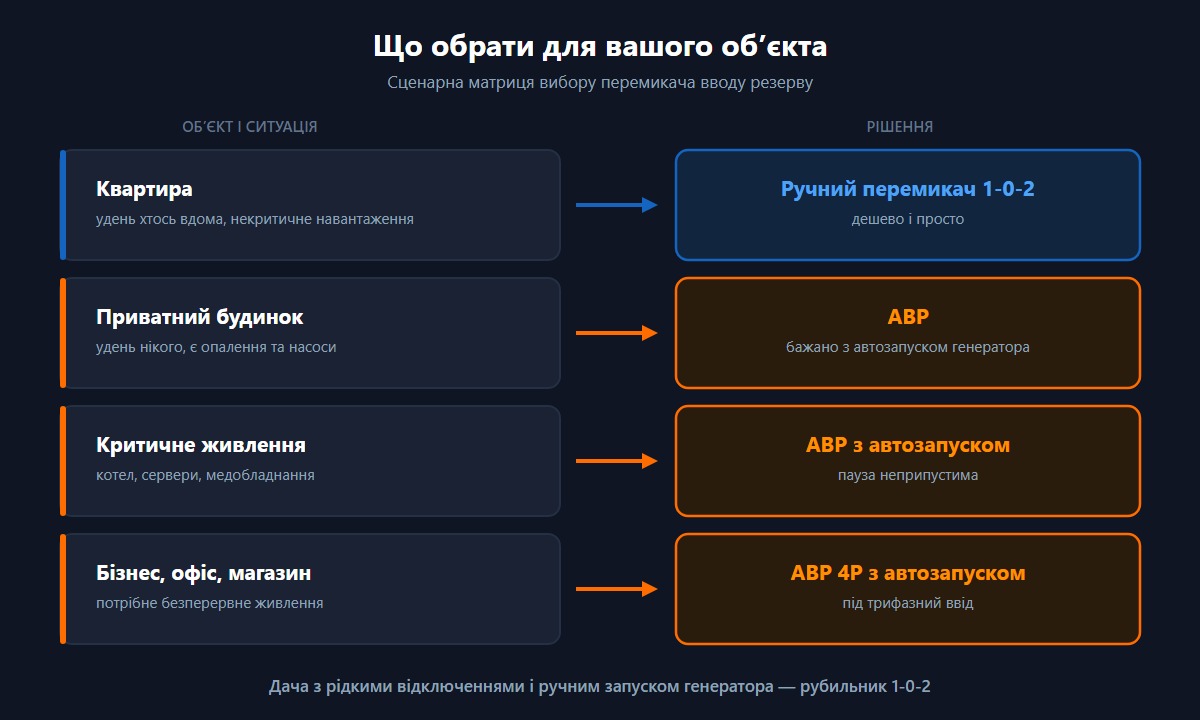
There is no universal answer — the choice depends on how critical your power supply is and whether anyone is at home during an outage. Below is our scenario-based guideline.
| Property / situation | Recommended solution |
|---|---|
| Apartment, someone at home during the day, non-critical loads | Manual 1-0-2 changeover switch (cheap, simple) |
| Private house, nobody at home during the day, heating/pumps present | ATS (automatic, preferably with generator auto-start) |
| House with critical loads (boiler, servers, medical equipment) | ATS with generator auto-start |
| Business/office/shop requiring uninterrupted power | ATS with auto-start, 4P for a three-phase supply |
| Country house, rare outages, generator started manually | Manual 1-0-2 changeover switch |
When we at UEC specify panels, we advise counting not the price of an individual device but the cost of downtime: for a cottage with heating, or for a business, one hour without power costs more than the difference between a manual changeover switch and an ATS. If, however, the home is non-critical and occupied during the day, a manual load transfer switch fully covers the task. We also compare the manual option with the automatic one from the design perspective in the article about the changeover switch and 1-0-2 isolator, while typical operating mistakes are already collected in the material on common ATS mistakes.
FAQ — ATS or manual changeover switch
❓ Which is better for a home: an ATS or a manual changeover switch?
It depends on the situation. If someone is at home during the day and the load is non-critical, a manual 1-0-2 changeover switch is enough. If the power supply is critical (heating, servers) or nobody is at home during the day, you need an ATS that will switch the sources by itself.
❓ How much more expensive is an ATS than a manual changeover switch?
An ATS is noticeably more expensive because it contains automation, a drive and a control unit, whereas a manual changeover switch is simple mechanical switching. We do not quote the exact difference in hryvnia (prices change), but by device class an automatic transfer switch always costs more.
❓ Can you manage without an ATS and switch manually?
Yes, if someone is present during the outage and the pause until manual switching is not critical. A manual 1-0-2 changeover switch is a complete and safe solution that also implements the break-before-make principle. It is unsuitable only where the power supply must be uninterrupted or where there is nobody to operate it.
❓ Is an ATS compatible with a generator with electric start?
Yes. The ATS integrates with the generator auto-start system: it monitors the grid voltage, issues the start command, holds the warm-up delay and returns the load to the grid once it is restored. A manual changeover switch has no such function — the generator is started by hand.
❓ Which rating of transfer switch should you choose?
The rating of the transfer switch must be no lower than that of the main circuit breaker and of the calculated load, with a margin of 20-30% [7]. If the main breaker is 40 A, the transfer switch is chosen from 40 A upwards. For a three-phase supply, 4P is typical.