
Article Contents
Optimal Voltage Relay Settings: Thresholds and Delay for Your Network


Key takeaways
A voltage relay protects your appliances only as far as its thresholds and delay are set correctly. Factory values are an averaged compromise, so for a specific line they should be adjusted by logic, not at random.
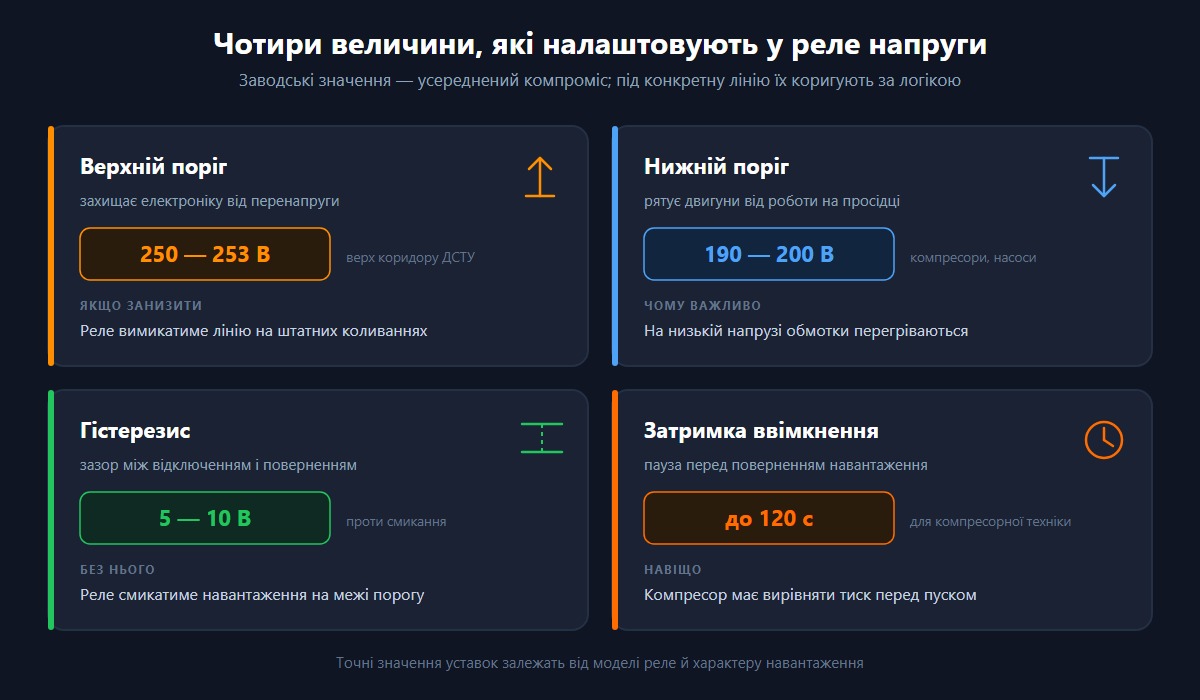
Key point: four values are tuned - the upper threshold (about 250-253 V), the lower threshold (190-200 V), hysteresis (5-10 V), and the reconnection delay (up to 120 s for compressor appliances).
Hi, I'm Oleh Lukianchuk, electrical engineer at UEC. I specialize in electrical network protection and I see every day how well-set relay thresholds save expensive appliances, while poor ones turn a protective device into a source of daily false trips.
In this article I'll explain the method for tuning the four key values - the upper and lower thresholds, hysteresis, and delay - to the real state of your network and the type of load behind the relay.

Warning! Work in an electrical panel requires a qualification of no lower than electrical safety group III.
Entrust installation and the final threshold tuning to a licensed electrician. All work in the electrical panel must be performed only with the power disconnected and the absence of voltage verified with a measuring device.
A purchased relay protects your appliances exactly as far as its voltage thresholds and reconnection delay are set competently. Factory values are an averaged compromise that accounts for neither the state of your line nor the type of load behind the device. This article is about method: how to choose the upper and lower threshold by logic rather than guesswork, how to tune hysteresis and the delay time for a fridge, air conditioner, or water heater, and how not to turn a protective device into a source of daily false trips. What a relay is, how it works, and where to put it in the panel are covered in the base voltage relay guide; here we dive specifically into the settings numbers.
| Setting | Working setpoint range | Why it matters |
|---|---|---|
| Upper trip threshold | Close to 250-253 V (ceiling of the DSTU EN 50160 norm) | Catches overvoltage from a neutral break, does not trip on light surges |
| Lower trip threshold | About 190-200 V | Protects compressor appliances from sag, does not react to short dips |
| Hysteresis (return threshold) | 5-10 V from the trip threshold | Removes the "chattering" effect at the trip boundary |
| Reconnection delay | 5-15 s (light), 120 s (compressor) | Lets the pressure in the compressor drop, removes the inrush shock |
| Load current | Up to 63-80 A directly, above that - via a contactor | Above 40 A without a contactor the relay contacts overheat |
| Measurement accuracy | True RMS, +-1-2 V | Accuracy determines whether the threshold trips in time |
What does optimal voltage relay tuning mean?
Optimal tuning is a compromise between two opposite risks: letting dangerous voltage through, and cutting power on every harmless fluctuation. A voltage relay does not correct voltage; it only opens the line when the value goes beyond the set thresholds, so all its usefulness depends on how correctly those thresholds are set for a specific network. The ideal numbers for a new urban line and for a rural feeder with sags will be different, and blindly copying someone else's values often gives either underprotection or endless trips. The electrician's task is to read the behavior of their own network and load and select four values: the upper threshold, the lower threshold, hysteresis, and the delay.
How do optimal thresholds differ from factory ones?
The manufacturer sets factory thresholds symmetrically and cautiously, targeting the average network rather than yours. This approach guarantees the device will "catch something" out of the box, but guarantees neither full protection of expensive appliances nor the absence of false trips. Optimal values build on real statistics: what range your voltage wanders through by day and by night, whether a neutral break is in the district's history, and what appliances sit behind the relay. That is exactly why a multifunction relay with adjustable thresholds, such as the UEC SB-RV range, has the advantage over devices with hard-wired values.
Which four values do you tune?
Full tuning affects the upper trip threshold, the lower trip threshold, the return threshold (hysteresis), and the reconnection delay. The upper and lower thresholds define the window of permissible voltage within which the relay keeps the line closed. Hysteresis sets how far the voltage must recover before the device gives power again, to avoid flicker at the boundary. The delay defines the pause before reconnection and is critical for compressor appliances, which need time to release pressure.
How to choose the upper voltage threshold?
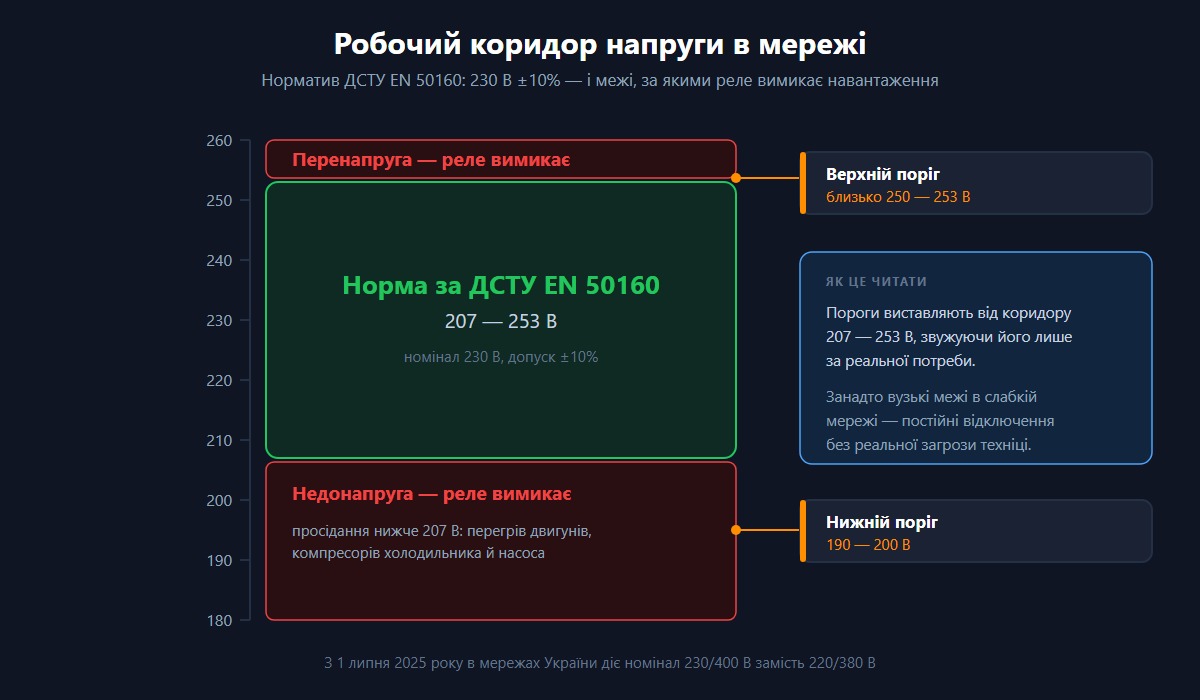
The upper threshold is the value above which the relay disconnects the line so that overvoltage does not burn out power supplies, lamps, and electronics. The DSTU EN 50160:2023 norm sets a nominal of 230 V with a +-10% tolerance, meaning the upper limit of normal voltage is 253 V. Setting the threshold below this limit makes no sense: the relay will cut power on entirely legal network fluctuations, annoying you with false trips.
A sensible reference for the upper threshold:
The 250-253 V zone: the device ignores normal daily surges but trips as soon as the voltage exceeds the rated ceiling.
Why shouldn't you set the upper threshold too low?
The temptation to "play it safe" and set 240 V turns into daily trips, because in many districts the voltage legally rises to 245-250 V in the evening. Each such trip is a power cut to the fridge, a reset of appliance settings, and an extra switching cycle of the power relay. The device's mechanical life is not limitless: the SB-RV is rated for 1,000,000 cycles, and pointless trips waste it for nothing. The upper threshold must catch an emergency (a neutral break gives an instant surge to 300-400 V), not punish the network for working normally.
How does the upper threshold save you from a neutral break?
The most dangerous overvoltage scenario is a break of the neutral conductor at a three-phase input, when the voltage on single-phase consumers can jump almost twofold. The relay reacts to the upper threshold fastest: the trip time on an excess is 0.02-0.05 s, which is enough to cut off the line before insulation breakdown and appliance burnout. For full protection against the threat of a neutral break, a two-pole relay that opens both the phase and the neutral is critical; the entire SB-RV range is made in the 2P format. That is the reason the upper threshold should not be disabled or raised "so it doesn't get in the way."
How to set the lower threshold and why you need it?
The lower threshold is the value below which the relay disconnects the line so that a voltage sag does not burn out the compressors of fridges, air conditioners, and pumps. Per the DSTU EN 50160 norm, the lower limit of normal voltage is 207 V (230 V minus 10%), but setting the threshold exactly at 207 is usually too strict for a real network. A practical reference is 190-200 V: in this zone appliances still work without winding overheating, and the relay does not trip on the short dips that occur when powerful neighboring consumers start up. The main logic of the lower threshold is to protect the motors specifically, because for them reduced voltage is more dangerous than a brief power cut.
Why does a voltage sag kill compressors?
At reduced voltage the compressor's electric motor does not reach operating speed, the current in the windings rises, and they overheat to the point of insulation burnout. Household appliances with asynchronous motors - a fridge, an air conditioner, a borehole pump - suffer from chronic sag more than from a short upward surge. The relay's trip time on the lower threshold is deliberately slower, 0.2-2 s, because a short sag lasting a fraction of a second does no harm to appliances, and there is no need to disconnect the line for it. Which device is most vulnerable and how to choose protection by appliance type is covered in detail in the article on a voltage relay for a fridge and household appliances.
When does the lower threshold signal the need for a stabilizer?
If the relay disconnects the line on the lower threshold every day and for a long time, the problem is not in the setting but in the network itself: the voltage is chronically below the norm. In this case the relay merely states the problem but does not solve it, because it cannot correct voltage by design. Constantly raising the lower threshold so it "stops disconnecting" is a harmful tactic: you are simply letting your appliances run at dangerously low voltage. The correct solution for a chronic deficit is a voltage stabilizer, and the line between these two devices is covered in the material on whether to choose a relay or a stabilizer.
What are hysteresis and return thresholds?
Hysteresis is the difference between the trip voltage and the voltage at which the relay returns power. Without hysteresis the device, having tripped at the threshold boundary, would switch back on instantly, again see the excess, and disconnect - producing "chattering" at the trip boundary with dozens of cycles per minute. That is why return thresholds are always shifted inside the safe window: after tripping on the upper threshold, the relay waits until the voltage drops 5-10 V below the limit, and only then gives power. Similarly for the lower threshold: the relay switches on not at the limiting value itself but when the voltage rises a few volts above the trip threshold.
How does hysteresis remove the chattering effect?
Imagine the upper threshold is set at 250 V and the network fluctuates right around 250. Without hysteresis, every micro-fluctuation would give a disconnect-connect cycle, killing the contact life and jerking the appliances around. A hysteresis of 5-10 V means that after tripping at 250 V the relay will close the line only when the voltage drops, for example, to 243 V - that is, returns to a stable zone. Measurement accuracy matters here too: a relay with True RMS and a +-1-2 V error correctly sees the actual effective value and does not get confused by a distorted sine wave.
Can the return threshold be adjusted separately
In simple devices hysteresis is hard-wired and not adjustable; in multifunction ones it can be changed together with the thresholds. Wider hysteresis makes operation calmer but delays the return of power after the voltage normalizes. Narrower hysteresis returns the line faster but increases the risk of flicker on an unstable network. For most household lines the optimal compromise is a medium hysteresis, which the SB-RV relay lets you set in tandem with the trip thresholds.
How to set the reconnection delay?
The reconnection delay is the pause the relay holds after the emergency disappears, before it supplies power again. Its main purpose is to protect compressor appliances: after a disconnection, the pressure in the circuit of a fridge or air conditioner must equalize, otherwise the motor starts under load and fails. The minimum permissible delay for compressor devices is 5-15 s, the standard factory value is 120 s, and some relays allow setting up to 600-900 s. The more powerful the compressor behind the relay, the longer the delay you should set, and it is precisely the adjustable pause that distinguishes a flexible device from a primitive one.
What delay to set for different loads?
For a purely resistive load (heaters, incandescent lamps, a water heater without inverter control) the delay is not critical; a minimal 5-15 s is enough here. For a fridge, freezer, air conditioner, and heat pump a full pause of about 120 s is needed so the pressure in the system equalizes. If several compressor appliances sit behind a single relay at once, it makes sense to increase the delay further, spacing their starts in time and removing the total inrush shock on the network.
| Load type behind the relay | Recommended delay | Logic |
|---|---|---|
| Resistive (heating, lighting, heating element) | 5-15 s | No inrush current, the pause is formal |
| One fridge / air conditioner | about 120 s | Time to release the pressure in the compressor |
| Several compressor appliances | 120-600 s | Spacing the starts, removing the total shock |
| Borehole / circulation pump | 120 s and more | Protecting the motor from starting under pressure |
Why is too short a delay dangerous?
The temptation to set a minimal delay for the sake of quickly restoring the light turns into wear of expensive appliances. A compressor that starts 5 seconds after a disconnection works against residual pressure, its inrush current rises, and its life falls. Old fridges with linear compressors and powerful air conditioners are especially sensitive to this. The rule is simple: if you do not know for certain that there is no compressor behind the relay, set a delay of about 120 s - this is a safe default value.
Optimal thresholds by network condition
Correct thresholds cannot be copied from a manual - they follow from the state of a specific line, so first it is worth observing the voltage for a few days. A new urban network with steady voltage lets you set thresholds closer to the edges of the norm; an old or rural line with sags requires compromises. Below are three typical scenarios the electrician starts from, adjusting the numbers to the actual behavior of the network. In all of them the thresholds always stay inside the 207-253 V range set by DSTU EN 50160, or are shifted with justification given the real load.
New urban network: a narrow window
In modern housing stock with a quality line the voltage holds steady, so the window can be narrowed for finer protection. The upper threshold is set at about 250-253 V, the lower at about 195-200 V, hysteresis medium. The delay is set by load type rather than network state, because there are almost no emergency sags here. Such a setting catches real emergencies and practically never gives false trips.
Old or overloaded network: a wider window
In old stock and on overloaded feeders the voltage wanders more, especially during evening peak hours. The upper threshold is left at 253 V, and the lower is dropped closer to 190 V so the relay does not trip on regular evening dips. It is advisable to make the hysteresis wider so the device does not flicker on an unstable sine wave. If even at such thresholds the relay disconnects the line every day, this is a direct signal of a technical problem in the line, not a reason to raise the thresholds further.
Rural line and a private house
Long rural feeders produce the deepest sags and the most frequent neutral breaks, so protection is most critical here. The upper threshold is kept at 253 V without any relaxation, because the risk of a neutral break with a sharp surge is real, and the lower one is selected experimentally in the 185-195 V zone. For a private house with a pump and a boiler, a full delay of about 120 s is mandatory and, with a powerful input, operation via a contactor. The specifics of protecting a whole house are covered in the base guide, and a three-phase input has its own method, laid out in the article on a three-phase voltage relay and phase control.
How to program the relay and avoid tuning mistakes?
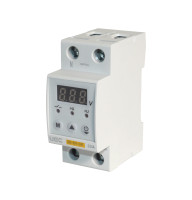
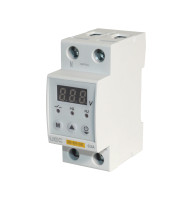
Programming a relay comes down to entering the setup mode, sequentially selecting parameters with buttons, and fixing the values on the display. In most DIN-rail devices a short press switches between parameters (upper threshold, lower threshold, delay, hysteresis), while a long press enters the edit mode of the selected value. The display shows the current voltage in operating mode and the value being edited in setup mode, so it is worth checking against it specifically rather than against the datasheet. The main rule is to change one parameter at a time and observe the result for a few days before turning the next one.
Typical threshold tuning mistakes
The most common mistake is too narrow a window, when the upper threshold is set too low and the lower one too high; the result is daily false trips on normal voltage. The second mistake is the mirror image: too wide a window (for example, the upper one under 260 V), when the relay effectively does not protect, letting dangerous overvoltage through. The third is ignoring the delay when there is a compressor behind the relay and the pause is set to minimal. The fourth is confusion in the wiring rather than the numbers: a relay connected without regard for the sequence in the panel works incorrectly even with ideal thresholds.
How are the settings and correct wiring related?
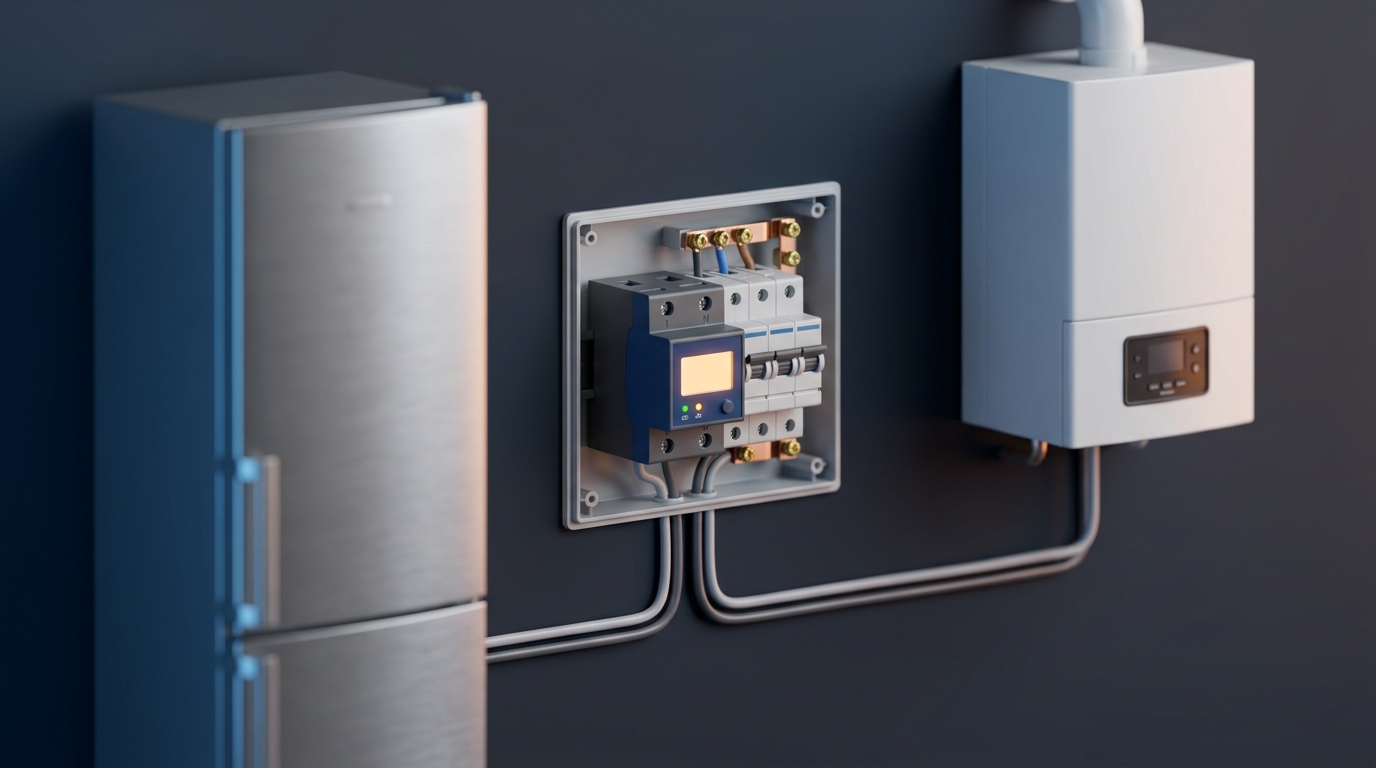
No thresholds will save you if the device sits in the panel out of place or without a contactor at high current. By the norms, a voltage relay is installed after the input circuit breaker and before the RCD or RCBO, and at a load above 40 A it controls not the line directly but the contactor coil. The full sequence of assembling the panel and five typical connection mistakes are covered in the article on the relay wiring diagram in the panel. Before fine-tuning the numbers, make sure the physical circuit is assembled correctly.
How to get the maximum result from your settings?
The maximum result comes not from a one-time entry of the numbers but from periodic adjustment to the season and the load. The network behaves differently in summer, when peak loads from air conditioners drag the voltage down, and in winter, when heaters cause the sags. Once a season it is worth checking the device's statistics (if it keeps them) or simply observing the display during peak hours and, if needed, adjusting the lower threshold or hysteresis. This approach turns the relay from "set and forget" into a live tool that really takes the state of your line into account.
Seasonal threshold adjustment
In summer, when the voltage sags more often toward evening, it can be worth slightly widening the hysteresis so the relay does not cut power on regular dips. In winter the risk of overvoltage rises when large loads are switched off, so the upper threshold is kept without any relaxation. The relay's own consumption is negligible, 2-5 W (less than 5 UAH per month), so keeping it on around the clock all year is both economical and safe. A seasonal review takes a few minutes but noticeably extends the life of your appliances.
Tuning a multifunction relay
A multifunction device with adjustable thresholds, hysteresis, and delay gives the most room for precise tuning to the network. The UEC SB-RV range covers the 32, 40, 63, and 80 A ratings in a two-pole design with a 6 kV impulse withstand voltage and a life of 1,000,000 cycles, so it is selected to match the current of a specific line. For a load above 40 A the relay works in tandem with a contactor that switches the power circuit, while the relay only controls its coil. You can choose a relay for the required current and, if needed, a matching contactor in the UEC SB-RV voltage relay catalog.
Another view: are factory settings enough?
A common argument: the factory thresholds are set by the manufacturer's engineers, so an average user had better not touch anything so as not to make it worse. There is a grain of truth in this - for a typical urban apartment with a stable network the default symmetrical values really do give acceptable protection, and unskilled interference can worsen the situation. If you are not ready to observe the voltage and do not understand the logic of thresholds, leaving the factory values and entrusting the fine-tuning to an electrician is smarter than turning knobs at random. But this is not an argument against optimization as such, only a caution about qualification.
The weak spot of this position is that the factory thresholds know nothing about your specific line and load. A relay with defaults stands equally in a new building and in a rural cottage with neutral breaks, even though the optimal thresholds for them are opposite. So the correct conclusion is not "never touch it" but "touch it consciously": take the network statistics, understand the load type, and adjust the four values to the facts. It is precisely for this that manufacturers make the thresholds adjustable.
"The worst relay setting is not too wide, but too narrow. The client gets scared of overvoltage, squeezes the window down to 240 volts, and then spends a month with a fridge that switches off every evening. Thresholds must catch an emergency, not punish the network for working normally."
— Oleh Lukianchuk, electrical engineer at UEC
Verified facts that save your appliances
A few practical truths that save appliances and nerves, gathered from norms and the real characteristics of devices. These facts are not always obvious from the manual, but they follow directly from the physics of relay operation and the requirements of the standards. Keep them in mind when you set the thresholds and the delay. Each of them has a concrete justification and is not a marketing slogan.
- The upper limit of the DSTU EN 50160:2023 norm is exactly 253 V, so setting the upper threshold below this value means deliberately provoking false trips.
- The trip time on the upper threshold (0.02-0.05 s) is deliberately faster than on the lower one (0.2-2 s), because overvoltage kills instantly, while a short sag does not.
- The 120 s delay is not a whim but a physical requirement of the compressor: with a shorter pause the pressure in the circuit does not have time to drop, and the motor starts under load.
- Since 01.07.2025 Ukraine has officially switched to the 230/400 V standard instead of 220/380 V, so all thresholds are counted from the 230 V nominal rather than from the old 220 V.
- Installing a voltage relay before the meter is prohibited by the wiring rules (PUE), so any tuning starts from the correct placement of the device in the panel, not from the numbers.
"Thresholds are set not from the datasheet but from the network. I always ask the client to let the device run on defaults for a week and see what window the voltage actually wanders through. Only after that do we narrow the window to the fact - and then the relay works for years without a single unnecessary trip."
— Oleh Lukianchuk, electrical engineer at UEC
Frequently asked questions (FAQ)
❓ What voltage thresholds should I set on the relay by default?
For a typical network a safe start is an upper threshold of about 250-253 V (the ceiling of the DSTU EN 50160 norm) and a lower one of about 190-200 V. These values catch real emergencies, in particular the surge from a neutral break, and do not cut power on normal daily fluctuations. Then the thresholds are adjusted to the real behavior of your line after observing the display for a few days.
❓ Why does the voltage relay cut the light every day?
The most common cause is too narrow a window: the upper threshold is set too low or the lower one too high, so the relay reacts to normal voltage as if it were an emergency. Widen the window within the norm (upper to 253 V, lower to 190 V) and increase the hysteresis. If the trips continue even with wide thresholds, the problem is in the network itself, and here a stabilizer is needed, not further raising of the thresholds.
❓ What reconnection delay should I set for a fridge?
For a fridge, an air conditioner, and other compressor appliances, set a pause of about 120 s. In this time the pressure in the compressor equalizes, and the motor starts without overload. A minimal 5-15 s is permissible only for a resistive load without compressors; for appliances with a motor it shortens their life.
❓ What is hysteresis in a voltage relay and why tune it?
Hysteresis is the difference between the trip voltage and the power-return voltage. It keeps the relay from flickering at the threshold boundary: after tripping, the device waits until the voltage moves 5-10 V into the safe zone, and only then switches the line on. Wider hysteresis makes operation calmer on an unstable network, narrower returns power faster.
❓ Can I set the upper threshold above 253 V for reliability?
You shouldn't: 253 V is the upper limit of the norm, and everything above it is already potentially harmful to appliances. By raising the threshold to 260 V, you effectively leave the line without protection against moderate overvoltage. The upper threshold must cut off anything beyond the rated ceiling, not let it through for the sake of rarer trips.
❓ Do I need to change the relay settings by season?
Yes, a short seasonal review is useful. In summer air conditioners drag the voltage down toward evening, so wider hysteresis is sometimes advisable; in winter the risk of overvoltage rises when large loads are switched off, and the upper threshold is kept strict. The review takes a few minutes at the panel and extends the life of your appliances.