
Article Contents
Three-Phase Voltage Relay and Phase Control Relay (380 V): Protecting a Three-Phase Network


Key takeaways
A 230/400 V three-phase supply creates faults that do not exist in a single-phase network: phase loss, voltage imbalance and a broken phase sequence. An ordinary voltage relay only sees the U level on its own phase, so three-phase equipment is protected by phase control relays that watch all three phases and the neutral at once.
Key point: for motors, pumps and industrial lines, coordinated phase control paired with a contactor is a mandatory protection link, because imbalance burns a winding even when the voltage is formally normal.
A 230/400 V three-phase input creates a class of faults that physically cannot occur in a single-phase network: loss of one phase, voltage imbalance between phases, a broken phase sequence. An ordinary voltage relay only sees the voltage level on its own phase, so full protection of three-phase equipment relies on a phase control relay - a device that watches all three phases at once as well as the state of the neutral. This article deals specifically with the three-phase aspect: which faults phase control catches, when a three-phase voltage relay beats three separate single-phase ones, and how to build a protection funnel for motors, pumps and industrial facilities.
The basic concepts (what a voltage relay is, the measurement principle, classification, the order within the panel) are covered in detail in the complete voltage relay guide - here we only mention them and go deeper into the three-phase context.
Hi, I am Oleh Lukianchuk, electrical engineer at UEC. I specialise in electrical network protection, particularly three-phase: phase control relays, coordination with contactors, and assembling panels for motors and pumps.
In this article I cover the three-phase specifics - which faults phase control catches, when a three-phase relay beats three separate single-phase ones, and how to build a working protection funnel for a private house and an industrial site.

Warning! Work in an electrical panel requires a qualification of at least electrical safety group III.
Entrust the installation to a licensed electrician. All work in the electrical panel is performed with the power switched off; before starting work, be sure to de-energize the line and verify the absence of voltage with a measuring device.
What is a phase control relay and how does it differ from a voltage relay?
A phase control relay is a three-phase network protection device that tracks not only the voltage level but also the mutual relationships of the three phases: their presence, symmetry and sequence order. A voltage relay only reacts to the U level exceeding the upper or lower threshold on one phase, whereas phase control additionally catches phase loss, imbalance and wrong sequence. This is a fundamental difference in the object of measurement: one watches a magnitude, the other watches the structure of the three-phase system. For a three-phase motor it is precisely the phase structure that determines whether the winding will burn out.
After Ukraine's transition from 01.07.2025 to the 230/400 V standard instead of 220/380 V, the nominal phase voltage is 230 V and the line voltage is 400 V. Under DSTU EN 50160:2023 the permissible phase-voltage range is 230 V plus or minus 10 percent, that is from 207 to 253 V. The phase control relay evaluates each phase relative to the neutral and the phases against each other, and any sustained excursion beyond these limits is treated as a fault. The logic of setting the thresholds themselves is the same as in the single-phase case and is moved to a separate article on the optimal voltage relay settings.
| Parameter | Voltage relay (1-phase) | Phase control relay (3-phase) | Why it matters |
|---|---|---|---|
| Object of control | U level on one phase | Three phases + neutral | Three-phase faults are not reducible to a level |
| Phase loss | Not detected | Detected | A motor on two phases overheats |
| Phase imbalance (asymmetry) | Not detected | Detected | Phase inequality burns windings |
| Phase sequence | Not controlled | Controlled | The motor rotates the other way |
| Neutral loss | Partially (2P) | Detected | Voltage surge on the phases |
| Typical site | Apartment, socket | Motors, pumps, workshop | B2B and a private house |
Which three-phase network faults does a phase control relay catch?
A three-phase network has five typical fault scenarios, and each of them is potentially destructive for equipment with an electric motor. A phase control relay recognises phase loss, phase imbalance (asymmetry), wrong phase sequence, phase sticking and neutral loss. These events are not reducible to a simple "voltage high or low", so a single-phase voltage relay misses them. Let us examine each mechanism separately.
Phase loss and phase sticking
Loss of one phase means that a motor rated for three phases keeps running on two - because of this the current in the working windings rises, the insulation overheats, and the motor fails within minutes. When the voltage on one of the phases disappears, the phase control relay instantly removes the command from the contactor coil and stops the motor. Phase sticking is a fault connection of two phases to each other, which also distorts the supply. The phase control device registers both scenarios as a violation of the normal three-phase picture and opens the power circuit before consequences appear.
Phase imbalance and asymmetry
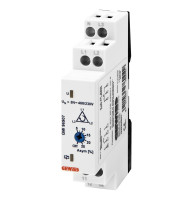
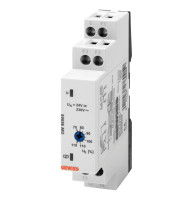
Phase imbalance is a situation where the voltages on the three phases differ significantly from each other, for example due to uneven load on the line or a fault at the substation. For a three-phase motor, asymmetry of even a few percent means uneven heating of the windings and a shorter service life. The GEWISS phase control relay in the version with phase control relay plus a three-position switch tracks phase asymmetry, over- and under-voltage and performs automatic disconnection for motors, pumps and compressors. The three-phase low-voltage relay GW96909 controls under-voltage with an adjustable threshold of 160-240 V on the phase-neutral line, which gives flexible tuning of the lower limit. It is important to understand: the GW96909 controls specifically the minimum voltage, not the full set of phase faults, whereas a dedicated phase control relay covers the entire list.
Phase sequence and neutral
The phase sequence order sets the direction of rotation of a three-phase motor. If after repair or rewiring the phases are swapped, a pump will start pumping backwards and a conveyor will move the wrong way - the phase control relay GW96907 controls the phase sequence and blocks startup on a wrong sequence. The same device watches for loss of the neutral or of one of the phases, which is critical for the stability of the phase voltages. Loss of the neutral in a three-phase system with an unbalanced load causes a redistribution of voltages: on some phases they can surge to dangerous values. That is exactly why the phase control unit is regarded as a mandatory link in protecting a three-phase input, alongside the incoming circuit breaker, which handles current overloads and short circuits.
One three-phase voltage relay or three separate single-phase ones: which to choose?
A three-phase input can be protected in two ways: with one three-phase voltage relay (or phase control relay) or with three separate single-phase relays, one per phase. The choice is determined by the type of load and the need to control the relationship between the phases. For single-phase consumers evenly spread across the three phases, three independent relays are suitable. For three-phase equipment with a motor, the correct solution is a device that sees the phases together.
Three separate single-phase relays
Three separate single-phase relays provide per-segment selectivity: a fault on one phase disconnects only its branch, while the rest of the apartment or house keeps being supplied. This is convenient when independent single-phase circuits sit on each phase - lighting, sockets, individual appliances. However, three single-phase relays fundamentally do not see the phase sequence and do not coordinate the disconnection of a three-phase motor: each of them makes its decision in isolation. So for a pump or a machine tool such a scheme does not provide protection against imbalance and wrong sequence. Detailed wiring diagrams of both options, including the three-phase section, are covered in the article on the voltage relay wiring diagram in the panel.
One three-phase relay
A three-phase voltage relay or a phase control relay, on the contrary, makes a single decision for the whole system: if a phase disappears or the sequence is broken, power is removed from the entire three-phase consumer at once. This is a loss of per-segment flexibility, but a gain in motor safety. The GEWISS solutions are made compactly: DIN-rail mounting, width 1 module 18 mm, contact 1CO, rated impulse withstand voltage 4 kV, protection degree IP20, operating range from minus 25 to plus 55 degrees, mechanical life 20 million cycles. For a B2B site, where equipment downtime is expensive, a single coordinated protection is justified.
Who needs three-phase phase protection?
A phase control relay is needed where there is a three-phase load with an electric motor or equipment sensitive to phase quality. These are primarily pumps, compressors, ventilation units, machine tools, conveyors and industrial lines. For such consumers a phase loss or imbalance means not just a disconnection but physical damage to an expensive unit. A private house with a three-phase input also falls into this category if it has a borehole pump, a heat pump or a three-phase boiler.
Borehole and circulation pumps are a typical example: their motor overheats within minutes on a phase loss, while a wrong phase sequence forces the pump to rotate backwards with a loss of performance. Compressor equipment (refrigeration units, air conditioners, heat pumps) additionally requires a restart delay so that the pressure in the circuit can equalise before restarting. Industrial sites with grouped three-phase equipment get an additional diagnostic benefit from a phase control relay: the device signals the reason for the disconnection, which speeds up fault finding. In service panels, the convenient version is a phase control relay with a three-position I-0-II switch, which allows manually switching the supply between the main network and a reserve with a current of up to 16 A within 1 module.
Secrets of three-phase protection: verified facts
Four engineering details that are not always obvious when choosing three-phase protection but directly affect motor safety and the quality of the supply at the input.
- Loss of the neutral in a three-phase system is more dangerous than a phase loss: with an unbalanced load, the voltage on some phases surges above 253 V (the upper limit under DSTU EN 50160:2023), and single-phase appliances on the "overloaded" phase fail. The phase control relay GW96907 watches for neutral loss separately.
- The disconnection time at the upper voltage threshold is measured in hundredths of a second (0.02-0.05 s), so the relay manages to react to an emergency surge before it can damage the insulation of the windings.
- The adjustable under-voltage threshold of 160-240 V in the three-phase relay GW96909 allows setting the lower limit for specific equipment rather than relying on the factory value (provenance: GW96909 product page).
- A phase control relay does not correct the voltage - it only disconnects the load. With chronically low or asymmetric mains voltage the protection will work by constant disconnection, and the issue is solved by a stabiliser, not a relay (a comparison is in the article on choosing between a relay and a stabiliser).
How three-phase protection works: control and disconnection logic
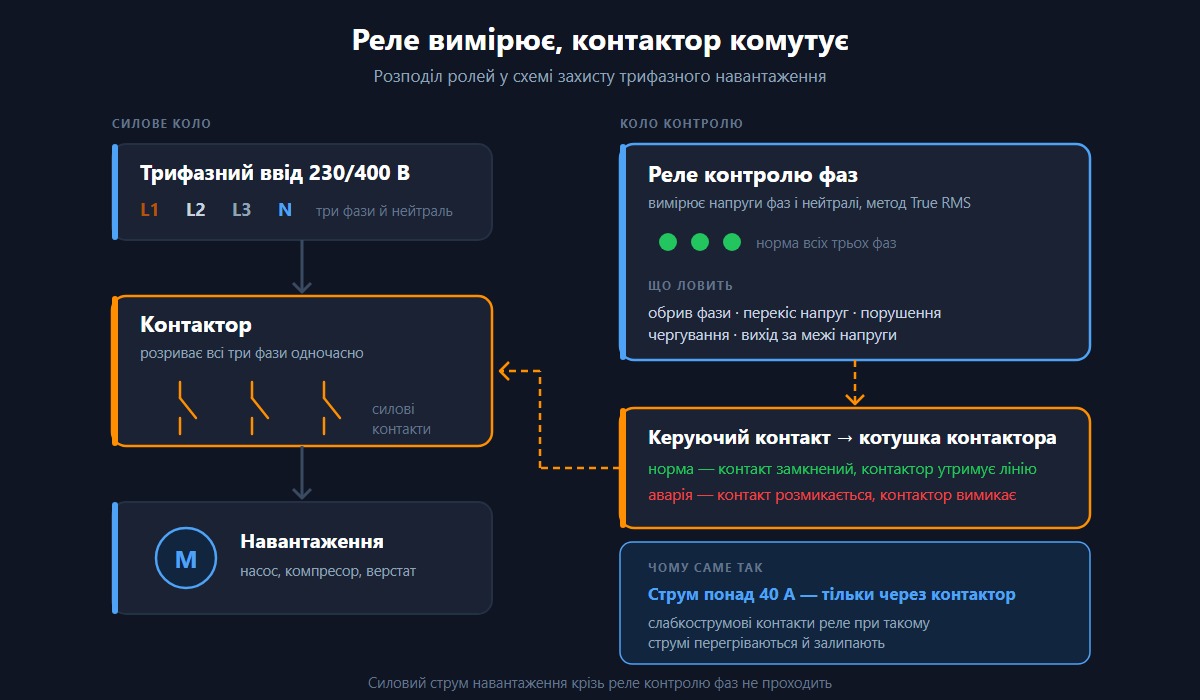
A phase control relay continuously measures the voltage on each of the three phases relative to the neutral and between the phases, compares the obtained values with the permissible limits and analyses their mutual relationship. The measurement is performed by the True RMS method for a correct estimate of the real effective voltage value. In the normal state of all three phases the relay keeps its control contact closed, through which power is supplied to the contactor coil. As soon as a fault is registered - loss, imbalance, wrong sequence or neutral loss - the relay opens the contact and removes power from the coil.
The key difference from the single-phase case is that the decision is made not by a single magnitude but by the state of the whole three-phase system. The device simultaneously checks several conditions: whether all three phases are present, whether none has exceeded the voltage limits, whether their sequence order is correct, whether the neutral is normal. A violation of any single condition is enough to trip the protection.
Restart delay:
After the normal mode is restored, the relay holds a restart delay - for compressor consumers it is a minimum of 5-15 seconds, typically about 120 seconds, and in some models up to 600-900 seconds. This pause protects the motor and compressor from starting under pressure immediately after power returns.
Since the relay's own contacts are rated for a control current, not a power current, they do not switch a powerful three-phase load directly. The relay only issues a signal, while the physical switching on and off of the power circuit is done by a contactor. It is exactly this division of roles that makes the scheme reliable: the low-current unit makes the decision, the power unit executes it.
A contactor for a three-phase load: when does the relay not switch directly?
A contactor is mandatory when the current of a three-phase load exceeds 40 A: the relay's low-current contacts overheat, spark and stick at such a current, so the power switching is handed over to a separate device. The phase control relay sends a signal to the contactor coil, and the contactor switches the three-phase circuit on and off with its power contacts. This pair of relay plus contactor is the standard for motors, pumps and industrial equipment.
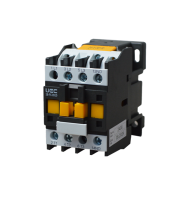
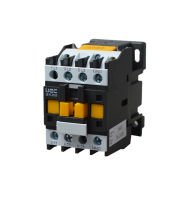
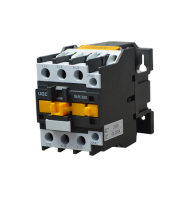
For a three-phase load, three-pole contactors are used predominantly, rated for switching motors in the AC-3 class. The UEC line includes modular contactors of the SB-РС series for mounting on a 35 mm DIN rail, contactors in an IP54 enclosure of the SB-СMS series for installation outside the panel, and reversing SB-РCR ones for schemes with a change of rotation direction. The rating range covers values from 9 to 630 A, including 25, 32, 40, 50, 65 and 80 A, which allows selecting a device for a specific motor power. The coils are produced for different control voltages - 24, 36, 110, 220, 380, 400 V AC and in a DC version - so the coil is matched to the voltage the relay outputs. Ready-made modular UEC contactors are convenient to order in the UEC contactors section, and the full range of power switching is collected in the general contactors category.
A reference for selecting the rating by power: 16 A corresponds to about 3.5 kW, 25 A - 5.5 kW, 32 A - 7 kW, 40 A - 8.8 kW, 63 A - 13-14 kW. These values help to match the rated power of a three-phase motor with the rating of the contactor and the incoming circuit breaker.
| Rating | Approximate power | Contactor needed | Application class |
|---|---|---|---|
| 16 A | 3.5 kW | No (relay directly) | Light load |
| 25 A | 5.5 kW | No | Domestic |
| 32 A | 7 kW | Borderline | Medium-power pump |
| 40 A | 8.8 kW | Yes, from 40 A | Motor |
| 63 A | 13-14 kW | Yes | Industrial motor |
How to get the maximum result from three-phase protection?
The maximum effect comes not from a single device but from a correctly built protection funnel: the incoming circuit breaker, the phase control relay, a contactor for power switching and group protective devices lower in the scheme. The phase control relay must match the task - for the full set of phase faults a dedicated device is chosen, not just a minimum-voltage relay. The contactor is selected by the load current and its coil voltage is matched to the relay's control signal. The thresholds and delays are set for the specific equipment, rather than leaving the factory defaults blindly.
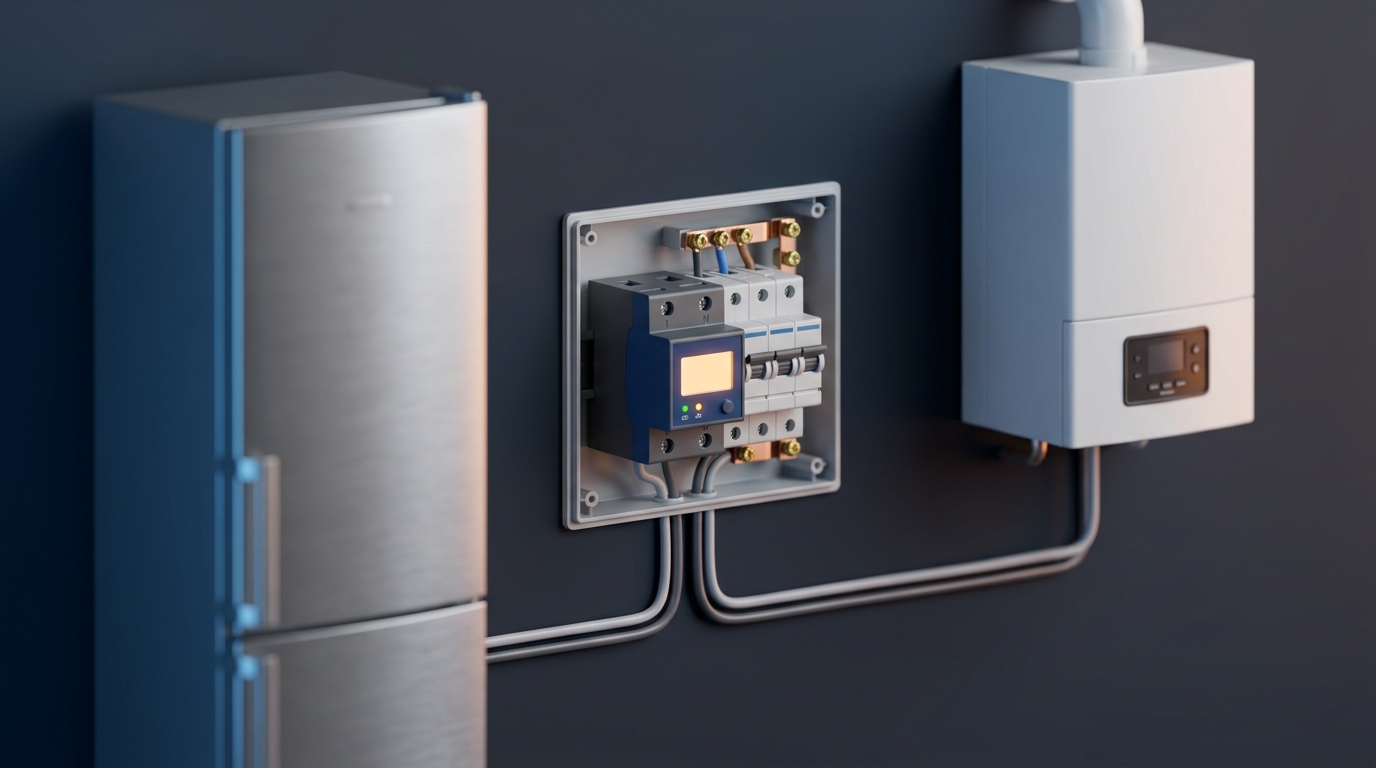
The correct installation order in the panel looks like this: the meter, then the incoming circuit breaker, then the voltage or phase control relay, after it the contactor, then the RCD or RCBO and the group breakers.
Installing any relay before the meter is prohibited by the Ukrainian Electrical Installation Code (ПУЕ, 2021 edition), and the neutral protection unit and marking themselves are regulated by section 1.7. For three-phase motors, the phase sequence is controlled separately at the first startup - after a repair or rewiring the phase order is checked without fail. Setting the lower and upper thresholds and the restart delay is moved to a separate article on the relay settings, so as not to duplicate the methodology here.
It is worth remembering the limit of the relay's competence. A phase control relay protects against phase faults and voltage excursions beyond the limits, but it does not suppress microsecond pulses from lightning or switching - for that a separate surge protective device to DSTU EN 61643-11:2015 is used. Likewise the relay does not correct the voltage level: with a chronically low mains it will only disconnect, and the issue is solved by a stabiliser. A comprehensive approach means that each class of threats is covered by its own device, not by a single universal one.
Another opinion: an ordinary voltage relay is enough for a three-phase input
A common argument goes like this: if you put a simple voltage relay on each phase, it will switch off the branch during a fault, and no separate phase control relay is needed. There is a grain of truth in this - for purely single-phase consumers spread across three phases without any three-phase motor, three independent voltage relays really do close the task of controlling the U level on each phase. If the house has neither a pump, nor a three-phase boiler, nor a machine tool, paying extra for dedicated phase control may be unjustified.
However, as soon as at least one three-phase motor appears at the input, this logic breaks down. Three separate voltage relays do not see the phase sequence, do not coordinate the motor's disconnection and do not react to imbalance while the voltage is formally within limits. A motor can burn out from asymmetry at an absolutely normal voltage level on each phase - and none of the three relays will stop this. So the balanced answer is this: for a purely single-phase distribution the opponent is right, and for any three-phase equipment with rotation, coordinated phase control is exactly what is needed. Choosing the unit for a specific task is easier after getting acquainted with the product items of the GEWISS phase control relay and the GEWISS three-phase low-voltage relay.
«The most expensive mistake on a three-phase input is saving on phase control where a motor stands. The loss of one phase at a formally normal voltage on the other two will burn the winding faster than the owner manages to notice the problem. An ordinary voltage relay will not see this - it was not created for that.»
- Oleh Lukianchuk, electrical engineer at UEC
How to build a working three-phase protection scheme for a specific site?
The order of actions is simple and the same for a house and a workshop: first determine the nature of the load, then select the relay, after it the contactor, and only then finalise the panel scheme. If there is a three-phase motor, the base unit becomes a phase control relay; if the task is limited to controlling under-voltage - a three-phase low-voltage relay with an adjustable threshold is suitable. Then the load current is calculated and the contactor question is resolved.
For a site with a motor, the selection logic looks like this. The phase control relay GW96907 covers the phase sequence, asymmetry and loss of neutral or phase - this is the main motor protection. In service and redundant panels, a version with a three-position I-0-II switch is appropriate, which adds manual mains-reserve switching with a current of up to 16 A to the protective functions. If only minimum-voltage control on the three-phase input is needed, without the full set of phase faults, the GW96909 with an adjustable threshold of 160-240 V is chosen. Single-phase branches inside a three-phase input are supplemented if necessary with a separate single-phase low-voltage relay GW96908 powered from 24 V AC/DC or 230 V AC. Then the contactor of the required rating is selected by the load current and the coil voltage is matched. The scheme is completed by the standard sequence of protective devices in the panel, shown in detail in the material on wiring diagrams.
For a domestic alternative in terms of power switching and basic protection, UEC contactors rated from 9 to 630 A with a manufacturer's warranty are available, and the unit controlling the voltage level on individual phases can be closed with two-pole UEC voltage relays of the SB-RV series (models for 32, 40, 63 and 80 A with two-pole disconnection of phase and neutral). The choice of the specific combination depends on the budget and the requirements for the depth of phase control.
«The rule that saves equipment: the relay makes the decision, the contactor does the power work. At a load above 40 A, never run a three-phase motor directly through the relay contacts - they are not for power current. A pair of relay plus contactor serves for years, a direct connection sticks within months.»
- Oleh Lukianchuk, electrical engineer at UEC
Frequently asked questions (FAQ)
❓ How does a phase control relay differ from a three-phase voltage relay?
A three-phase voltage relay mainly watches the voltage level on the phases and disconnects the load when it exceeds the upper or lower threshold. A phase control relay additionally controls the structure of the three-phase system: the presence of all phases, their symmetry, sequence order and neutral state. For a three-phase motor, phase control is exactly what is needed, because it catches faults invisible by voltage level - for example, asymmetry at a normal U value on each phase.
❓ Will a phase control relay protect a pump against phase loss?
Yes, this is one of its key functions. When the voltage on one of the three phases disappears, the relay removes the command from the contactor coil and stops the pump, preventing the motor from running on two phases with overheating windings. The phase control relay GW96907 also controls the wrong phase sequence, so the pump will not start backwards after rewiring.
❓ Is a contactor needed for a three-phase connection?
A contactor is needed when the load current exceeds 40 A, because the relay's contacts are not rated for power switching of a powerful three-phase motor and, when connected directly, overheat and stick. The relay sends a control signal, and the contactor switches the power circuit. For motors, three-pole AC-3 class contactors are used, for example from the UEC line of the SB-РС, SB-СMS series or the reversing SB-РCR ones.
❓ What happens on neutral loss in a three-phase network?
On neutral loss and an unbalanced load, the voltage is redistributed between the phases: on some phases it surges above the upper limit of 253 V per DSTU EN 50160:2023, and single-phase appliances on those phases are damaged. The phase control relay GW96907 watches for neutral loss separately and disconnects the load before consequences appear. This is one of the reasons why a three-phase input requires phase control specifically, not only voltage-level control.
❓ Will three separate single-phase relays replace one phase control relay?
For purely single-phase consumers on three phases, three separate voltage relays work, providing per-segment disconnection. For three-phase equipment with a motor they are not suitable: they do not see the phase sequence, do not coordinate the disconnection and miss imbalance at a formally normal voltage. So when a three-phase motor is present, a coordinated phase control relay is needed.
❓ Does a phase control relay correct low mains voltage?
No, the relay only disconnects the load when the parameters go beyond the limits, but it does not raise or stabilise the voltage level. With chronically low voltage the protection will work with constant disconnections, and the task of levelling the voltage is solved by a stabiliser. The relay's own consumption is negligible - about 2-5 W, that is less than 5 UAH per month.