
Article Contents
RCD (Residual Current Device) — Full Guide: How to Choose, Connect, and Avoid Mistakes


Key takeaways
According to the State Emergency Service of Ukraine, over 30% of fires in Ukraine are caused by electrical wiring faults. A residual current device — RCD (in everyday practice the abbreviation "UZO" is often used) — is the only apparatus in a panel that detects current leakage to an enclosure or a person's body and instantly breaks the circuit. Without it, a circuit breaker simply "does not see" the leakage: the line's rated current is not exceeded, yet the danger is already real.
At UEC we assemble distribution panels for residential complexes, industrial facilities, and infrastructure projects across Ukraine every day. In this guide we have gathered our engineering experience: from the operating principle to concrete selection tables — so you can choose an RCD correctly the first time.
Hello! This material was prepared by the UEC engineering department — a manufacturer and supplier of electrical equipment. Every day we assemble distribution panels for residential, commercial, and industrial facilities, so we know the topic of leakage-current protection not from theory but from installation practice.
In this article we will walk through, step by step, what an RCD is and how it works, what types exist, how to choose a device by rating and sensitivity, how to connect it in a panel, and which mistakes to avoid.

⚠ Warning: Work on an electrical panel requires an electrical-safety qualification of no lower than Group III. Entrust the installation to a licensed electrician.
All work in the electrical panel must be performed only by qualified electricians with the power disconnected. Before starting work, be sure to de-energize the line and verify the absence of voltage with a measuring device.
What an RCD is and why you need it
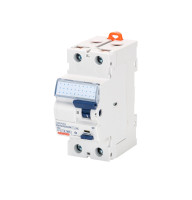
An RCD (also known as a differential relay or diff-relay) is a switching apparatus that monitors the difference (differential) between the current that went into the load along the phase conductor and the current that returned along the neutral. If part of the current has "leaked away" — through damaged insulation, moisture, or a person touching a bare conductor — the RCD breaks the circuit within a fraction of a second.
Main purpose:
- Protection against electric shock. With a leakage of 30 mA to a person's body, the RCD trips in no more than 0.3 s (and with a leakage of 150 mA — in 0.04 s), which is significantly less than the heart fibrillation threshold.
- Fire protection. A leakage of 100–300 mA through damaged insulation can heat a conductor to ignition temperature. A fire-protection RCD at the input detects such a leakage and disconnects the line.
- Equipment protection. In industrial systems, a leakage to the enclosure of a machine tool or control cabinet leads to contact corrosion and failure of electronics.
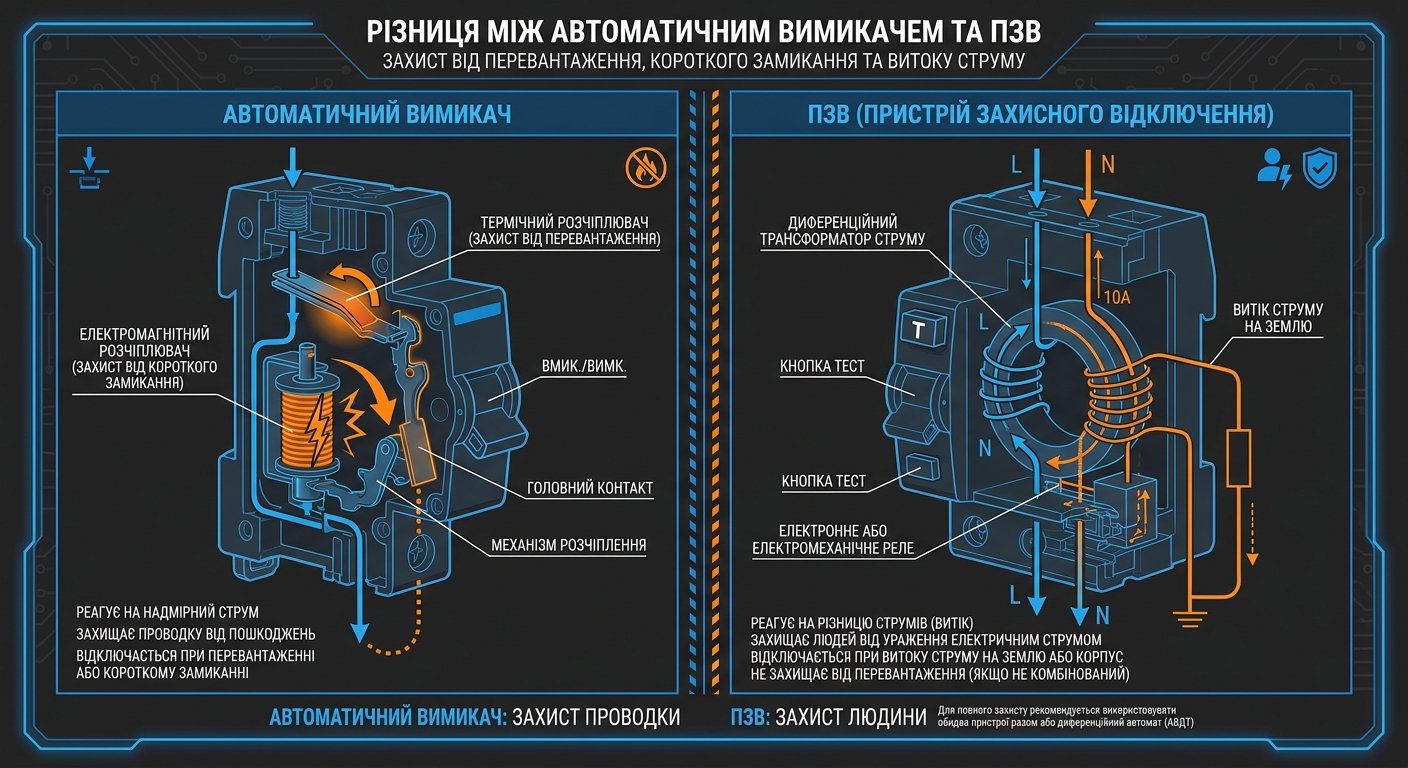
How an RCD differs from a circuit breaker
| Parameter | Circuit breaker | RCD |
|---|---|---|
| What it protects against | Overload, short circuit | Current leakage (to enclosure, earth, body) |
| Principle | Thermal + electromagnetic release | Differential transformer |
| Panel cannot work without it | Mandatory | Mandatory (on groups or at the input) |
| Protects wiring from fire on leakage | No | Yes |
Important:
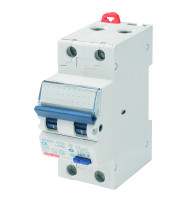
An RCD does not protect against overload and short circuit. Therefore, before or after each RCD, a circuit breaker of the appropriate rating must always be installed. The alternative is an RCBO, which combines both functions in one housing.
How a residual current device works: the operating principle
The heart of an RCD is the differential transformer. Two conductors pass through its toroidal core: the phase (L) and the neutral (N). In normal operation, the currents in both conductors are equal in magnitude but opposite in direction — their magnetic fields cancel out, and the voltage on the transformer's secondary winding is zero.
If a leakage occurs (part of the current went through a person's body, a wet wall, or damaged insulation), the balance is broken. A voltage appears in the secondary winding, which, through a polarized relay or an electronic circuit, sends a command to the release — and the RCD instantly opens the contacts.
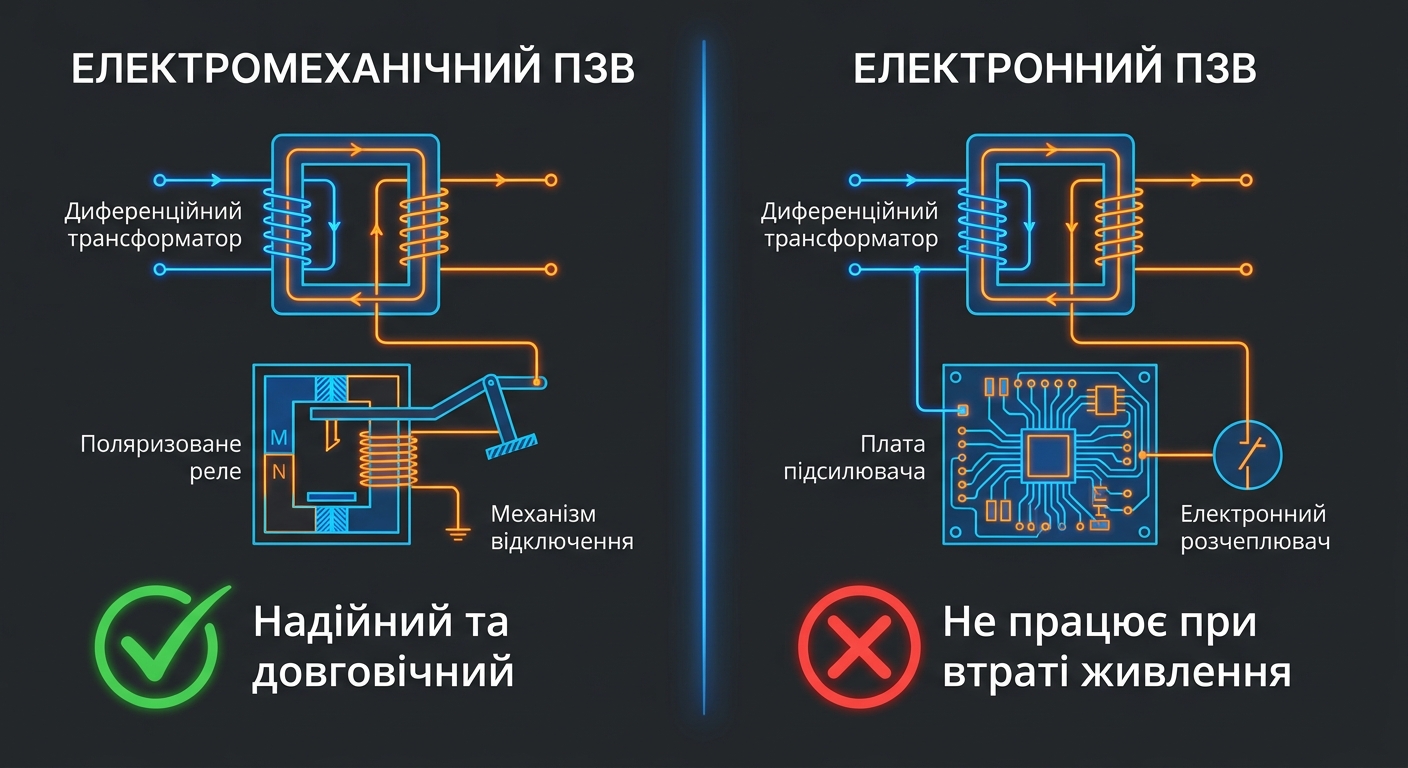
Electromechanical vs electronic RCD
This is one of the most important distinctions, one that is rarely discussed in detail.
| Criterion | Electromechanical | Electronic |
|---|---|---|
| Energy source for tripping | The leakage itself (energy of the differential transformer) | External mains (supply voltage required) |
| Works with a broken neutral | Yes — a critical advantage | No — left without protection |
| Resistance to impulse disturbances | High | Lower (electronics are sensitive to overvoltages) |
| Price | Higher by 20–40% | Lower |
| Where to apply | Housing, industry, facilities with an unstable grid | Acceptable in stable grids with voltage monitoring |
| How to distinguish (marking) | On the housing diagram — only a transformer and a relay | On the diagram — a triangle (amplifier) with the letter "A" |
Recommendation for B2B customers:
in project documentation for residential complexes and industrial facilities, always specify electromechanical RCDs. The DSTU EN 61008-1:2015 standard does not distinguish these types by requirements, but an electromechanical device remains operational even in the event of a grid failure — and this complies with the fail-safe principle under the PUE (Electrical Installation Rules).
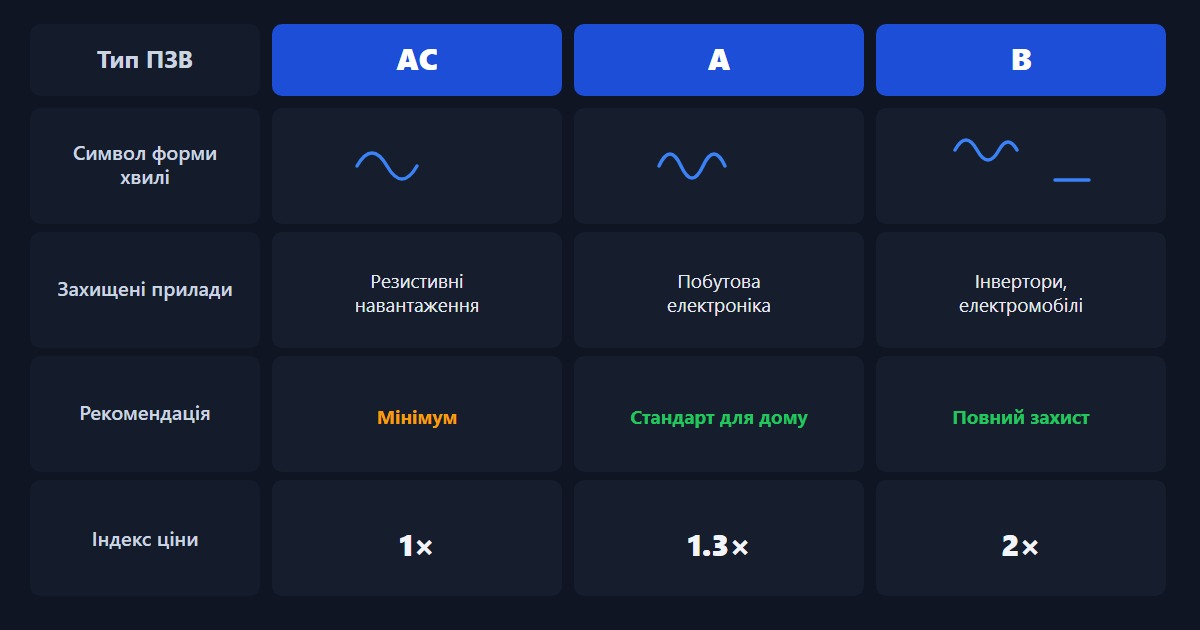
RCD types: AC, A, B — what's the difference
The RCD type determines which forms of differential current the device responds to. This is not a "quality level" but a functional classification per IEC 61008-1 and DSTU EN 61008-1:2015.
| Type | Symbol on housing | Leakage currents it responds to | Typical application | Price category |
|---|---|---|---|---|
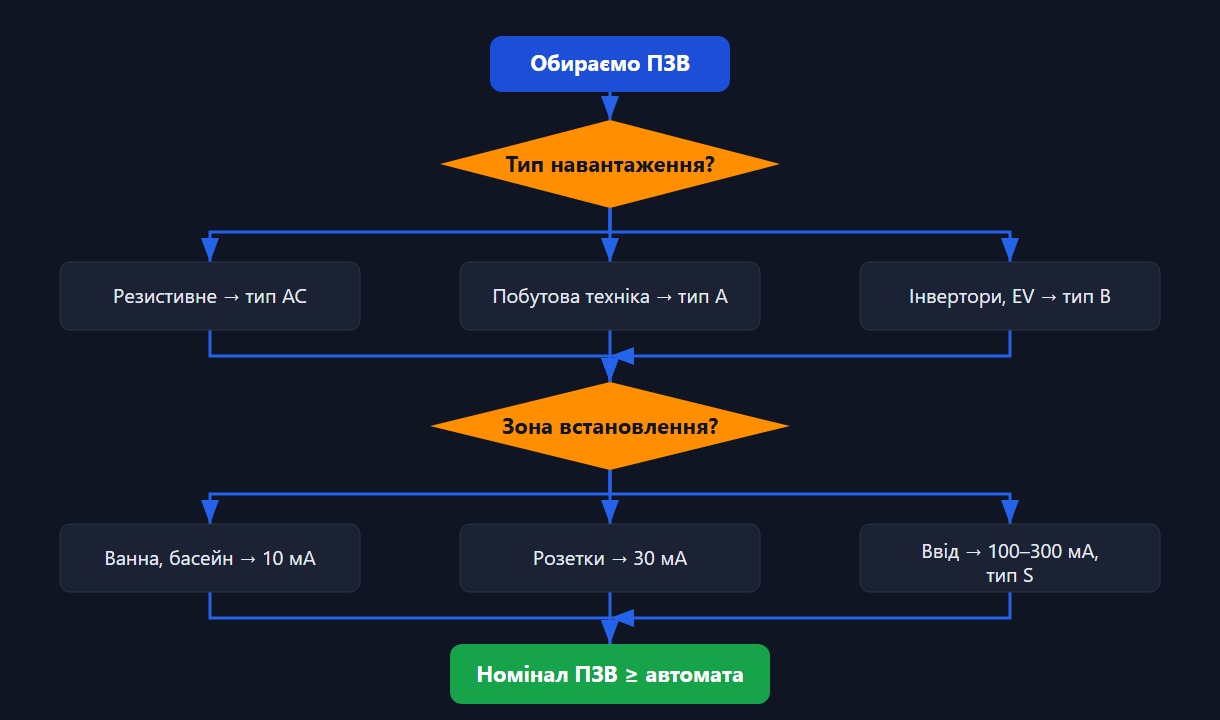
| AC | ~ (sine wave) | AC sinusoidal only | Lighting, resistive load (heaters, boilers without an inverter) | Basic |
| A | ~ + ⎍ (sine wave + pulsation) | AC + pulsating DC | Household appliances with switching power supplies: washing machines, induction hobs, air conditioners, LED drivers | Medium (+25–40% over AC) |
| B | ~ + ⎍ + ⎓ (all forms) | AC + pulsating + smooth DC | Industrial frequency converters, EV charging stations, medical equipment, photovoltaic systems | High (+80–150% over AC) |
Which type to choose in practice
- Type AC — the minimum permitted under the PUE for lines without electronics. Suitable for purely resistive loads: incandescent lamps, simple heaters.
- Type A — mandatory for modern housing and commercial facilities. A washing machine, dishwasher, induction hob, air conditioner, laptop charger — all of these create a pulsating DC component of leakage that type AC "does not see".
- Type B — needed in industry: frequency converters for pump, fan, and elevator motors; electric vehicle charging stations (Mode 3, IEC 61851); inverter photovoltaic systems.
⚠ Important for designers: in Ukraine, new buildings are handed over with type AC RCDs, which formally meets the minimum PUE requirements. But DBN V.2.5-23:2010 "Design of electrical equipment for civil-purpose facilities" recommends type A for lines with household appliances. In projects for the EU (Directive 2014/35/EU), type A is mandatory.
How to choose an RCD by rated current and sensitivity
Choosing an RCD is always about two parameters at once: the rated current (In) and the rated residual operating current (IΔn), that is, the sensitivity.
Rated current (In)
This is the maximum operating current that an RCD can continuously carry without overheating. The standard series is: 16, 25, 32, 40, 50, 63, 80 A.
Rule:
the RCD rating must be equal to or greater than the rating of the circuit breaker in front of it. If the breaker on the line is C25, then the RCD is chosen for 25 A or 40 A.
| Breaker before RCD | Minimum RCD rating | Recommended RCD rating |
|---|---|---|
| C10 | 16 A | 25 A |
| C16 | 16 A | 25 A |
| C20 | 25 A | 25 A |
| C25 | 25 A | 40 A |
| C32 | 40 A | 40 A |
| C40 | 40 A | 63 A |
| C50 | 63 A | 63 A |
| C63 | 63 A | 80 A |
Sensitivity (IΔn) — rated residual current
This is the leakage value at which the RCD is guaranteed to trip. Actual tripping occurs in the range from 0.5·IΔn to 1.0·IΔn (IEC 61008-1 requirement). That is, a 30 mA RCD will trip at a leakage from 15 to 30 mA.
| IΔn | Purpose | Where to install | Tripping time at IΔn | Tripping time at 5·IΔn |
|---|---|---|---|---|
| 10 mA | Protection of people in high-risk zones | Bathroom, shower, nursery, pool, sauna | ≤ 0.3 s | ≤ 0.04 s |
| 30 mA | Protection of people — general | All socket groups of an apartment, house, office | ≤ 0.3 s | ≤ 0.04 s |
| 100 mA | Fire protection | Input panel (after the meter), separate buildings | ≤ 0.3 s | ≤ 0.04 s |
| 300 mA | Fire protection of industrial facilities | Main distribution board, transformer substation, production | ≤ 0.3 s | ≤ 0.04 s |
| 500 mA | Special application | Large industrial loads, outdoor lighting lines | ≤ 0.3 s | ≤ 0.04 s |
Selectivity: main + group RCD
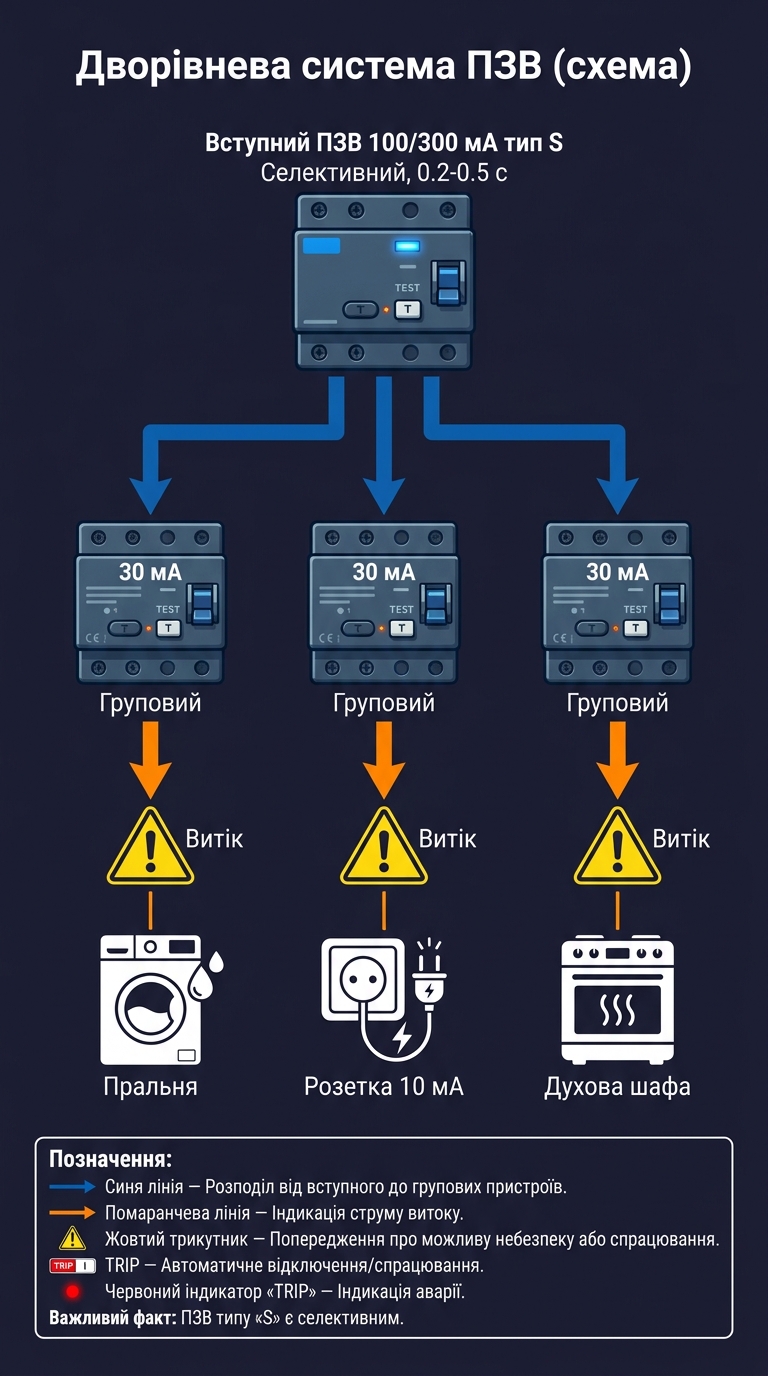
To ensure selectivity (so that on a leakage only one group is switched off, not the entire panel), a two-level scheme is used:
- Main (fire-protection) RCD — 100 or 300 mA, type S (selective, with a tripping delay of 0.13–0.5 s). Marked "S" or "G" on the housing.
- Group RCDs — 10 or 30 mA, without delay (instantaneous).
On a leakage on the line, the 30 mA group RCD trips first (instantaneously), while the 300 mA/S main RCD remains on thanks to the delay.
RCDs for an apartment, house, and industrial facility
Apartment (single-phase input, 220 V)
A typical scheme for an apartment of 50–100 m²:
| Group | Breaker | RCD: In / IΔn / Type | Comment |
|---|---|---|---|
| Bathroom (sockets) | C16 | 25 A / 10 mA / A | High-risk zone — 10 mA only |
| Kitchen (sockets) | C16 | 25 A / 30 mA / A | Washing machine, dishwasher — type A mandatory |
| Rooms (sockets) | C16 | 25 A / 30 mA / A | General protection |
| Electric stove | C32 | 40 A / 30 mA / A | Induction hob — type A only |
| Air conditioner | C16 | 25 A / 30 mA / A | Inverter compressor — type A |
| Lighting | C10 | 25 A / 30 mA / AC | AC acceptable if lamps only |
| Input (fire-protection) | — | 63 A / 100 mA / S | Selective, after the meter |
Private house (three-phase input, 380 V)
In a private house, three-phase consumers are added (electric boiler, welding machine, pumping station). The main differences:
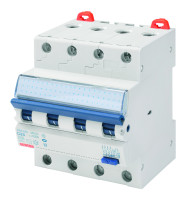
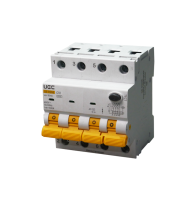
- The main RCD is four-pole (3P+N), 63 A, 300 mA, type S.
- For single-phase groups — a two-pole RCD for each group or for 2–3 adjacent groups.
- A separate line for the boiler with a 40 A / 30 mA / A RCD.
- Outdoor lighting and outbuildings — a separate 30 mA RCD.
Industrial facility
For industrial facilities, RCD selection is governed by the project documentation and the requirements of the PUE (section 7.1).
| Facility / Line | Recommended RCD | Rationale |
|---|---|---|
| Main input (main distribution board) | 4P, 300 mA, type S | Fire protection of the entire facility |
| Workshop distribution boards | 4P, 100 mA, type S | Selectivity with group RCDs |
| Machine tools with frequency converters | 30 mA, type B | Smooth DC leakage from the inverter |
| EV charging stations | 30 mA, type B or type A + RDC-DD | IEC 61851, Mode 3 |
| Administrative premises | 30 mA, type A | Same as an apartment |
| Wet zones (showers, laundries) | 10 mA, type A | Increased danger |
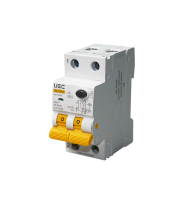
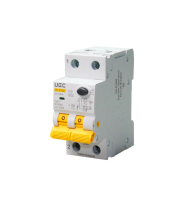
The UEC SB-R10N series is a budget option for assembling panels: UEC residual current protection devices. For projects with increased quality requirements, we recommend the GEWISS Compact RCBO — a series with European certification.
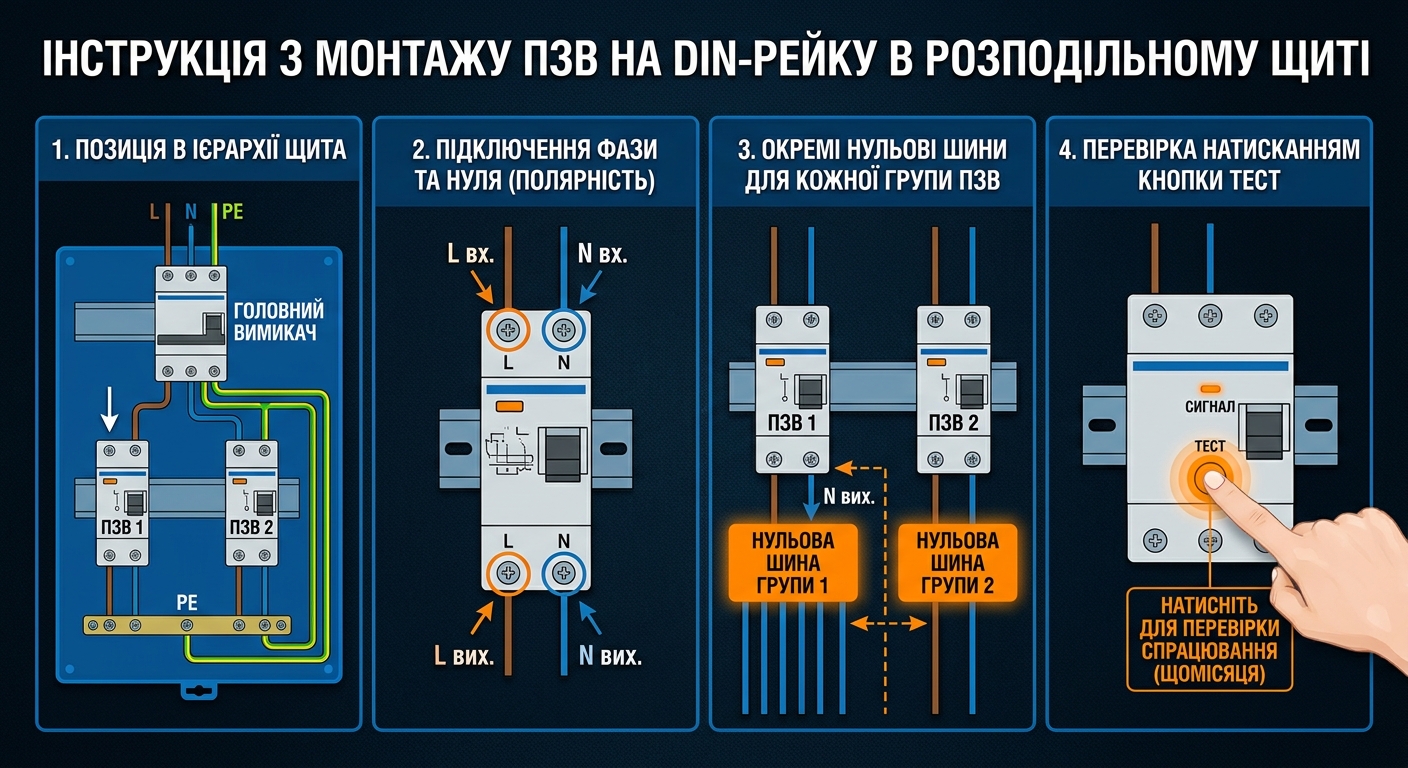
How to connect an RCD in a panel: the sequence
Step 1. Determine the RCD's place in the scheme
The standard sequence in a panel (left to right or top to bottom):
Input breaker → Meter → Fire-protection RCD (100–300 mA/S) → Group breakers → Group RCDs (30 mA) → Load
An alternative option (group RCD before the breakers):
Input breaker → Meter → Fire-protection RCD → Group RCD (30 mA) → Group breakers → Load
Both schemes are permitted under the PUE. The first is more convenient for fault-finding — on a false trip you switch off the breakers one by one. Detailed wiring diagrams with conductor routing are in the article RCD wiring diagram in a panel.
Step 2. Connect the conductors
- Phase (L) — always at the top (input) on the contact marked "1" or "L in".
- Neutral (N) — at the top (input) on the "N in" contact. Output — "N out" or "2".
- Earth (PE) — passes by the RCD to a separate PE bus.
Step 3. The "own neutral" rule
Each RCD must have its "own" neutral. It is strictly forbidden to:
- combine the neutrals of different RCDs after them;
- connect the load's neutral to a neutral bus, bypassing the RCD;
- use the neutral of another group.
Violating this rule is the No. 1 cause of false trips.
Step 4. Check the connection
- Switch on the RCD.
- Press the "TEST" button on the housing — the device must trip instantly.
- If it did not trip — the connection was made incorrectly or the device is faulty.
Conductor cross-section
| Breaker rating | Minimum copper conductor cross-section | Recommended cross-section |
|---|---|---|
| C10 | 1.5 mm² | 1.5 mm² |
| C16 | 1.5 mm² | 2.5 mm² |
| C20 | 2.5 mm² | 2.5 mm² |
| C25 | 2.5 mm² | 4.0 mm² |
| C32 | 4.0 mm² | 6.0 mm² |
| C40 | 6.0 mm² | 10.0 mm² |
| C63 | 10.0 mm² | 16.0 mm² |
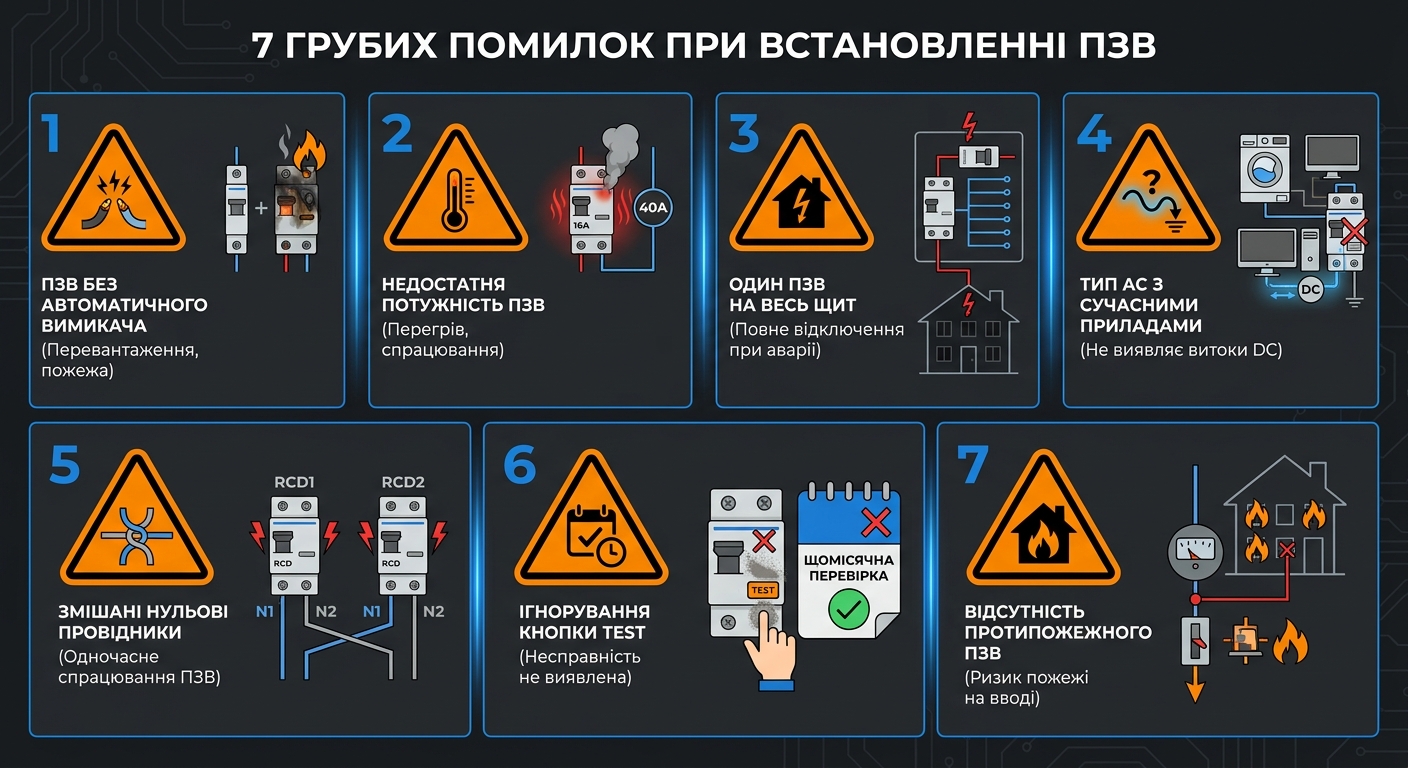
Mistakes when selecting and connecting an RCD
❌ Mistake 1. An RCD without a breaker
An RCD has no protection against overload and short circuit. On a short circuit, thousands of amperes will flow through it — the contacts will weld together, the housing will melt. Always install a circuit breaker before the RCD or use an RCBO.
❌ Mistake 2. An RCD rating too low relative to the breaker
If the breaker on the line is C25 but the RCD is rated for 16 A, then at a load of 20 A (which is normal for a C25 breaker) the RCD contacts overheat. The result is melted terminals, false trips, and a fire risk.
❌ Mistake 3. One RCD for the entire panel
Formally permissible, but extremely inconvenient. On a leakage on one line, the whole apartment is de-energized. And finding the faulty line without a selective scheme is a lengthy diagnosis in the dark. The optimum: 1 RCD per 2–4 group breakers.
❌ Mistake 4. Type AC instead of type A for modern appliances
A washing machine, dishwasher, induction hob, inverter air conditioner — all of them generate a pulsating DC component in the leakage. Type AC does not detect it. The consequence is that a person is either not protected at all, or the RCD trips falsely due to the accumulation of the DC component.
❌ Mistake 5. Combining neutrals after different RCDs
A classic mistake of novice installers. If the neutral from the load of group A went to the neutral bus of group B, both RCDs "see" the imbalance and switch off simultaneously. The solution: each RCD gets its own neutral bus. In the panel, mark them with colored stickers.
❌ Mistake 6. Ignoring the "TEST" button
The "T" button on the RCD housing is not a decoration. It simulates a leakage equal to the rated residual current. Manufacturers and the IEC 61008-1 standard require a check monthly. If the RCD does not trip when pressed, the device is faulty and must be replaced.
❌ Mistake 7. No fire-protection RCD at the input
Group RCDs of 30 mA protect a person but not the entire facility. A leakage of 50–80 mA on the main line (between the meter and the group panel) will go unnoticed. A main RCD of 100–300 mA with a delay (type S) is a mandatory level of protection. The third level is the AFDD (arc fault detection device), which detects sparking in the wiring even when the breaker and the RCD "do not see" the threat.
RCD inspection and maintenance schedule
Competitors barely cover this topic, yet for B2B customers it is critical: at industrial facilities, RCD inspection is a requirement of regulatory documents.
Frequency of inspections
| Type of inspection | Method | Frequency | Who performs it |
|---|---|---|---|
| Pressing the "TEST" button | Manual leakage simulation | Once a month | Owner / person responsible for the electrical facilities |
| Measuring the tripping current | Special instrument (RCD tester) | Once a year | Licensed electrical laboratory |
| Measuring the tripping time | Special instrument | Once a year | Licensed electrical laboratory |
| Visual inspection (terminal, housing condition) | Inspection | Once every 6 months | Enterprise electrician |
When to replace an RCD
- It does not trip when the "TEST" button is pressed.
- The measured tripping time exceeds the standard value (> 0.3 s at IΔn).
- Visible housing damage, melted terminals.
- The device is over 10 years old (a manufacturer's recommendation, although the standard does not directly limit it).
- After tripping on a real short circuit — the contacts may be damaged.
Inspection log (for industrial facilities)
At facilities with organized electrical management, the results of RCD inspections are recorded in a log signed by the responsible person. This is a requirement of NPAOP 40.1-1.21-98 "Rules for the safe operation of consumers' electrical installations".
FAQ — RCD (UZO)
❓ Can an RCD be installed without earthing?
Yes, an RCD also works in a two-wire system (without PE). On a leakage to an appliance's enclosure, the device will trip when a person touches the enclosure — the leakage current will flow through the body into the ground. But with earthing, the protection trips instantly, without a person's touch — which is why the TN-S system (with earthing) is always better.
❓ Why does an RCD trip for no apparent reason?
The most common causes of false trips: 1) combined neutrals of different groups; 2) insulation damage in old wiring (especially in wet zones); 3) a leakage in a household appliance (a boiler's heating element, a washing machine's motor); 4) an incorrectly chosen type (AC instead of A — accumulation of the DC component). Diagnostic algorithm: switch off all breakers after the RCD, switch on the RCD, then switch on the breakers one by one — the faulty line will reveal itself.
❓ What is the difference between an RCD and an RCBO?
An RCD protects only against current leakage. An RCBO = a circuit breaker + an RCD in one housing. An RCBO protects against leakage, and against overload, and against a short circuit. A detailed comparison is in our article RCD or RCBO — which to choose.
❓ Which RCD to choose for an electric vehicle charging station?
IEC 61851-1 requires protection against DC leakage. Two options: a type B RCD (responds to all forms of leakage, including smooth DC) or a combination of a type A RCD + an RDC-DD module (DC leakage detector). Type B is more expensive but simpler to install.
❓ How many groups can be connected to one RCD?
Optimally 2–4 groups. More — and the total background leakage grows (each appliance has a natural leakage of 0.5–1.5 mA), and the RCD begins to trip falsely. For a 30 mA RCD, the total background leakage of all connected groups must not exceed 10 mA (1/3 of the rating) — an IEC 61008-1 requirement.