
Article Contents
How to Choose the Right Circuit Breaker for Home and Apartment: Complete Guide 2026


What is a circuit breaker and why is it needed? (The essentials)
A circuit breaker is your main protector in the electrical panel. Its task is to instantly break the electric circuit when dangerous situations occur, such as overloads or short circuits. This prevents wiring overheating, damage to household appliances, and, most importantly, protects your home from fire.
Main Function
Protecting your electrical network from overloads and short circuits:
- Overload — occurs when the total power of simultaneously switched-on appliances exceeds what the wiring is designed for. For example, if a washing machine, water heater, and electric kettle are running. The current increases, the cable begins to heat up, and without protection, its insulation can melt. The circuit breaker responds to this using a thermal trip unit: a special bimetallic strip heats up, bends, and opens the circuit.
- Short Circuit — is a much more dangerous situation where the phase conductor contacts the neutral one directly, for example, due to damaged insulation. The current in the network instantly increases hundreds of times over. Here, the circuit breaker's electromagnetic trip unit activates, reacting in a fraction of a second.
As noted in The Ultimate Guide to Selecting Household Appliance Circuit Breakers by OneSto-EP, a correctly selected device is critical for preventing accidents.
Important: How does a circuit breaker differ from an RCD and an RCBO? (Key difference)
These three devices are often confused, although they perform different functions. A circuit breaker protects appliances and wiring from overcurrents, but it will not save a person from electric shock if they touch a bare wire.
To protect people, there is the RCD (Residual Current Device), which reacts to current leakage. It instantly cuts power to the line if it detects that part of the current has "gone astray," for example, through a human body. An RCBO is a hybrid device that combines the functions of a circuit breaker and an RCD in one housing.
| Device | What it protects against | Main purpose |
|---|---|---|
| Circuit Breaker | From overloads, short circuits | Protection of the electrical network and wiring from overheating and damage |
| RCD | From current leakage (ground faults) | Protecting people from electric shock |
| RCBO | From overloads, short circuits, current leakage | Comprehensive protection of the network and people, combines circuit breaker and RCD functions |

Warning! Working with electrical equipment is life-threatening!
All work in the electrical panel must be performed only by qualified electricians with the power disconnected. Before starting work, be sure to de-energize the line and verify the absence of voltage with a measuring device.
Key Selection Parameters: Step-by-Step Instructions
Choosing the right circuit breaker is not a lottery, but a precise engineering calculation. As a practicing specialist, I always start with an analysis of the network and load. Follow these instructions to make the right choice of breaker, considering key criteria such as rated current, tripping characteristic, number of poles, and breaking capacity.
Step 1: Calculation of Rated Current (Amperes, A)
This is the most important parameter. The rated current of the circuit breaker must be higher than your normal operating current, but lower than the maximum current the wiring can withstand. Only then can it effectively protect against overloads. In my practice, I use two calculation methods for maximum accuracy.
Option A: Calculation by Total Appliance Power (kW)
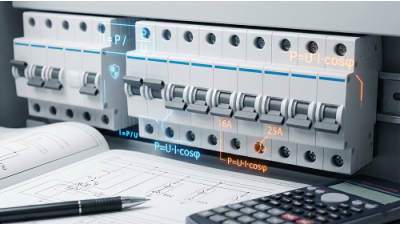
This method is suitable for a preliminary assessment. First, sum up the power (P) of all appliances that can run simultaneously on one line. Then calculate the current using the formula for a single-phase network: I = P / U, where U is the voltage (usually 220 V). Add a 20% margin to the obtained value for reliability.
For example, a kettle (2200 W) and a microwave oven (1100 W) are working on the line. Total power: P = 3300 W. Current: I = 3300 / 220 = 15 A. With a 20% margin, we get 18 A. In this case, you should choose the nearest lower standard rating — 16 A.
| Total Power (kW) | Calculated Current (A) | Recommended Breaker Rating (A) |
|---|---|---|
| 2.2 | 10 | 10 or 16 (depending on cable) |
| 3.5 | 15.9 | 16 |
| 4.4 | 20 | 20 or 25 (depending on cable) |
| 5.5 | 25 | 25 |
| 7.0 | 31.8 | 32 |
This method does not take into account the main thing — the capabilities of your wiring. You can learn more about how to correctly calculate the breaker rating for a 220V network.
Option B: Selection by Wire/Cable Cross-Section — The Most Reliable Method!
This is the only correct and safe approach. The circuit breaker is designed to protect the cable from overheating. Its rating must in no way exceed the maximum permissible current for a given conductor cross-section. Otherwise, during an overload, the wiring in the wall will start to melt, and the breaker will not even trip.
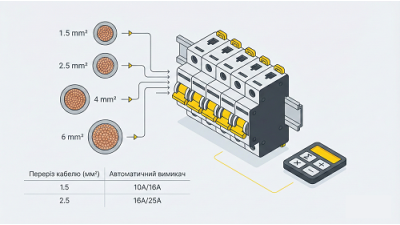
| Copper Wire Cross-Section (mm²) | Maximum Permissible Current (A) | Recommended Breaker Rating (A) |
|---|---|---|
| 1.5 | 19 | 16 |
| 2.5 | 27 | 25 |
| 4 | 38 | 32 |
| 6 | 46 | 40 |
| 10 | 70 | 63 |
Table for VVG type copper cable, laid hidden in the wall.
"Always choose the circuit breaker to protect the cable, not the appliance! If you put a 25A breaker on a line with a 1.5 mm² cable, the wiring in the wall will burn out during an overload, and the breaker won't even trip. This is a direct path to a fire." — Lukyanchuk Oleg, Electrical Engineer.
Step 2: Selection by tripping characteristic (B, C, D)
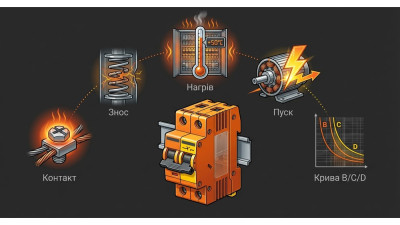
This letter on the breaker's housing indicates its sensitivity to inrush currents — short-term current spikes that occur when starting motors (for example, in a refrigerator or washing machine).
Characteristic B: for lines without large inrush currents (lighting, sockets without powerful appliances)
Trips when the rating is exceeded by 3-5 times. Ideal for lighting networks and sockets where TVs and chargers are connected.
Characteristic C: universal choice for an apartment (sockets, air conditioners, washing machines)
Trips when the rating is exceeded by 5-10 times. This is the most common option for residential premises, as it does not react to the inrush currents of most household appliances. As noted in the guide Different Types of Circuit Breakers by BreakerHunters, type C is the primary choice for home use.
Characteristic D: for powerful equipment with high inrush currents (motors, welding machines)
Trips when the rating is exceeded by 10-20 times. It is almost never used in everyday life; it is a choice for garages with powerful machine tools or pumping stations.
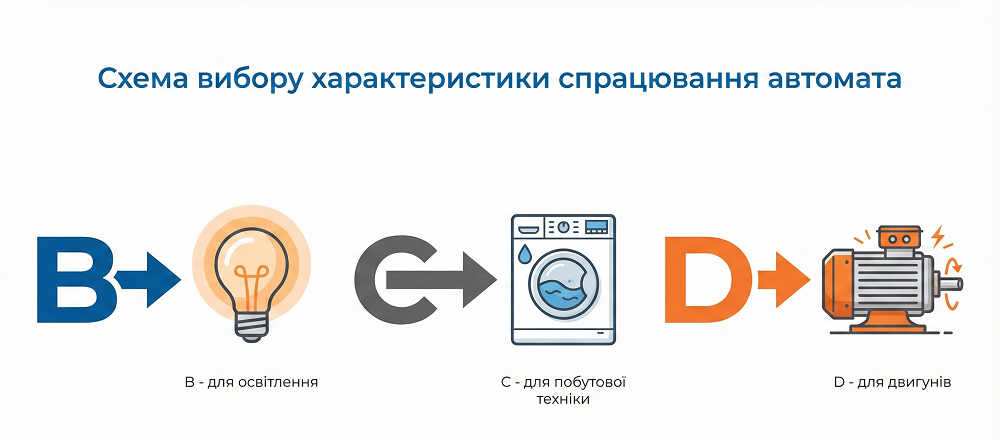
You can learn more about how circuit breakers with characteristics B, C, and D differ in our separate article.
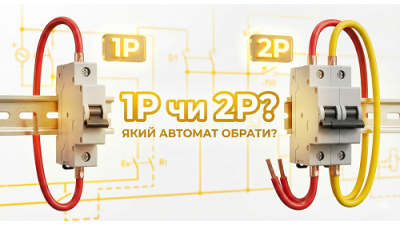
Step 3: Determining the number of poles (1P, 2P, 3P, 4P)
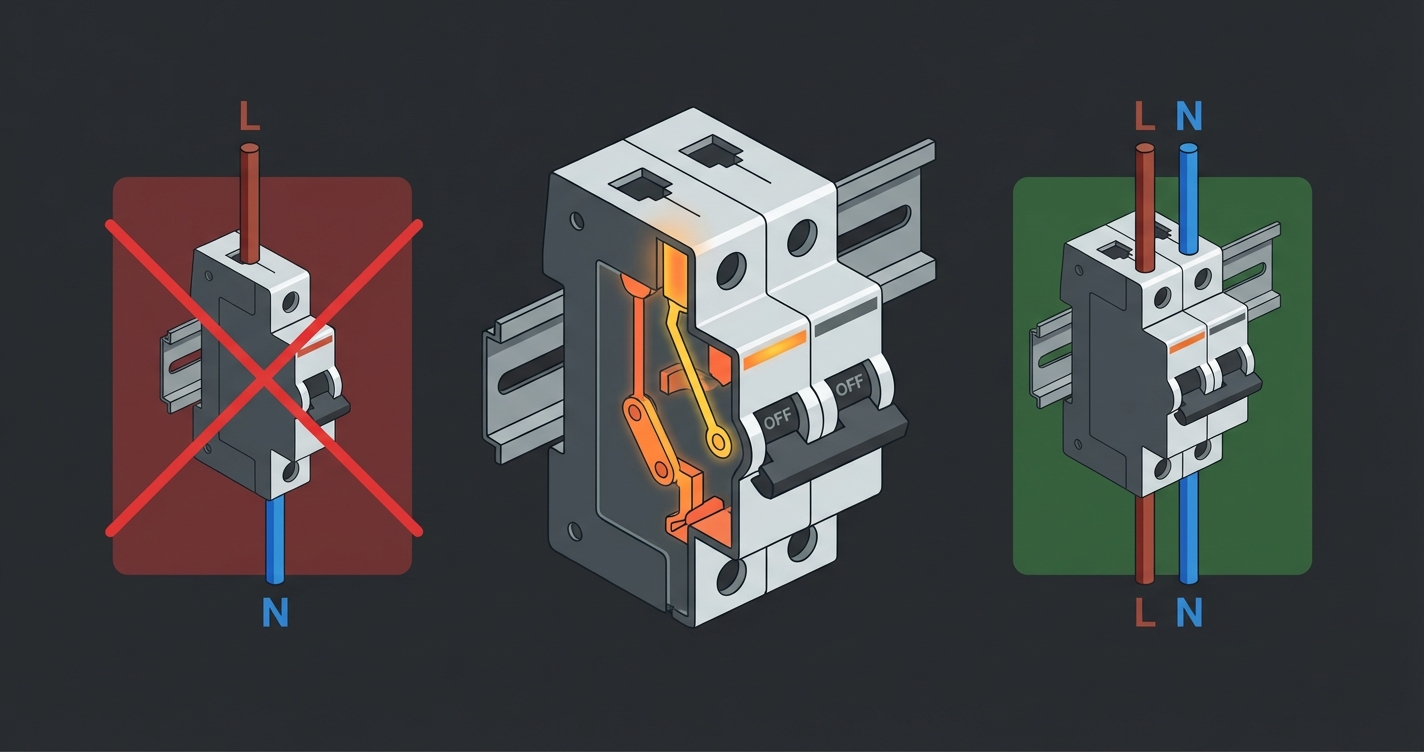
The number of poles of a circuit breaker is the number of conductors it can disconnect simultaneously.
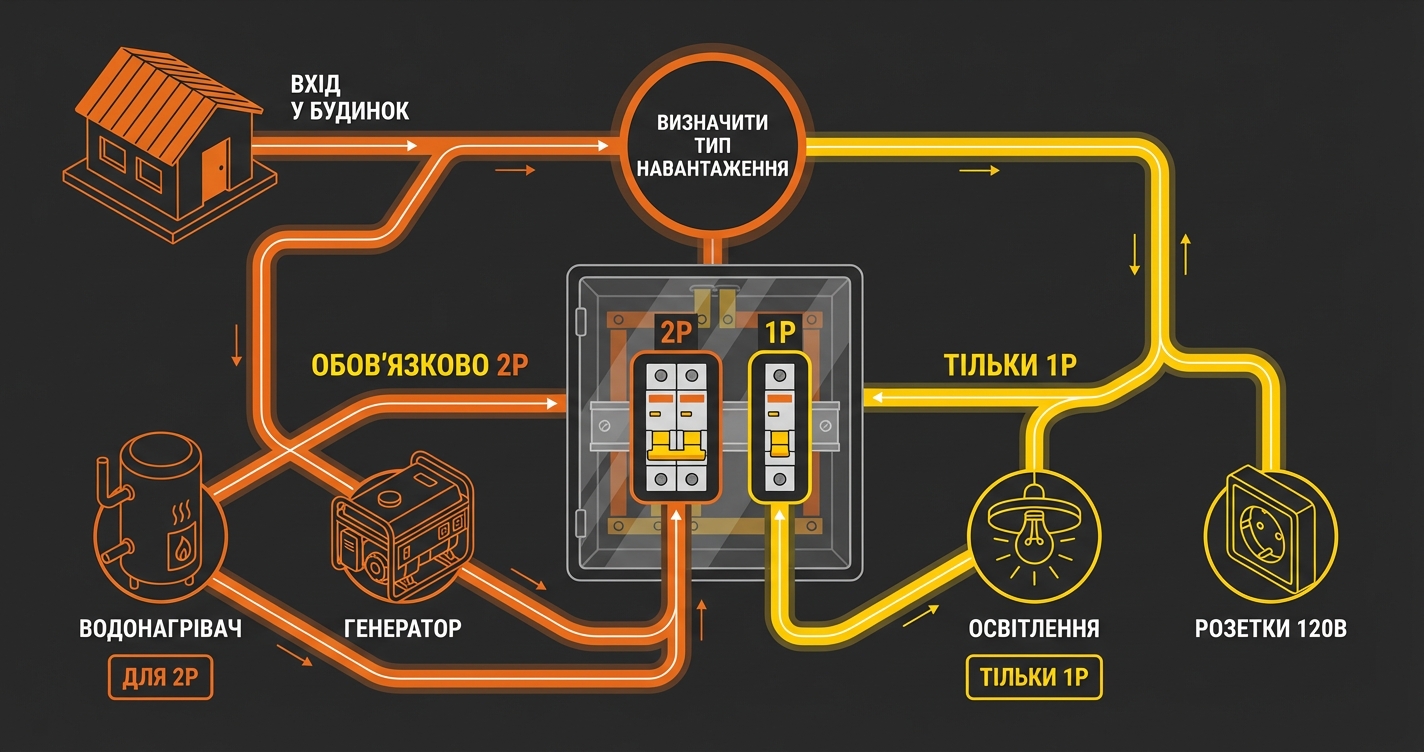
Single-pole (1P) for single-phase 220V network
1P (single-pole) breaks only the phase wire. This is the standard solution for protecting individual socket groups or lighting.
Double-pole (2P) for single-phase 220V network
2P (double-pole) breaks both the phase and neutral simultaneously. This increases safety, so double-pole breakers are recommended to be installed as the input breaker for the entire apartment or to protect powerful appliances, such as water heaters or electric stoves.
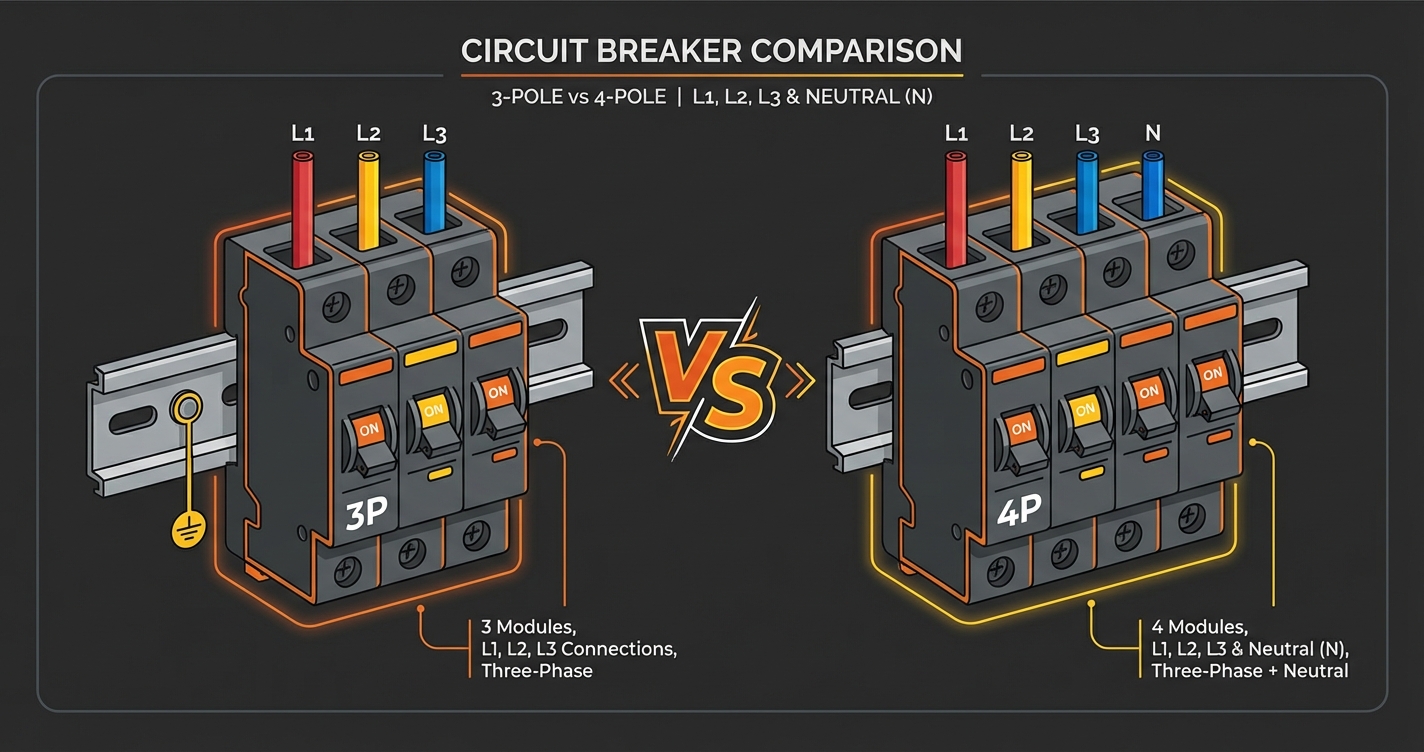
Three-pole (3P) and Four-pole (4P) for three-phase 380V network
Used in private houses with a three-phase input or to power powerful equipment (electric boilers, machine tools). 3P breaks three phases, and 4P — three phases and the neutral conductor.
There is detailed material on how to choose the number of circuit breaker poles.
Step 4: Selection by breaking capacity (kA)
This parameter (measured in kiloamperes, kA) indicates the maximum short-circuit current the breaker can break without being destroyed. This is its "safety margin". For domestic conditions, 4.5 kA or 6 kA is usually sufficient. For new buildings and private houses where the transformer substation is located nearby, I recommend choosing 6 kA for greater reliability.
You will find more information about what the breaking capacity of a circuit breaker is at the link.
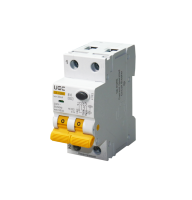
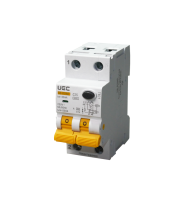
Practical Examples: Which Circuit Breaker to Install on...?
Here are ready-made solutions based on typical electrical installation tasks.
...Lighting
For lighting networks, a cable with a cross-section of 1.5 mm² is usually used. Therefore, we install a 10 A circuit breaker with characteristic B.
...Room Sockets
The standard for socket groups is a 2.5 mm² cable. Accordingly, the circuit breaker must be 16 A with characteristic C.
...Powerful Appliances (Water Heater, Electric Stove, Air Conditioner)
A separate line is laid for such appliances. For a water heater or air conditioner of average power (up to 3.5 kW) — 2.5 mm² cable and 16 A breaker (C). For an electric stove — 4 or 6 mm² cable and a 25-32 A breaker (C).
...Input Circuit Breaker for an Apartment or House
It depends on the allocated power. For an apartment, this is usually 25-40 A. For a private house, it can be 63 A.
| Consumer Group | Recommended Copper Cable Cross-section, mm² | Recommended Breaker Rating, A | Recommended Characteristic |
|---|---|---|---|
| Lighting | 1.5 | 10 | B |
| Sockets | 2.5 | 16 | C |
| Water Heater | 2.5-4 | 16-20 | C |
| Electric Stove | 4-6 | 25-32 | C |
| Air Conditioner | 2.5 | 16 | C |
A circuit breaker is not everything: what else is needed for complete protection?
A circuit breaker is the foundation of protection, but for complete safety, it is worth adding a few more devices.
RCD – for protecting people from electric shock
This device is mandatory for "wet" zones: bathrooms, kitchens, as well as for children's rooms. It reacts to minimal current leakage (usually 30 mA) and saves lives.
RCBO – a combined 2-in-1 solution when space in the panel is limited
If space in your electrical panel is scarce, an RCBO is an excellent solution, as it combines the functions of a circuit breaker and an RCD.
Voltage Relay – for protecting appliances from voltage surges
This relay monitors the mains voltage. If it goes beyond safe limits (for example, drops to 170 V or rises to 260 V), the relay cuts off power, saving your expensive equipment from burning out.
 для дому та квартири: повний посібник 2026/1_statya.png)
Choosing a manufacturer: who to trust and how to avoid fakes?
The market is saturated with brands offering different price-to-quality ratios. Your choice should be based on reliability, as your safety depends on it.
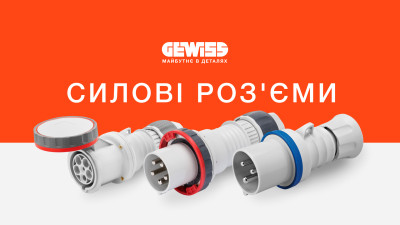
Premium segment: ABB, Schneider Electric, Hager, Legrand, Gewiss
These are European manufacturers with a long history, whose products meet the strictest quality and safety standards. They offer innovative solutions and have an impeccable reputation. The price is higher, but it is an investment in your peace of mind for decades.
Middle and budget segment: E.NEXT, ETI, UEC
These brands offer affordable solutions that satisfy basic needs for most household tasks. They have acceptable quality and are a popular choice for budget renovations.
How to distinguish an original from a fake?
Unfortunately, the market is overflowing with fakes even of famous brands. Pay attention to the quality of the plastic (it should not have a pungent smell), the clarity and evenness of the marking, the weight of the device (originals are heavier), and the presence of security elements, such as holograms or QR codes. The main rule is to buy electrical equipment only from official representatives or trusted stores.
 для дому та квартири: повний посібник 2026/vimikachi.png)
Top 5 mistakes when choosing and installing circuit breakers
❌ Overestimating the rating
Installing a 25 A breaker on a line with a 1.5 mm² cable is the most common and dangerous mistake.
❌ Incorrect characteristic
Installing a type B breaker on a line with an air conditioner will lead to constant false tripping.
❌ Skimping on safety
Buying unbranded breakers at the market or refusing an RCD in the bathroom.
❌ One group for everything
Connecting the entire apartment to one powerful breaker. In case of any fault, you will be left without light everywhere.
❌ DIY installation without experience
A poorly tightened contact in the breaker terminal is a potential source of sparking and fire.
In my practice, the consequences of such mistakes always cost more than the services of a qualified electrician.
FAQ: Quick Answers to Common Questions
Which circuit breaker should be installed for sockets?
For a standard socket group with a 2.5 mm² copper cable, a 16 A circuit breaker with characteristic C should be used.
How much does a good circuit breaker cost?
Prices in 2025 vary greatly. Devices from budget brands cost from 80-130 UAH, while premium manufacturers (e.g., Gewiss, Hager) offer breakers from 198 - 554 UAH for a single-pole model.
Is it okay to install a higher rated breaker "just in case"?
Absolutely not. This is deadly dangerous for your wiring. The breaker will not be able to protect the cable from overheating, which can lead to a fire.
How often should circuit breakers be replaced?
Most manufacturers indicate a service life of about 15-20 years or a certain number of switching cycles. It is recommended to check them once a year, and replace them if defects are found or as planned after the end of the service life.
Conclusions: a short checklist for making the right choice
Click on an item to mark it as done:
"Remember, choosing the right circuit breaker is only half the battle. Improper installation, poor contact, or the use of low-quality materials can nullify the effectiveness of even the most expensive device. Always entrust electrical installation work only to qualified specialists! This is an investment in your safety and peace of mind."
— Lukyanchuk Oleg, Electrical Engineer