


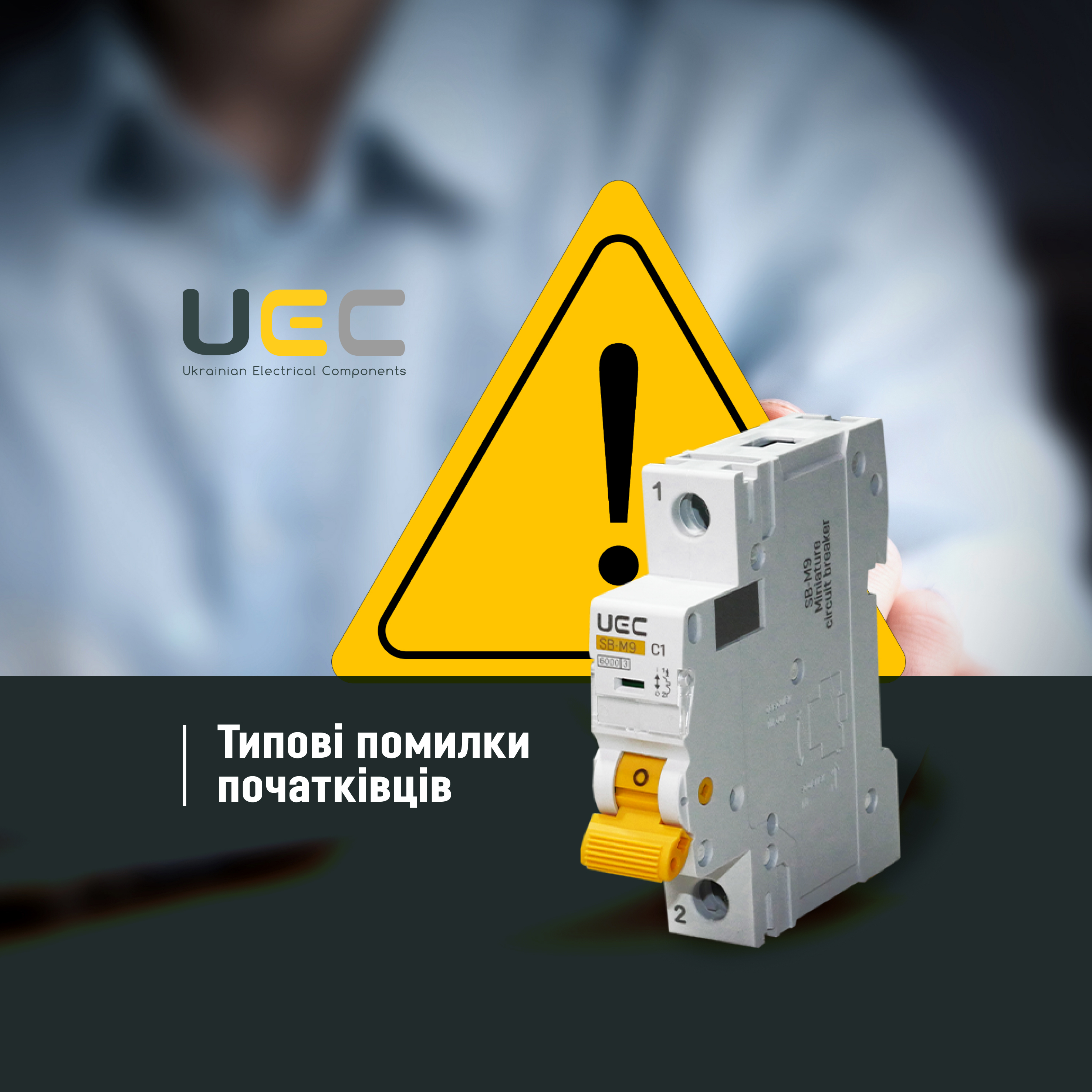
Modern apartments and private houses are filled with powerful household appliances that consume far more electricity than 10–15 years ago. Beginner electricians and homeowners often face a common problem: circuit breakers trip when high-power devices are switched on. On forums, a simple solution is often suggested — install a “stronger” modular circuit breaker. This may seem to solve the problem, but in reality, it only increases the danger.
According to the State Emergency Service of Ukraine, about 40% of household fires are caused by overheated cables and short circuits. Electrical Installation Rules (EIR) strictly prohibit selecting protection devices without prior load calculation. They require that the breaker trips before the cable reaches a critical temperature.
In this article, we will examine why a “stronger breaker” can be dangerous, how to correctly calculate the load, select a UEC circuit breaker, residual current device (RCD), or differential breaker for each line, and create a safe electrical panel scheme.
What does “stronger breaker” mean and why it attracts beginners
By “stronger,” we mean a circuit breaker with a rated current higher than necessary. For example, 25–32 A instead of 16 A.
Beginners usually do this when:
- they do not calculate actual consumption;
- they want a “margin” for kitchen appliances;
- they rely on questionable advice from the internet.
Remember the important correspondence between cable cross-section and the maximum permissible breaker rating:
| Cable Cross-Section | Maximum Breaker Rating |
| 1.5 mm² | 16 A |
| 2.5 mm² | 25 A |
| 4 mm² | 32 A |
Correct selection of modular breakers is based on load calculation and cable cross-section:
I = P / U
- I — calculated current,
- P — total power of all devices,
- U — network voltage.
The breaker rating should be chosen based on this current, not “by eye.”
It is also important to choose the correct trip characteristic (B, C, D):
- B — for long lines and lighting, where inrush currents are small;
- C — for most socket groups and moderate loads (fridge, washing machine, boiler);
- D — for power lines with high inrush currents (pumps, motors, machinery).
In household panels, B and C are usually used, while D is exclusively for specialized high-power consumers.
The Ukrainian manufacturer UEC offers modular circuit breakers with precisely defined B, C, D characteristics and certified quality, ensuring safe operation even during short circuits. This is the optimal solution for apartments, private houses, and commercial facilities.
Why you shouldn’t install a “stronger breaker”
Installing a breaker with a higher rating than allowed for the cable cross-section is dangerous because it stops performing its main function — protecting the line from overload.
Circuit breakers are designed to protect the cable from overheating, not a specific device. For example, a 32 A modular breaker on a 1.5 mm² wire will not trip in time, the cable will overheat, insulation will melt, and the risk of short circuit and fire increases.
The correct solution is to increase the cable cross-section and select the corresponding UEC breaker rating, not “guess.”
Risks and consequences
Incorrect selection of circuit breakers or installing a “stronger” one without calculation creates serious danger:
- Overloading the wiring — the breaker fails to disconnect the line in time. The wire heats up, insulation melts, possible short circuit and fire.
- Non-compliance with EIR and Ukrainian standards — deviations from the rules can cause refusal of commissioning, certification problems, and insurance issues.
Therefore, selecting UEC protective devices by rating and trip characteristic (B, C, or D) must exactly match the wire cross-section. This ensures safety and stable operation of the electrical system.
Typical beginner mistakes
- Installing a 40 A modular breaker on a 1.5 mm² wire — overheating and fire risk.
- Using characteristic C for lighting instead of B.
- Ignoring RCD or differential breaker installation in bathrooms.
- Lack of labeling of electrical lines — complicates maintenance.
- Installing the panel without testing terminal tightness and short-circuit checks.
Practical recommendations and examples
To avoid mistakes and ensure safe installation, follow a simple algorithm:
- Calculate the load of each line.
- Select the rated modular breakers and RCD type (A, AC) for different zones.
- Properly distribute line groups in the panel.
- Leave 20–30% space for future groups.
For a typical two-room apartment, at least 5–6 groups are recommended. Example electrical panel scheme:
[Main Input] → [Main Modular Circuit Breaker 32 A]
 ├── Kitchen (sockets) → Breaker 16 A + RCD 30 mA
 ├── Bathroom (sockets) → Breaker 16 A + RCD 30 mA (type A)
 ├── Lighting → Breaker 10 A
 ├── Room 1 sockets → Breaker 16 A
 ├── Room 2 sockets → Breaker 16 A
 └── Reserve / Air conditioner → Breaker 16 A or 20 A
Example calculation
- Create a list of all consumers and determine total power (P).
- Calculate rated current: I = P / U (U = 230 V).
- Select cable cross-section and modular breaker rating (e.g., 1.5 mm² → 16 A, 2.5 mm² → 25 A).
- For wet zones, install RCD or differential breaker at 30 mA.
For reference: RCD sensitivity (10 mA, 30 mA) is the rated leakage current at which the device instantly disconnects the circuit, protecting people from electric shock and preventing fires. The lower the sensitivity, the faster the protection works.
Audit your panel today and select high-quality UEC modular circuit breakers, type A RCDs for the kitchen, bathroom, and laundry, as well as voltage relays to protect your equipment from power surges. All equipment is certified and complies with EIR and fire safety standards.


