
Article Contents
Circuit Breaker Interrupting Capacity: What It Is and How to Choose (4.5kA, 6kA, 10kA)


Briefly about the essentials
Breaking capacity (Icu) is the maximum short-circuit current in kiloamperes that a circuit breaker can safely interrupt. The main rule: the breaker's breaking capacity must be ≥ the short-circuit current in your network.
Selection standards: 4.5 kA — old residential buildings; 6 kA — modern apartments and houses; 10 kA — main distribution boards near substations.
Hi, I'm Oleg Lukyanchuk. Over more than 12 years in electrical engineering — from maintaining railway signaling systems (S&T) to implementing European standards at UEC — I've repeatedly seen distribution boards burned out completely. The reason is often trivial: people look at the rating (e.g., 16A) but ignore the breaker's ability to interrupt fault current.
This article is a condensation of my experience and international safety standards, so you can avoid fatal mistakes when choosing protection.
What is the breaking capacity of a circuit breaker (Icu)?
To put it simply about something complex, the breaking capacity of a circuit breaker (or Icu — ultimate breaking capacity) is the maximum short-circuit current in kiloamperes (kA) that the device can safely interrupt without being destroyed.
Imagine a situation: a breaker marked 6000 (6 kA) catches a hard fault. If the current reaches 6000 Amperes, the breaker will trip normally. But if the current jumps to 7000 A, the contacts may weld together, and the housing may shatter.
Important not to confuse:
These are two different breaker parameters:
In — Rated current
How much the device will "hold" for years (e.g., 16 A or 25 A).
Icn — Breaking capacity
How much it will withstand for a fraction of a second during a fault (thousands of amperes).
I covered the nature of this parameter in more detail in the article about what is the breaking capacity of a circuit breaker.
Relationship with short-circuit current (Isc) and the selection rule
Short-circuit current (Isc) is an avalanche-like process. At the moment of phase-to-neutral contact, the network resistance approaches zero, and the current instantly surges to hundreds or thousands of amperes. The physics of the process is relentless: the thicker the cable and the closer you are to the substation, the lower the line resistance and the more powerful the current surge during a fault.
The main engineering selection rule:
The rated breaking capacity (Icn) of the breaker must be greater than or equal to the calculated short-circuit current (Isc) at that point.
Safety formula
Icn (breaker) ≥ Isc (network)
Icn — rated capacity of the breaker (e.g., 6000A)
Isc — actual fault current at your outlet
"To ensure the adequacy of the selected circuit breaker for the system, it is necessary to calculate the required breaking capacity. This involves determining the maximum fault current that can occur in the system"
— The interrupt capacity of circuit breakers, TOSUNlux
If you are unsure about the calculations, I recommend reading our guide on how to calculate a breaker by power and current, where we cover the basic principles of load.
Standard breaking capacity values: 4.5 kA, 6 kA, 10 kA and their applications
The market clearly segments circuit breakers by their arc-quenching capability. In my practice, I have encountered cases where cheap 4.5 kA automation was installed in an elite cottage, which is a gross violation of protection logic. Let's break down the standards.
To better navigate the full range of devices, I recommend reading the article about types of circuit breakers and their classification.
4.5 kA (4500A) — Old residential buildings and summer houses
This is the minimum acceptable threshold. Such breakers are suitable for old networks (e.g., Soviet-era apartment blocks with aluminum wiring) or summer houses located far from the transformer.
Physics: The high resistance of old lines simply physically prevents the short-circuit current from rising above 2-3 thousand amperes.
UEC recommendation: Use only for repairing existing old networks, but not for new construction. In Europe, this standard is already considered outdated.
6 kA (6000A) — Modern standard (Golden mean)
This is the "de facto" standard for any modern construction: apartments in new buildings, offices, private houses within the city.
Physics: Copper wiring with a cross-section of 2.5 mm² has low resistance, so short-circuit currents here are higher.
UEC recommendation: Optimal balance of price and safety. In one of our cases for a comfort-class residential complex, we used exactly the 6-kiloampere series, which fully covered the calculated risks.
10 kA (10000A) — Main panels and industry
When a facility is located "right next to" a transformer substation (TS), the short-circuit current can be enormous. Here, 6 kA is no longer sufficient.
Where to apply: Main groups of cottages, shopping centers, small manufacturing facilities.
Important: The AIC rating (equivalent to breaking capacity) is a critical selection parameter that cannot be ignored.
25 kA and above — Industrial special purpose
This is already the league of industrial giants — factories, large main distribution boards (MDB), where currents are measured in tens of thousands of amperes.
For residential use: Such values are excessive and financially unjustified.
If you are hesitating between standards, we have a separate analysis: which circuit breaker breaking capacity to choose: 4.5 kA, 6 kA or 10 kA.
Breaking capacity selection table for different facilities
Use this table as a guide when selecting a breaker for a specific type of facility:
| Value (kA) | Typical facilities | Example situation |
|---|---|---|
| 4.5 kA | Old Soviet-era blocks, summer houses | Rural area, old long lines, aluminum |
| 6 kA | New buildings, offices | Standard apartment panel in the city, copper wiring |
| 10 kA | Main entry to cottage, shopping center | House in immediate proximity to TS (transformer) |
How to determine the required breaking capacity: distance method
Of course, the ideal option is to order a project from an engineer. But for a quick express assessment, we often use the "distance method". The logic is simple: the cable works like a resistor. The longer it is, the less current will reach the breaker during a fault.
Here are the basic guidelines I use for preliminary consultations:
| Distance to TS (transformer) | Recommended breaking capacity |
|---|---|
| Less than 100 m | 10 kA (High risk of powerful short circuit) |
| 100 – 300 m | 6 kA (Standard urban situation) |
| More than 300 m | 4.5 – 6 kA (High line resistance dampens current) |
Note: this method does not replace a full calculation, especially if you are using large cross-section cables that reduce resistance.
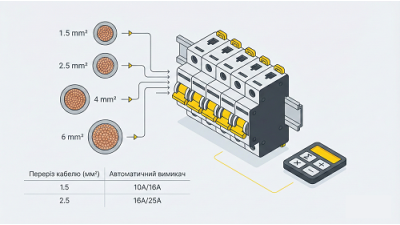
For more precise selection, taking into account cable cross-section, refer to our breaker selection table by cable cross-section and power.
Technical nuance: Difference between Icu and Ics
For those who like to dig into the details, let me explain the "fine print" in manufacturer catalogs. There are IEC/EN 60947-2 (industrial) and IEC/EN 60898 (residential) standards that distinguish between two characteristics:
Ultimate Breaking Capacity
Ultimate capacity
This is the current that the breaker will interrupt once. After that, it will save the wiring, but the device itself will most likely have to be discarded — its contacts will degrade.
Service Breaking Capacity
Service capacity
This is the current after which the breaker is guaranteed to remain operational and can continue to protect the network.
In quality modular breakers (even residential series that we test at UEC), Ics often equals 100% of Icu (for example, Ics=6000A with Icu=6000A).
⚠️ Important: In budget models, Ics may be only 50% or 75% of Icu. This means less survivability during faults — after the first serious short circuit, the breaker may lose its ability to reliably protect the network.

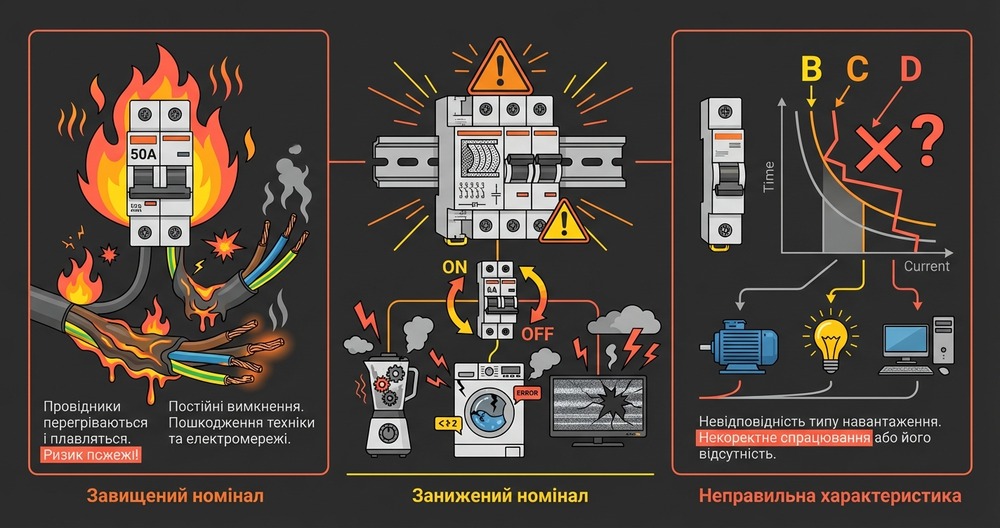
Warning! Consequences of incorrect breaker selection by breaking capacity
What will happen if you install a "weak" 4.5 kA breaker in the panel room of a new building near a substation where the short-circuit current reaches 6 kA? The consequences can be much more serious than just tripped power.
Consequences of incorrect breaker selection by breaking capacity
What will happen if you install a "weak" 4.5 kA breaker in the panel room of a new building near a substation where the short-circuit current reaches 6 kA? The consequences can be much more serious than just tripped power.
⚡ The electric arc will not extinguish
The arc chute will not handle the energy, and the arc will escape beyond the housing.
⚠ Contact welding
The contacts will fuse together. The breaker will "click", but the circuit will not open. The current will continue to heat the wiring until it ignites.
✖ Physical destruction
Molten metal and pressurized gases can rupture the breaker housing, damaging neighboring equipment in the panel.
"If the fault current exceeds the breaker's interrupting capacity, the breaker may not open properly, leading to hazardous conditions such as electrical fires or equipment damage"
— The interrupt capacity of circuit breakers, TOSUNlux
It is equally important to correctly select the rating to avoid overheating even before a short circuit. Read about this: what happens if you choose a breaker with the wrong rating.
.png)
FAQ: Frequently asked questions about kA in circuit breakers
❓ Can I install a 10kA breaker in a regular apartment?
Yes, this is completely acceptable and even better from a technical standpoint. You get a device with a more powerful arc chute and greater contact lifespan. The only downside is the price. But remember: it's worse to install less than needed, while more means a reliability margin.
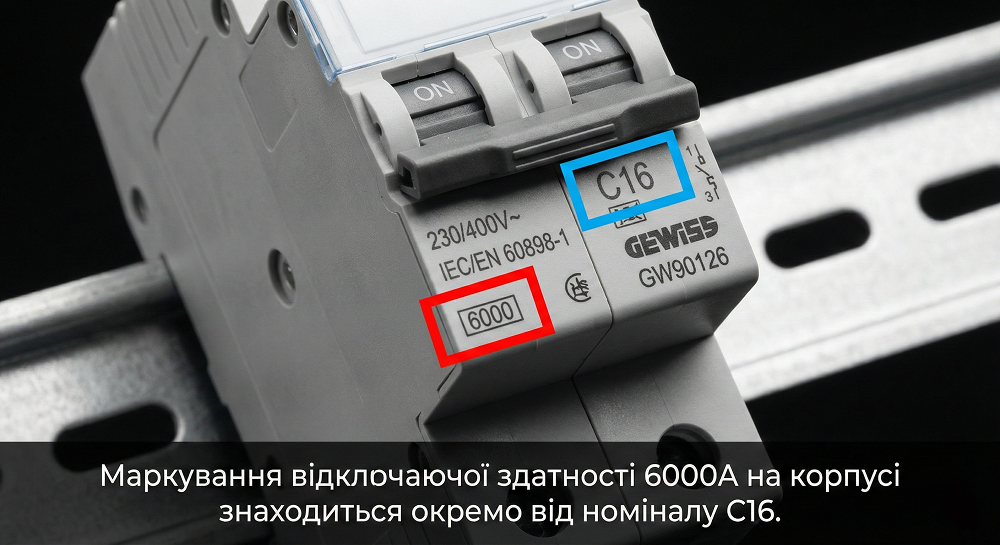
❓ Where can I find the 4500 or 6000 marking on the housing?
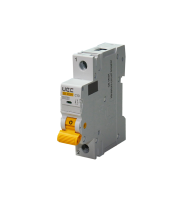
Look for the number in a rectangular frame on the front of the device, usually below the toggle lever or next to the technical specifications. It is always indicated in Amperes (4500, 6000, 10000).
❓ What will happen if I install a 4.5kA breaker in a new building?
You are creating a time bomb. During the first serious short circuit (for example, if you cut through a cable with a hammer drill), there is a high risk of contact sticking. The breaker may simply fail to disconnect the line, and the apartment will have to be protected by the main breaker in the floor panel — if it trips.
Conclusion
Choosing a breaker by breaking capacity is not a matter of economy, but a matter of safety. The price difference between 4.5 kA and 6 kA is minimal, while the consequences of the wrong choice can cost much more.
Don't skimp on breaking capacity. The price difference between 4.5 kA and 6 kA is insignificant, while the difference in peace of mind is enormous. Take care of yourself and your networks.
— Oleg Lukyanchuk, UEC Engineer