
Article Contents
Consequences of Incorrect Circuit Breaker Selection: Hidden and Obvious Hazards

Hello, I'm Oleh Lukianchuk, Technical Training Engineer and Chief Expert Reviewer at UEC. I have over 12 years of experience in electrical engineering, including maintenance of railway safety systems.
In this article, we will explore the dangers of incorrect circuit breaker selection — from hidden wiring overheating to real fire risk — and how to avoid them with a simple selection algorithm.
Quick Answer in 30 Seconds: What Happens If the Breaker Has the "Wrong" Rating
A circuit breaker has only one function — to protect cable lines from overheating and short circuits, not to provide comfort or "stop it from tripping." If you get the rating wrong, there are only two scenarios, and both are unpleasant.
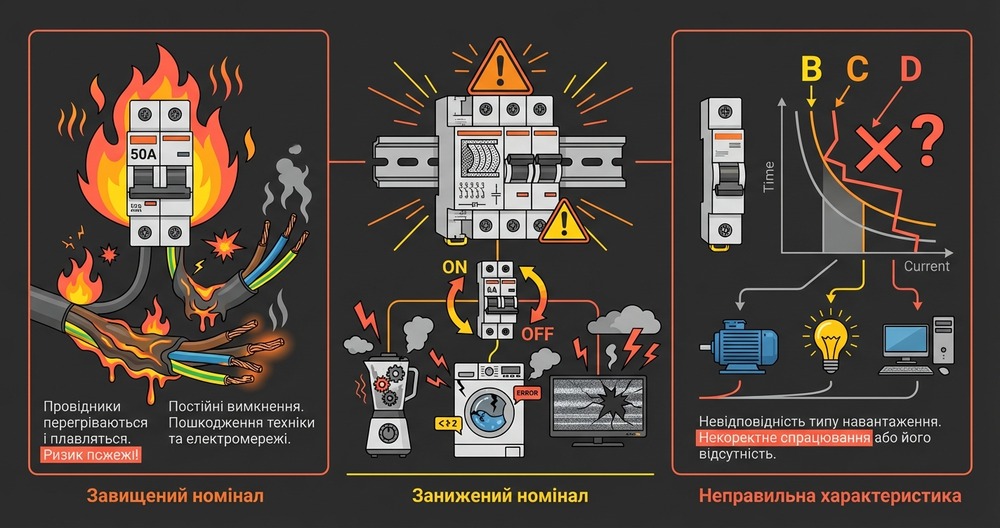
With an oversized rating (for example, 25A on a 2.5 mm² wire), the cable starts working as a heating element. Insulation melts, contacts burn out, and the breaker stays "silent" because this current is still normal for it. This is a direct path to fire. With an undersized rating, you get constant power outages when turning on a kettle or iron, which over time will "kill" the breaker mechanism and connected equipment. And a mistake with the characteristic (B, C, D) will result in the breaker either tripping when starting a vacuum cleaner, or not tripping instantly during a short circuit at the end of a long line.
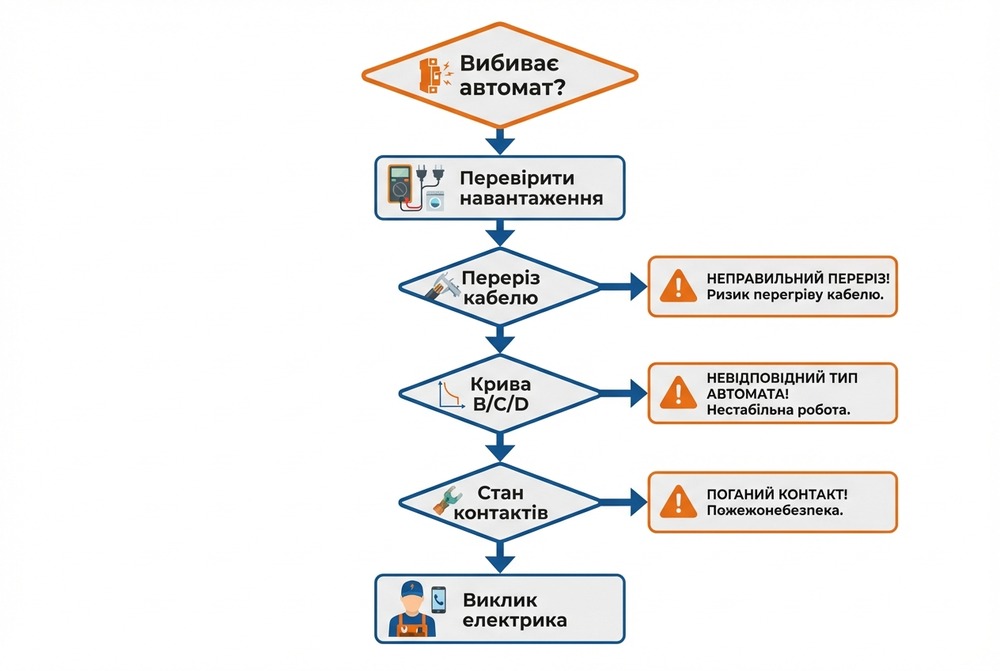
How Dangerous Is the Wrong Circuit Breaker: Consequences of Installing an Oversized Rating
If you install an oversized breaker, the consequences of the wrong selection can be critical: the cable overheats, and the protection does not trip in time during overload or certain fault conditions. The worst part is that the problem often remains "invisible" for years — insulation ages, plasticizer evaporates, contacts in junction boxes oxidize, while the breaker continues to carry current above the line's permissible level.
Therefore, the consequences of wrong circuit breaker selection, especially if you install an oversized breaker, are not a matter of convenience but a real risk of losing your home. While working on the railway, I saw how oversized fuse ratings in automation systems led to charring of entire wiring harnesses, endangering traffic safety. In residential settings, the physics is the same. There is only one correct approach: the breaker rating must be selected strictly according to the cable cross-section and material.
Main threats of an oversized rating:
- Overheating of copper or aluminum conductor and accelerated insulation degradation (it becomes brittle and crumbles).
- Failure to trip promptly during network overload.
- Fire risk at connection points, in the panel, or directly in outlets.
- Damage to expensive household equipment due to operation in fault conditions.
"Installing a higher-rated breaker (e.g. replacing a 15A with a 20A) means the breaker will allow more current to flow than the wire can safely handle. The wire will dangerously overheat before the breaker trips, risking an electrical fire"
— Any Hour Services [1]
This confirms the rule: the breaker protects the cable, not the appliances.
Regulatory basis for verification:
National standards and PUE (Electrical Installation Rules) clearly regulate protection selection (clause 3.1.4). International standards IEC 60898-1 (for residential breakers) and IEC 60947-2 (for industrial switchgear) are also applicable.
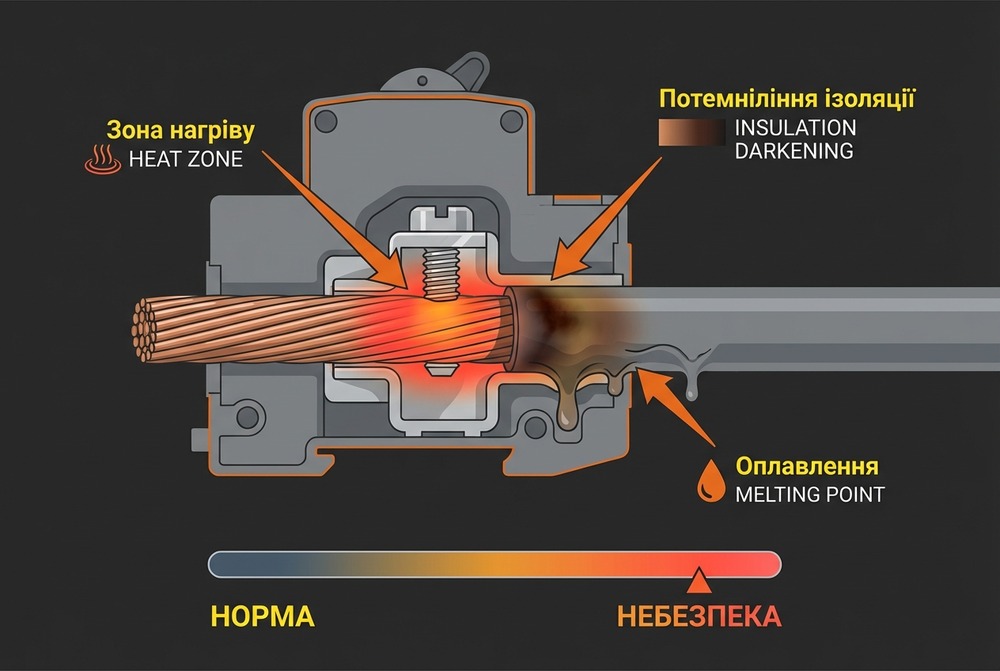

Warning! Working with electrical equipment is life-threatening!
All work in the electrical panel must be performed only by qualified electricians with the power disconnected. Before starting work, be sure to de-energize the line and verify the absence of voltage with a measuring device.
Scenario 1 — Oversized Rating: Why This Is the Most Dangerous
Why the Wiring Melts While the Breaker Doesn't Trip
A breaker protects a line only within its thermal (bimetallic strip) and magnetic characteristic. The principle is simple: the thermal release trips on a small but prolonged overcurrent (overload), while the magnetic release trips instantly on a short circuit.
If the breaker rating is higher than the cable's permissible current (for example, 25A installed on a cable rated for a maximum of 18A), the cable starts to heat up before the bimetallic strip reaches its trip temperature. You are heating your walls, and the protection "doesn't know" about it. Risks increase exponentially if you have aluminum wiring, old Soviet-era cables, poor connections in twists, or use cheap extension cords.
In the UEC laboratory, we simulated the situation: a 1.5 mm² cable under a 22A load (a C25 breaker "holds" this current for over an hour) heated up to 60°C within 15 minutes. The insulation started to soften. AutomationDirect research also emphasizes this effect:
"Excessive current can heat conductors and insulation, degrade components, and in extreme cases, ignite surrounding materials"
— AutomationDirect [2]
Learn more about how to calculate the correct parameters in our article on circuit breaker calculation by power and current.
Fire as the Final Consequence of Overload: Where Fires Start Most Often
Top 3 "Weak Points": Terminals, Outlets, Junction Boxes
Signs of trouble are often ignored until the very end. These include the distinctive "fishy" smell of overheated plastic, darkening of outlet housings, or a characteristic crackling sound.
Electrical Wiring Problem Diagnostics
| Symptom | Probable Cause | Action |
|---|---|---|
| Breaker trips when turning on a kettle | Actual line overload (not a "weak breaker") | Distribute the load across different outlets/circuits |
| Burning smell near an outlet | Poor contact or wire overheating | Immediately de-energize, check terminal tightness |
| Darkened terminals in the panel | Oversized rating or loose terminal | Replace breaker with one matching the cable, tighten (with torque wrench) |
| Crackling in junction box | Overheated twist or Wago connector (non-genuine) | Call an electrician to re-pack the junction box |
Safe Rating Table for Cables (Copper/Aluminum) + FAQ
This table is a reference guide for a quick audit of your panel. Keep in mind that the actual permissible current depends on the installation method (in wall, in conduit, bundled).
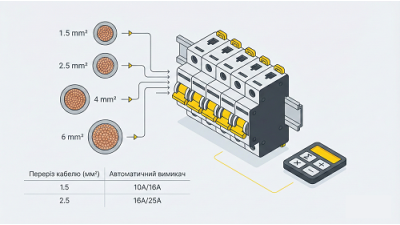
Recommended Breaker Ratings for Residential Cables
| Material (Cu/Al) | Cross-Section (mm²) | Approximate Rating (A) | Typical Application | Notes (Installation Method) |
|---|---|---|---|---|
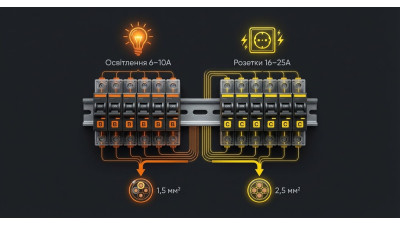
| Copper (Cu) | 1.5 | 10 - 16* | Lighting | *16A only for single cable runs |
| Copper (Cu) | 2.5 | 16 - 20* | Outlet circuits | *20A with quality cable, standard is 16A |
| Copper (Cu) | 4.0 | 20 - 25 | Heavy loads (cooktop, water heater) | Reduce rating if bundled |
| Copper (Cu) | 6.0 | 32 | Main supply/cooktop | Check appliance terminals |
| Aluminum (Al) | 2.5 | 10 - 13 | Legacy lighting | Aluminum creeps under pressure, needs re-tightening |
| Aluminum (Al) | 4.0 | 16 | Legacy outlets | Consider insulation age |
⚠ Important note on bundled installation: If several cables run side by side in a chase or cable tray ("bundle"), they heat each other. In this case, the permissible current is reduced, and a derating factor (0.8-0.9) must be applied. That is, for a 2.5 mm² cable in a bundle, it is safer to install a 16A rather than a 20A breaker.
For precise selection under specific conditions, use our breaker selection table by cable cross-section and power.
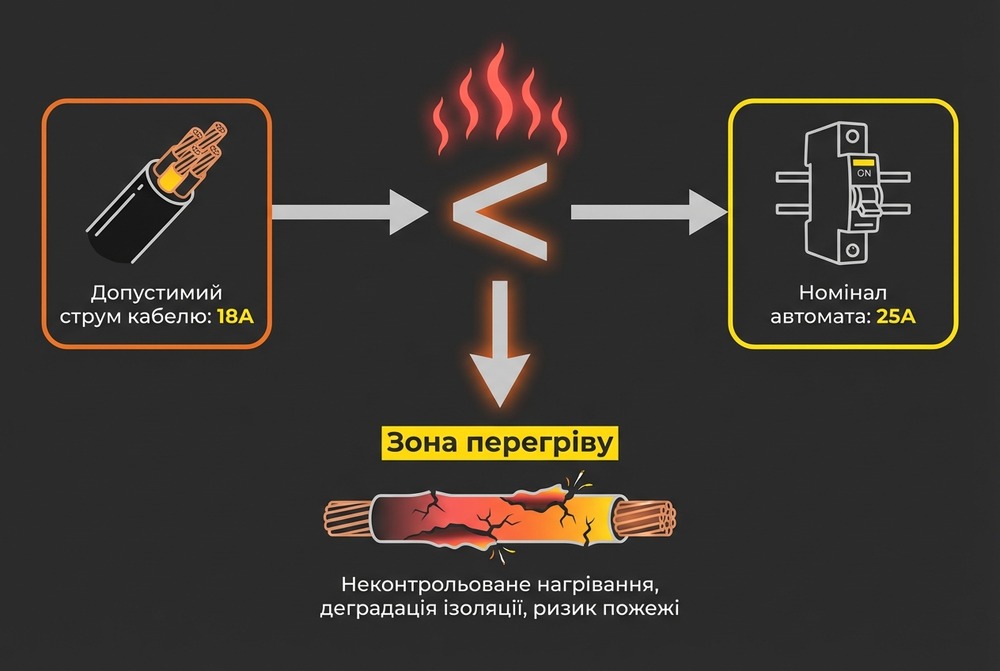
Scenario 2 — Undersized Rating: Inconvenience, Wear, and Wrong Conclusions
Constant Power Outages Under Load: What This Means in Practice
When the rating is chosen lower than the calculated load on the line, you face "false" trips (nuisance tripping). Causes:
- Total load exceeds the rating (kettle + microwave = 3.5 kW, which is more than 16A).
- Old breaker has "worn out" (bimetallic strip deformed from repeated overheating).
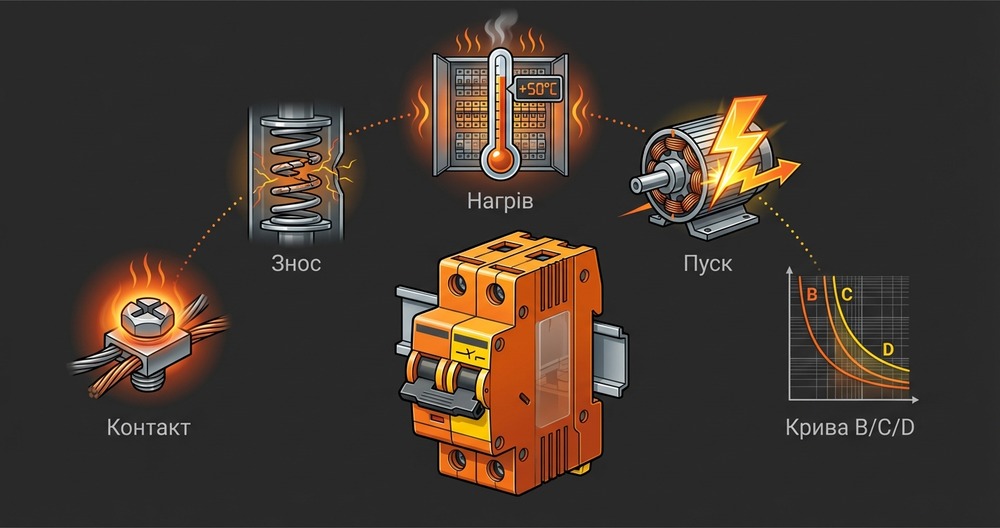
- Poor terminal contact heating the breaker itself, making it "think" an overload has occurred.
The consequences are not just about discomfort. Constant clicking leads to rapid wear of the breaker's contact group (carbon deposits form), and sudden disconnections can damage refrigerator compressors and electronics. Users often draw the wrong conclusion: "the breaker is bad/weak, I need a stronger one," and replace 16A with 25A without changing the cable. This way, they create Scenario 1 (fire hazard) with their own hands.
"A mismatched breaker may not trip on an overload or short circuit... or cause frequent nuisance tripping"
— ProElectric VA [3]
An undersized rating is safer than an oversized one, but makes using the electrical system impossible.
Load Calculation for Household Appliances:
| Appliance | Power (W) | Approximate Current (A) |
|---|---|---|
| Electric kettle | 2000 - 2400 | 9 - 11 A |
| Vacuum cleaner | 1400 - 1800 | 6 - 8 A |
| Water heater | 1500 - 2000 | 7 - 9 A |
| Total | 5000+ | > 22 A (16A breaker will trip) |
If your breaker is tripping, check the load before running to the store.
Trip Curve Selection Error (B, C, D): When the "Right Rating" Still Doesn't Work
Inrush Currents: Why It Trips on a Vacuum Cleaner, Pump, Compressor, Refrigerator
It often happens: the rating is 16A, the load is 10A, but the breaker trips when starting a vacuum cleaner or a machine tool. The problem is the letter before the number — B, C, or D. This is the type of instantaneous tripping (or electromagnetic sensitivity to inrush currents).
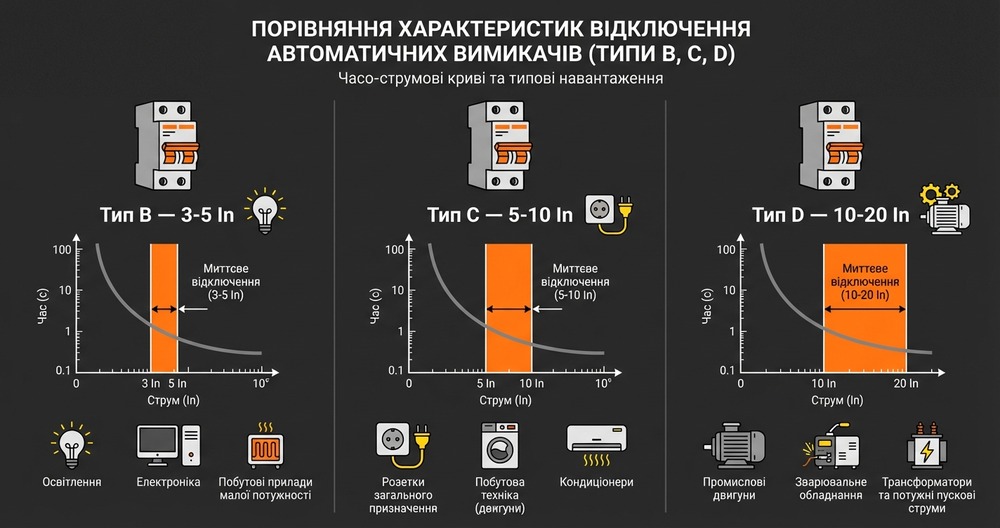
Type B (3-5 In)
Most sensitive. Ideal for long lines, old building stock, lighting, and resistive heating appliances (water heater, cooktop).
Type C (5-10 In)
"Gold standard." Handles moderate inrush currents from household appliances (refrigerators, air conditioners, office equipment).
Type D (10-20 In)
"Industrial." Needed for electric motors with heavy starting (machine tools, pump stations).
Learn more about the difference between curves in our article: what is the difference between B, C, and D circuit breakers.
What Wrong B/C/D Selection Leads To
- B instead of C: Constant nuisance tripping even when starting a powerful computer or vacuum cleaner.
- D "to stop it from tripping" in an apartment: This is dangerous. If your line is long and old, the short circuit current may be low (for example, 80A). A D16 breaker (which needs 160A+ for instantaneous tripping) will treat this short circuit as a normal overload and will trip in seconds, not milliseconds. During that time, the wiring can ignite.
Trip Characteristic Comparison
| Curve | Application Area | Typical Load | Error Risk |
|---|---|---|---|
| B | Apartments, long lines | Incandescent lamps, heating elements | Nuisance tripping on electronics |
| C | Universal (residential/office) | Outlets, household appliances | Won't trip on short circuit on very long line |
| D | Workshops, main supply | Electric motors, transformers | Delayed tripping leading to fire (residential) |
"Type D does not solve the overload problem — it only changes the instantaneous trip threshold for inrush currents. Installing D in an apartment with poor wiring 'to stop it from tripping' is criminal negligence."
— Oleh Lukianchuk, UEC Expert
In doubtful cases, especially when selecting protection for outlets and lighting, C characteristic is the safest compromise.
Breaking Capacity (kA) and Brand Quality: Why Saving Can Cost More
What Is kA and How It Affects Safety
The numbers 4500, 6000, 10000 in the rectangle on the housing — this is the ultimate breaking capacity (kA). It is the "impact force" the breaker can withstand during a severe short circuit without exploding.
- 4.5 kA: Budget segment, old residential buildings.
- 6 kA: Modern standard for apartments and houses.
- 10 kA: If you live near a transformer substation or this is a main breaker in the distribution board.
Choosing a device with insufficient breaking capacity (for example, 4.5 kA near a substation) means the risk that during a short circuit, the contacts will weld, the housing will be destroyed, and the arc will burst outward. We covered how to choose the right value in our guide: which breaker breaking capacity to choose: 4.5 kA, 6 kA, or 10 kA.
How to Identify a Counterfeit and "No-Name" Risks
Saving 50 hryvnias on the brand can cost you your entire panel. Counterfeits often have reduced weight (less copper inside), poor plastic (burns instead of self-extinguishing), and no arc-chute chamber.
Pre-purchase verification checklist:
- Marking: Clear, doesn't smudge when rubbed.
- Weight: A quality breaker (Gewiss, Eaton) feels noticeably heavy.
- Terminals: Should be rigid with serrations to hold the wire.
- Batch code: Serial number or QR code for verification on the manufacturer's website.
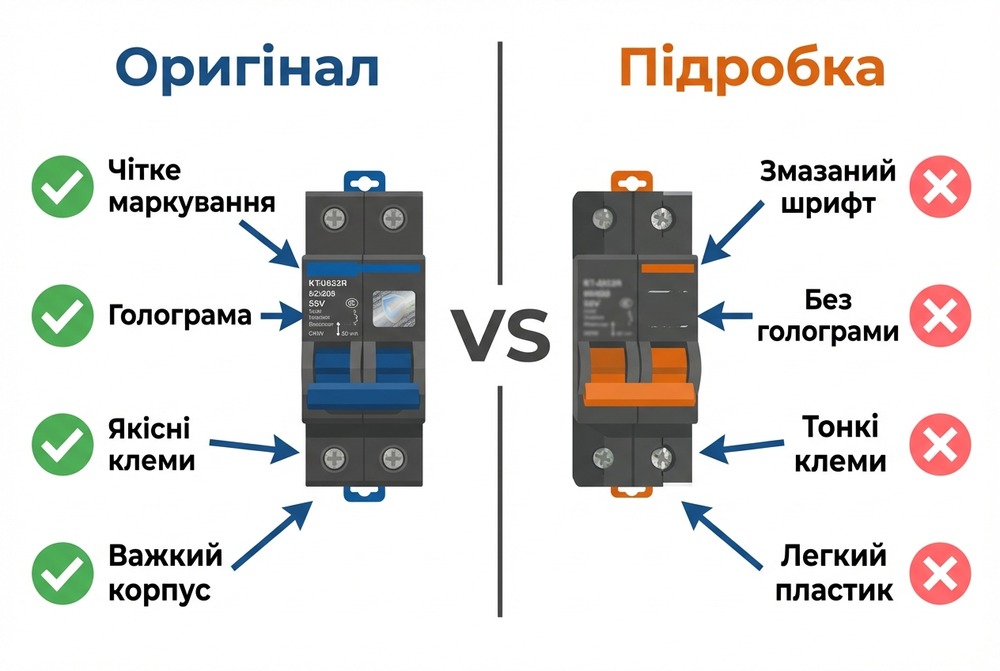
How to Choose the Right Circuit Breaker: A Quick Selection Algorithm (No Fluff)
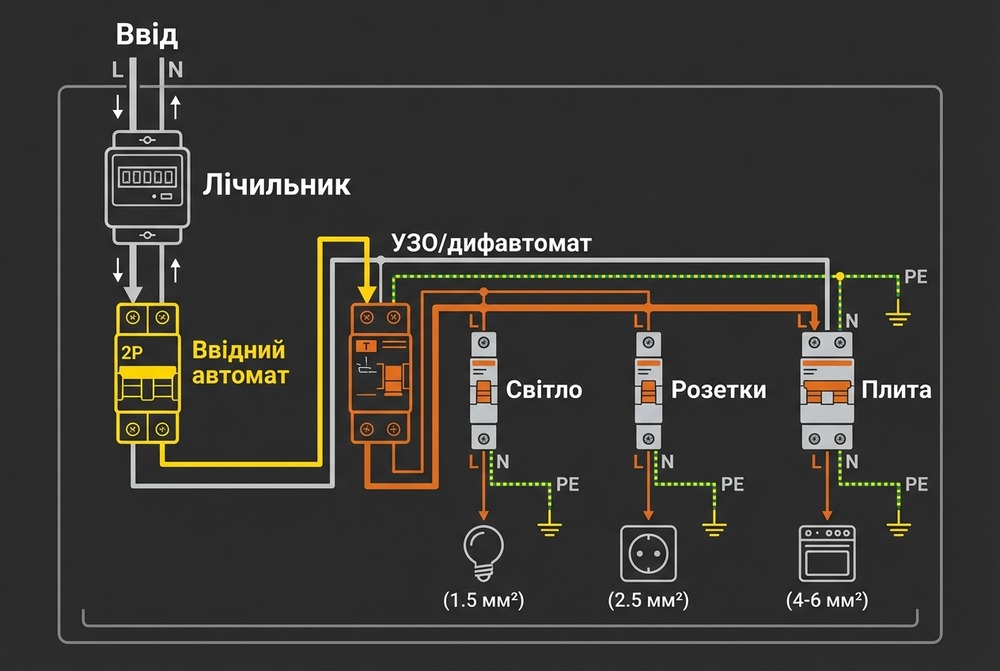
Step 1 — Identify the Line and Cable: What the Breaker Actually Protects
Electrician's axiom:
The breaker is selected for the weakest link in the line. If you have a 2.5 mm² cable from the panel that transitions to 1.5 mm² further along — the breaker must be rated for 1.5 mm² (i.e., maximum 10-13A, not 16-20A).
Checking "Cable ↔ Breaker" Compatibility
Inspect the wiring:
- Material (Copper or Aluminum?)
- Cross-section (Measure with calipers if markings are worn).
- Insulation condition (Are there cracks?).
Step 2 — Calculate Load Current (For Reference)
Single-Phase 230V Network: Formula and Example
For most appliances, the formula is simple:
Formula:
I (Current) = P (Power in W) / 230 (Voltage).
Example: A kitchen where a kettle (2 kW) and microwave (1 kW) run simultaneously. I = 3000 / 230 ≈ 13 A, which fits perfectly within a 16A breaker.
Three-Phase 400V: Formula and Example
This is more complex, especially for motors:
Formula:
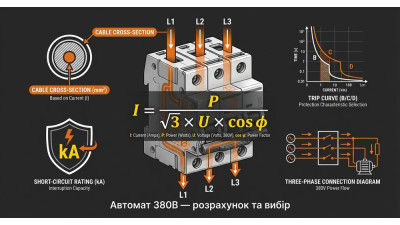
I = P / (√3 × 380 × cos φ).
A detailed example can be found in our article on calculating the rating for a 380V network.
Calculation for Typical Scenarios
| Scenario | Power | Voltage | Calculated Current | UEC Comment |
|---|---|---|---|---|
| Kitchen outlet group | 3500 W | 230 V | ~15.2 A | 16A breaker is borderline, better to split into 2 groups |
| Well pump | 1.5 kW | 230 V | ~8-10 A (start) | Account for inrush current, C curve |
| Three-phase motor | 5 kW | 380 V | ~9-10 A | Requires 3-pole breaker 10-16A (D/C curve) |
Step 3 — Select the Rating, Type (B/C/D), Number of Poles, and kA
Rating (A): "Lower/Higher" Selection Logic and Why "With a Safety Margin" Is Dangerous
Choose the nearest lower or equal to the cable's permissible current rating. The safety margin should be in the cable's current-carrying capacity, not in the "strength" of the breaker.
Number of Poles (1P/2P/3P/4P): When to Disconnect the Neutral
In apartment panels, 1P (single-pole) breakers are typically used on branch circuits, breaking only the phase. The main breaker should preferably be 2P (breaking both phase and neutral) to completely de-energize the dwelling for safe maintenance. More details: when to install a single-pole or double-pole breaker.
Number of Poles Selection
| Network/Line | Recommended Poles | Comment |
|---|---|---|
| Single-phase (branch circuits) | 1P | Saves space in the panel |
| Single-phase (main) | 2P (1P+N) | Complete de-energization + protection from "neutral burnout" |
| Three-phase (motor) | 3P | Without neutral |
| Three-phase (main/distribution) | 4P (3P+N) | Mandatory if there is asymmetric load |
Technical review by: Oleh Lukianchuk, Electrical Engineer, January 2026.
Common User Mistakes (and How to Avoid Them) — A Quick Anti-Checklist
❌ "To stop it from tripping" → installing a higher rating
This is a classic mistake that leads to the situations described in the oversized rating consequences section. If it trips — look for the cause in the load, don't "treat" symptoms by replacing the breaker.
❌ Ignoring total load and operating modes (heaters, water heater, kitchen)
Running a washing machine, water heater, and hair dryer on one line is a bad idea. Distribute heavy appliances across separate breakers ("dedicated lines").
❌ Selecting only by amperage without B/C/D and kA
Buying "a 16 Amp breaker" is not enough. You might accidentally buy B16 instead of C16 and have trouble with equipment startup, or buy 4.5kA for a house near a substation and risk safety.
❌ Saving on quality and installation (terminals, tightening, busbar)
Even the best GEWISS breaker won't save you if the wire in the terminal is not tightened. A poor contact heats up more than overload. Use busbars instead of wire jumpers.
Anti-Checklist (check yourself):
Click on an item to mark it as completed:
What to Do Right Now: Safe Actions If the Breaker Trips or "Doesn't Respond"
If It Trips Frequently — 5 Diagnostic Steps (Without Opening the Panel)
- Turn off some appliances. Leave only the essentials.
- Find the "provocateur." Turn on appliances one at a time. If it trips on a specific appliance — the problem is with it (short circuit in the cord, heating element breakdown).
- Remove power strips. They often create poor contacts and single-point overloads.
- Inspect the outlets. Are there signs of carbon deposits?
- Call a professional. If it trips even with no load — the problem is in the wiring or the breaker itself.
If There's a Burning Smell/Panel Overheating — Immediate Actions
Don't wait for smoke. If you notice a sharp "chemical" smell — immediately switch off the main breaker (the most important one). Do not touch exposed parts or even the panel housing if it is metal and hot. Call the emergency service or an electrician.
⚠ WARNING: Immediately de-energize the premises and contact a professional if you notice: burning insulation smell, smoke from outlets/panel, sparks, abnormal heating of switch housings.
Selecting a Breaker for Purchase: How Not to Make a Mistake in the Catalog
Which Parameters to Select in Filters: Rating, Curve, kA, Poles, Series
When you open the UEC online store catalog, use filters in this order:
- Rating: Strictly matching your cable (e.g., 16A for 2.5 mm²).
- Characteristic: "C" for most tasks, "B" for old buildings.
- Breaking capacity: 6 kA (optimal).
- Poles: 1P for branch circuits, 2P for main supply.
- Brand/Series: Choose reliable (GEWISS, UEC).
You may need these sections of our website:
- Circuit breakers (full catalog)
- Modular breakers for residential use
- RCBOs/RCDs (additional protection)
Ready-Made Solutions for Typical Tasks
| Task | Line Type (copper) | Recommended Protection | Additional |
|---|---|---|---|
| Room outlet protection | 2.5 mm² | 16A, Char. C, 6kA, 1P | RCD 30mA (mandatory) |
| Apartment main supply (gas cooktop) | 6.0 mm² | 32A - 40A, Char. C, 6kA, 2P | Voltage relay |
At UEC, we also provide a "Selection by Photo" service. Send a photo of your old panel to our engineers, and we'll help you avoid mistakes. But remember: the final decision is with the technician on site.
FAQ — Quick Answers to the Most Common Questions
❓ Can I install a higher-rated breaker if the old one keeps tripping?
No, absolutely not without replacing the cable. This significantly increases fire risk because the cable will start overheating before the protection trips. First, calculate the load and check the condition of the contacts.
❓ Why does a 16A breaker trip even though the load is "small"?
There can be several reasons: worn breaker mechanism, poor terminal contact (causing heating), or brief inrush currents from powerful equipment. Check the total power of all appliances.
❓ What's more important — the rating or the B/C/D curve?
Both parameters are critical. The rating protects the cable from overheating, while the curve (B/C/D) is responsible for proper handling of inrush currents (so the vacuum cleaner doesn't trip it) and the speed of disconnection during a short circuit.
❓ What breaking capacity (kA) should I choose for an apartment/house?
For a typical urban apartment, 4.5 kA is sufficient, but 6 kA is a more reliable modern standard. For a private house, especially if it's close to a transformer, a minimum of 6 kA is recommended, preferably 10 kA.
❓ Can I replace a breaker without replacing the cable?
Yes, provided that the new breaker rating matches the cross-section and material of the existing cable. Installing a more powerful breaker on an old, weak cable is prohibited.
❓ What's the difference between a circuit breaker and an RCBO/RCD?
A standard circuit breaker protects wiring from short circuits and overloads. An RCD protects people from electric shock (leakage current). An RCBO is a combined "2-in-1" device. A circuit breaker does not replace an RCD.
Sources and Regulatory References (for Verification)
At UEC, we rely exclusively on official standards and verified research:
- IEC 60898-1 — International standard for residential circuit breakers.
- PUE (Electrical Installation Rules), clause 3.1.4 — Selection of rated currents for fuses and releases.
- R 50030.2-2010 (IEC 60947-2) — Requirements for industrial switching equipment.
- [1] Any Hour Services — Research on risks of replacing breakers with higher ratings: Decoding Your Breaker Box.
- [2] AutomationDirect — Analysis of fire causes due to improper protection: 5 Circuit Protection Mistakes.
- [3] ProElectric VA — Consequences of mismatched breakers: The Dangers of Mismatched Circuit Breakers.
- [4] Schneider Electric Blog — Technical explanations regarding 80% vs 100% rated breakers.
How we prepare materials: Every UEC article undergoes a two-stage review: technical fact-checking by engineers (compliance with PUE/DSTU) and editorial proofreading for clarity. We regularly update data in accordance with changes in standards.