
Article Contents
Nuisance Tripping of Circuit Breakers: Causes, Diagnosis, and How Wrong Trip Curves Exacerbate the Problem


Key Takeaways
False circuit breaker tripping means the breaker disconnects without actual overload or short circuit. Causes include: loose terminals, mechanism wear, panel overheating, appliance inrush currents, or an incorrectly selected B/C/D trip curve.
Key point: 80% of "defective" breakers are actually the result of a loose terminal or improper selection. Step-by-step diagnostics and correct selection solve the problem without unnecessary expense.
Hi, I'm Oleksandr, an electrical engineer with 15 years of experience in low-voltage switchgear. I work at UEC — the official GEWISS distributor in Ukraine.
In this article, we'll examine why a circuit breaker may trip without an apparent cause, how to perform diagnostics, and why an incorrectly selected trip curve amplifies the problem.

Warning! Working with electrical equipment is life-threatening!
All work in the electrical panel must be performed only by qualified electricians with the power disconnected. Before starting work, be sure to de-energize the line and verify the absence of voltage with a measuring device.
What Is False Circuit Breaker Tripping and Why Does It Happen?
False tripping is a situation where the circuit breaker trips without exceeding the rated load and without an obvious short circuit. You simply turn on the light, and the panel goes dark. Often the problem is not the current, but the physics of contacts, temperature, or mechanism wear.
In my experience on the railway, where we serviced ALSN systems, the "mystery" of disappearing voltage always had a specific cause: from vibration loosening terminals to oxidation. In residential settings, the scenario is similar: it's important to distinguish real network protection from situations where the breaker trips due to an internal defect or external heating.
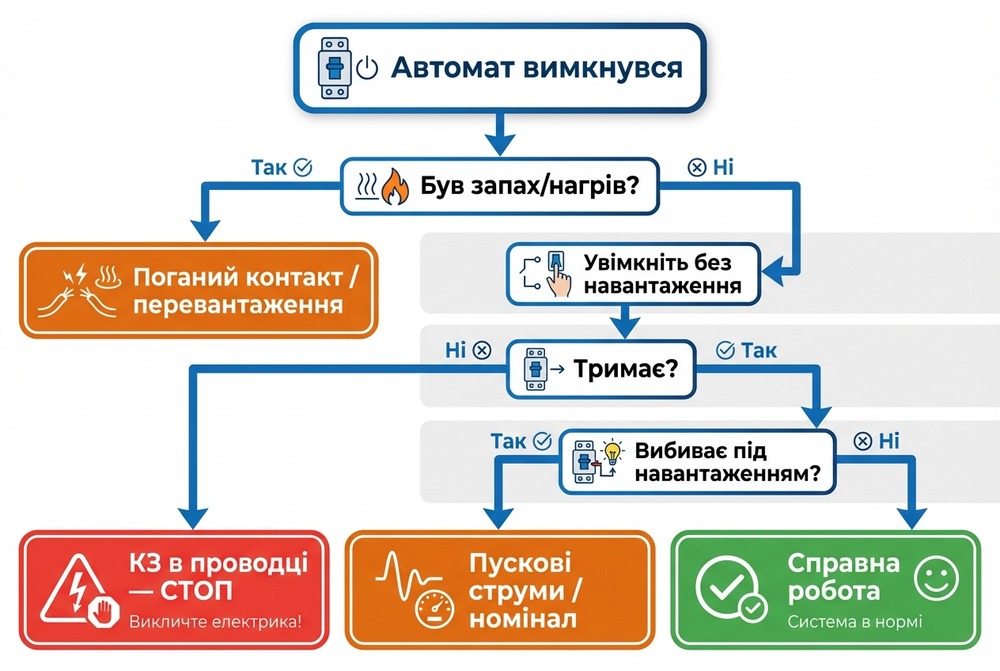
- The breaker has tripped. Was there a smell of burnt insulation or housing overheating?
- Yes: Likely a poor terminal contact (overheating) or overload.
- No: Try re-energizing (without load).
- Does it hold? If not — the problem is in the breaker mechanism or a short circuit in the wiring.
- Holds, but trips under load? Check inrush currents or rated current compliance.
Regulatory framework:
- IEC/EN 60898-1: Standard for circuit breakers for overcurrent protection for household use.
- IEC/EN 60947-2: Requirements for industrial switching apparatus.
- PUE: Electrical Installation Code (Section 3.1).
Main Causes of Tripping Without Overload (Top 5)
Loose Contacts and Terminal Overheating (Thermal Release Effect)
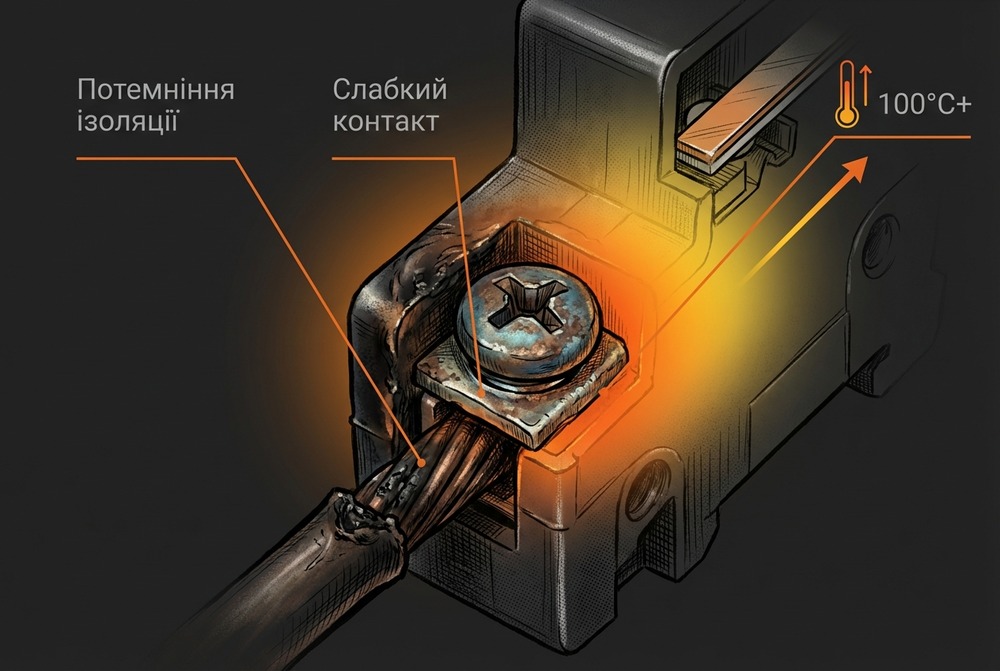
Copper has a tendency to "flow" under pressure, and temperature cycles (heating-cooling) gradually loosen screw clamping over time. This creates transition resistance. Even at 10A, a poor contact heats the terminal to 100°C and above. The heat transfers to the bimetallic strip inside the breaker, and it trips, "thinking" there is an overload on the line.
Diagnostics: A characteristic smell, darkening of the wire insulation near the breaker input.
Solution: Use a torque screwdriver. The standard tightening torque for residential series (e.g., GEWISS or our UEC) is 2–2.5 Nm.
⚠ Warning! Terminals may only be tightened with the main breaker fully de-energized.
"80% of so-called 'defective' breakers that we replace on service calls in Kyiv new-builds are actually the result of an under-tightened terminal or a missing ferrule on a stranded wire"
— Oleksandr Petrenko, Chief Power Engineer of the installation division, Kyiv
Mechanism Aging and Wear
The springs of the free-trip mechanism lose their elasticity, and contacts burn out after each disconnection under load (especially short circuits). The breaker becomes "oversensitive" and may trip from vibration (slamming the panel door) or at 50–60% of rated current.
| Symptom | What It Means | What to Do |
|---|---|---|
| Toggle does not latch (falls down) | Mechanical latch failure | Replacement only |
| Housing crackles/buzzes | Burnt contacts inside | Replacement + load check |
| Trips at current < In | Bimetallic strip fatigue | Replace with same series equivalent |
Effect of High Panel Temperature (Derating)
Circuit breakers are calibrated at +30°C. If the panel is at +50°C (due to dense installation, summer heat, or heat from adjacent devices), the breaker's effective rating decreases. A 16A breaker may start tripping at just 13–14A. Read more about proper selection considering operating conditions in our article on calculating the rated current for a 220V circuit.
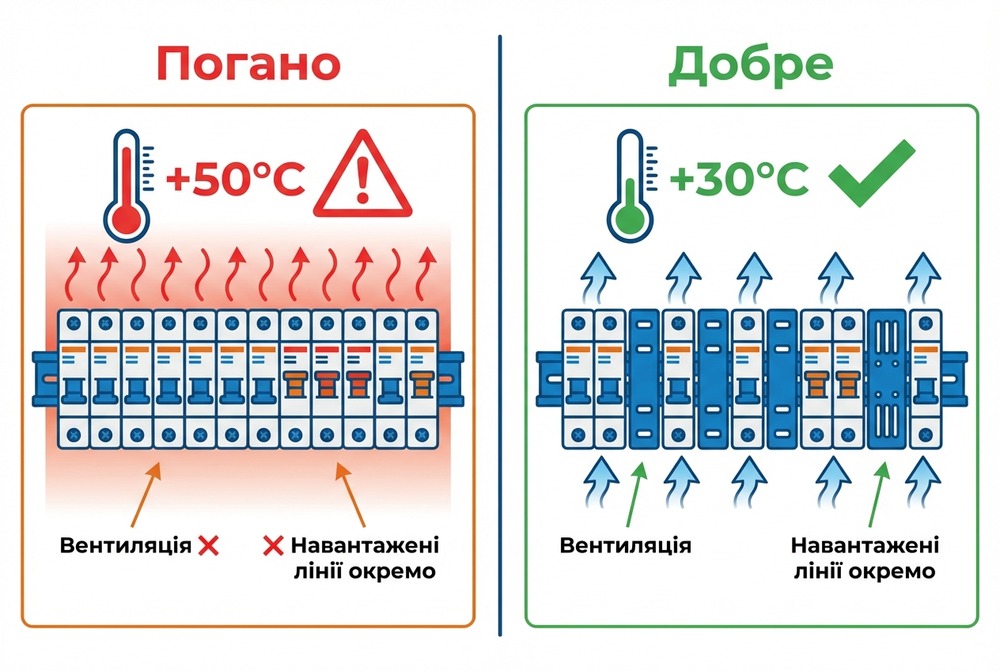
- Install ventilation blanking plates between heavily loaded breakers.
- Do not block the panel's perforation openings.
Inrush Currents of Household Appliances (Motors/Compressors/Switch-Mode PSUs)
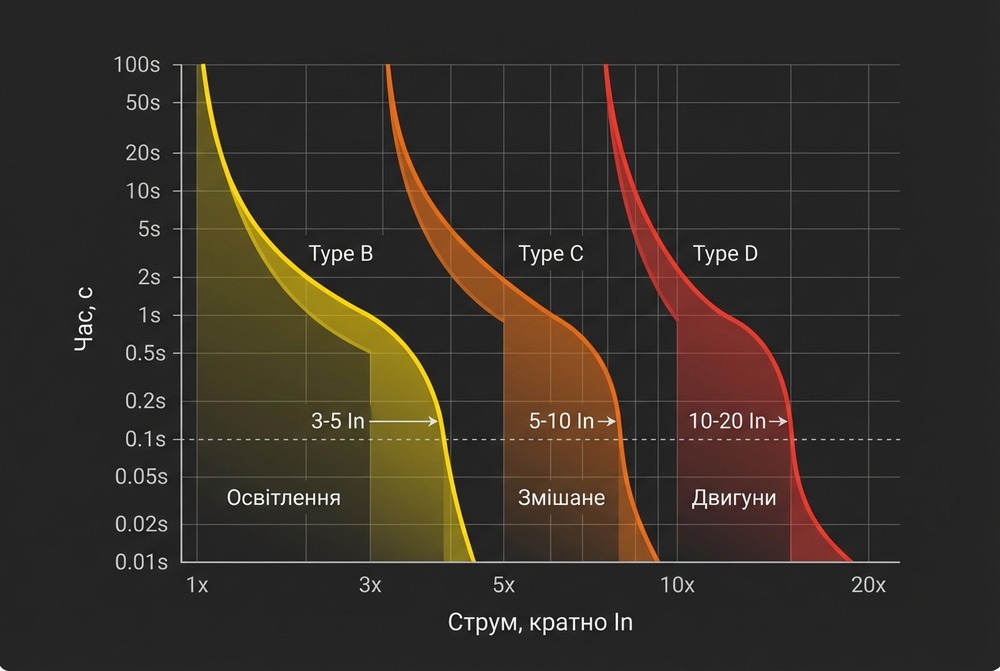
When starting, an electric motor draws current 5–7 times higher than rated. This lasts fractions of a second, but the breaker's magnetic release may interpret it as a short circuit if the trip curve is selected incorrectly. This is a classic problem with pumps, powerful vacuum cleaners, and workshop equipment. To understand the nuances, we recommend reading the article on the differences between B, C, and D trip curve breakers.
Typical Inrush Currents of Household Appliances
| Load Type | Inrush Multiplier (x In) | Recommended Curve |
|---|---|---|
| LED drivers (group) | up to 100x (microseconds) | C |
| Vacuum cleaner / Refrigerator | 5–7x | C or (rarely) D |
| Borehole pump | 7–10x | C or D |
Incorrect Breaker Characteristic Selection (In, B/C/D, Icu)
Installing a breaker "with a margin" (e.g., C25 instead of B16 for outlets) is playing with fire. And installing an overly sensitive breaker (B10 on a garage line with a compressor) guarantees constant tripping. The breaking capacity of the circuit breaker is also often ignored — if the short-circuit current near a substation exceeds 4.5 kA, a cheap breaker may fuse its contact group but fail to disconnect the line.
Express checklist:
- What is the cable cross-section? (1.5 / 2.5 / 4 mm²)
- Load type? (Lighting / Outlets / Motor)
- Distance to transformer? (Private sector / Apartment building)
- Result: If you have a motor and a long line — C or D. If old aluminium wiring — B only.
⚠ Safety: Any work in the electrical panel — only with the main breaker switched off. If you smell burning plastic, immediately de-energize the premises at the floor panel.
Why Does the Breaker Trip When Turning On Powerful Appliances (Vacuum, Boiler, Heater)?
This is one of the most common questions that UEC technical support receives. Let's examine in detail why the breaker trips when you turn on a vacuum cleaner or other powerful appliance.
High Motor Inrush Current
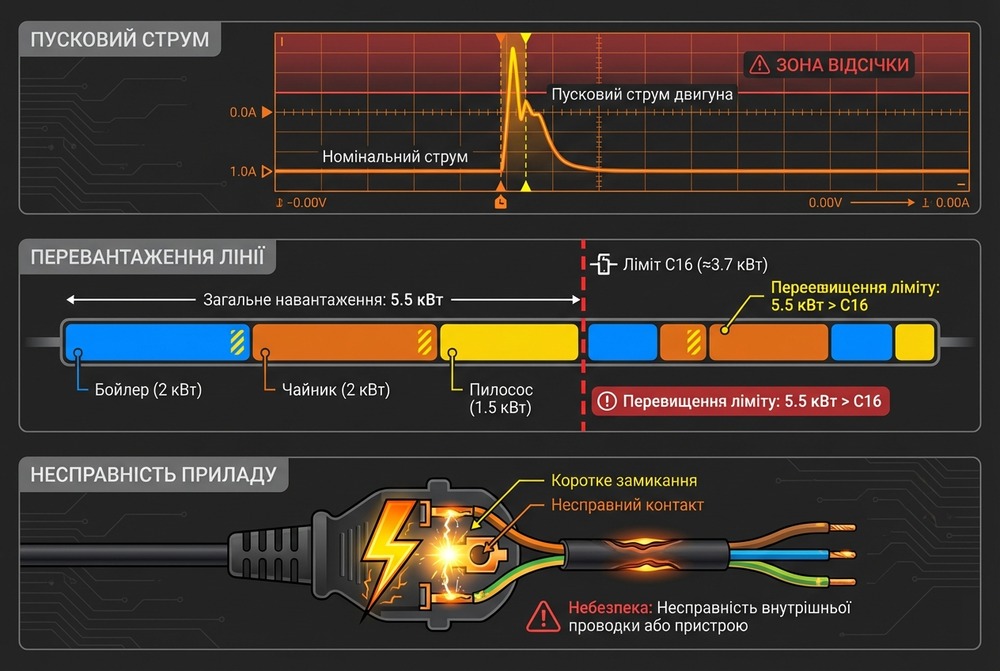
A vacuum cleaner has a powerful collector motor. At the moment of start-up, while the rotor hasn't spun up, it draws current significantly exceeding the rated 1600–2000 W. If the line has a breaker with a B trip curve (instantaneous tripping range 3–5 times rated), the inrush spike may fall into the cutoff zone. This is not a vacuum cleaner malfunction — it's the physics of transient processes. The solution is using a breaker with a C trip curve.
Simultaneous Line Overload
Often the "vacuum cleaner is to blame" only formally. If one line (e.g., kitchen + hallway) already has a boiler (2 kW) and an electric kettle (2 kW) running, adding a vacuum cleaner (1.5 kW) overloads the circuit to 5.5 kW (25 Amps). The thermal release of a C16 breaker will respond within 10–40 seconds. Check the load distribution across groups. Read more about this in the article which breaker to choose for outlets and lighting.
Appliance or Outlet Fault
If it trips instantly with a "click" sound, there may be a short circuit in the plug, cord, or appliance motor. The cause may also be a damaged outlet where contacts short from mechanical movement of the plug.
Video summary:
- Check the cord for insulation damage.
- Plug the vacuum cleaner into a different outlet on a different line. If it trips there too — the appliance needs repair.
- If it works — the problem is in the first line's overload or the breaker's trip curve.
What to Do When a Breaker Trips: Step-by-Step Diagnostics
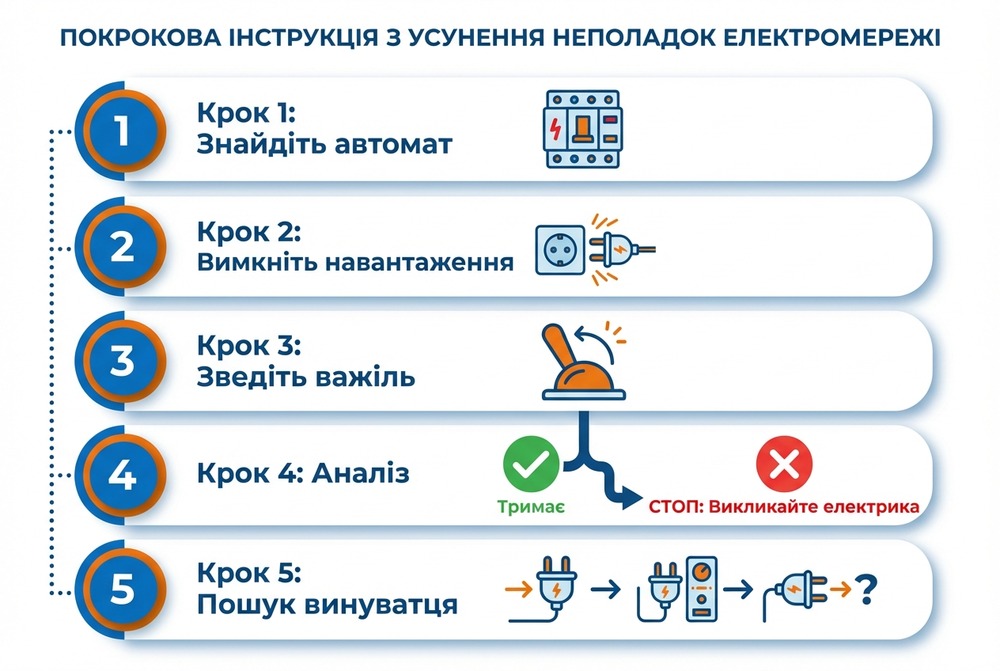
If the lights went out, don't rush to flip the toggle back. Follow the algorithm:
- Find the tripped breaker. Its toggle will be down (or in the middle position).
- Disconnect the load. Unplug all appliances from this group's outlets (iron, heater, computer).
- Do the first test. Try to flip the toggle up.
- Analyze the result:
- Tripped immediately (with spark/bang): Persistent short circuit in the wiring. Stop. Call an electrician.
- Switched on and holds: The problem was overload or a specific appliance.
- Finding the culprit. Plug appliances back in one at a time. Whichever one causes a trip — that's the faulty one.
Panel Diagnostics: How to Check Breaker Health (Without Dangerous Actions)
Visual Inspection and Terminal Tightness Check
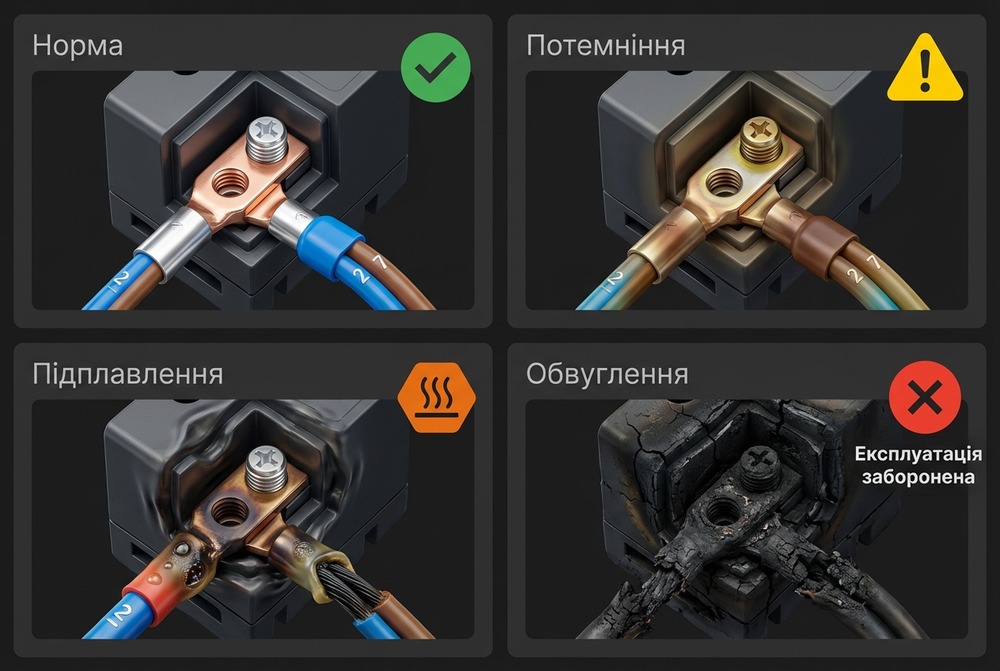
Inspection can only be performed with the main breaker fully de-energized. Arm yourself with a bright flashlight. Look for:
- Melted wire insulation (typically the blue or yellow-green color darkens from overheating).
- Copper droplets or soot on the breaker housing (arc traces).
- Plastic housing deformation.
If you see any of this — continued use is prohibited. A panel replacement or upgrade is needed.
How to Distinguish a Breaker Problem from a Wiring Problem
Express Diagnostics Table
| Symptom | Probable Cause | Action |
|---|---|---|
| Trips instantly without load | Short circuit in line or mechanical breaker failure | Disconnect wire from breaker output. If it trips again — replace the breaker. |
| Trips after 10–30 min | Thermal overheating (contact or overload) | Measure current with clamp meter, tighten terminals. |
| Crackles under load | Internal contact arcing | Immediate replacement. |
When Measurements Are Needed
You can't determine current "by eye." An electrician uses True RMS clamp meters to see the actual load.
- Example from UEC practice: A customer complained about a "defective" 16A breaker. Measurement showed 21A consumption (boiler + underfloor heating they had forgotten about). The breaker was honestly doing its job.
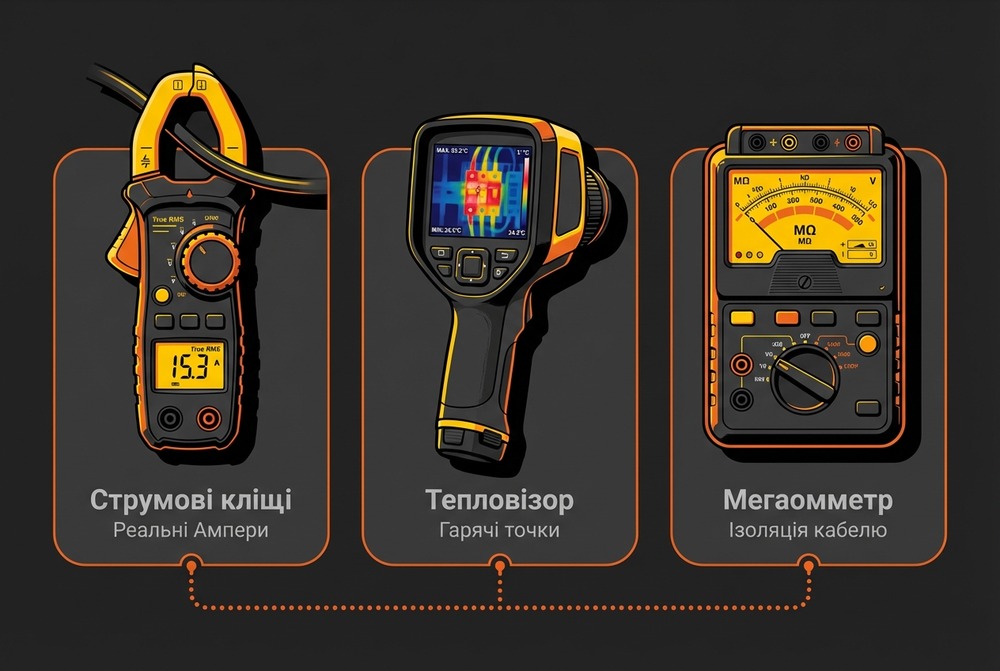
- Clamp meter: shows the actual Amps.
- Thermal imager: finds the "hot spot" before it catches fire.
- Megohmmeter: checks whether cable insulation in the wall is compromised.
⚠ Disclaimer: As an engineer, I emphasize: do not attempt to replace breakers in live panels. This is fatally dangerous. This article is informational and intended for diagnostics only.
How Incorrect Breaker Selection Leads to Problems: Consequences for Safety and Equipment
Understanding how to choose a circuit breaker for your home saves you from fires. Familiarize yourself with the risks.
Rated Current (In): What Happens If You Install a Lower or Higher Rating
If In is too low: You'll be living next to the panel, constantly resetting it. Frequent tripping wears out the mechanism.
If In is too high: This is the most dangerous mistake. If the cable is rated for 20A (2.5 mm²) and you install a C32, then at a 30A overload the cable will melt while the breaker stays "silent."
- Scientific fact: Exceeding the protection rating over the cable's current-carrying capacity is the primary cause of electrical fires in cable lines [1][3]. The consequences are described in detail in the article: what happens if you choose the wrong breaker rating.
Copper Cross-Section and Protection Relationship (Wall Installation)
| Cable Cross-Section | Max. Permissible Current | Recommended Breaker |
|---|---|---|
| 1.5 mm² (lighting) | ~18–20 A | 10 A (max. 16 A) |
| 2.5 mm² (outlets) | ~25–27 A | 16 A (max. 20 A) |
| 4.0 mm² (power lines) | ~36 A | 25 A |
Data based on PUE and DSTU HD 60364-5-52.
Trip Curve B/C/D: Selection Mistakes
Knowing the Amps alone is not enough. The curve determines the response time [4][6].
- Too "fast" (B instead of C for a motor): False tripping at every vacuum cleaner start.
- Too "slow" (D instead of B in old wiring): During a short circuit at the end of a long line, the current may not reach the 10x value (for D). The breaker will disconnect the line in several seconds instead of 0.1 s. During that time, the wire will catch fire. More details: what happens if you choose the wrong trip curve.
Breaking Capacity and Pole Count
Choosing between 4.5 kA, 6 kA, or 10 kA is critical for homes near substations. If the Icu is insufficient, contacts will weld during a strong short circuit [1].
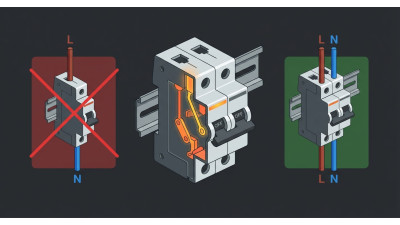
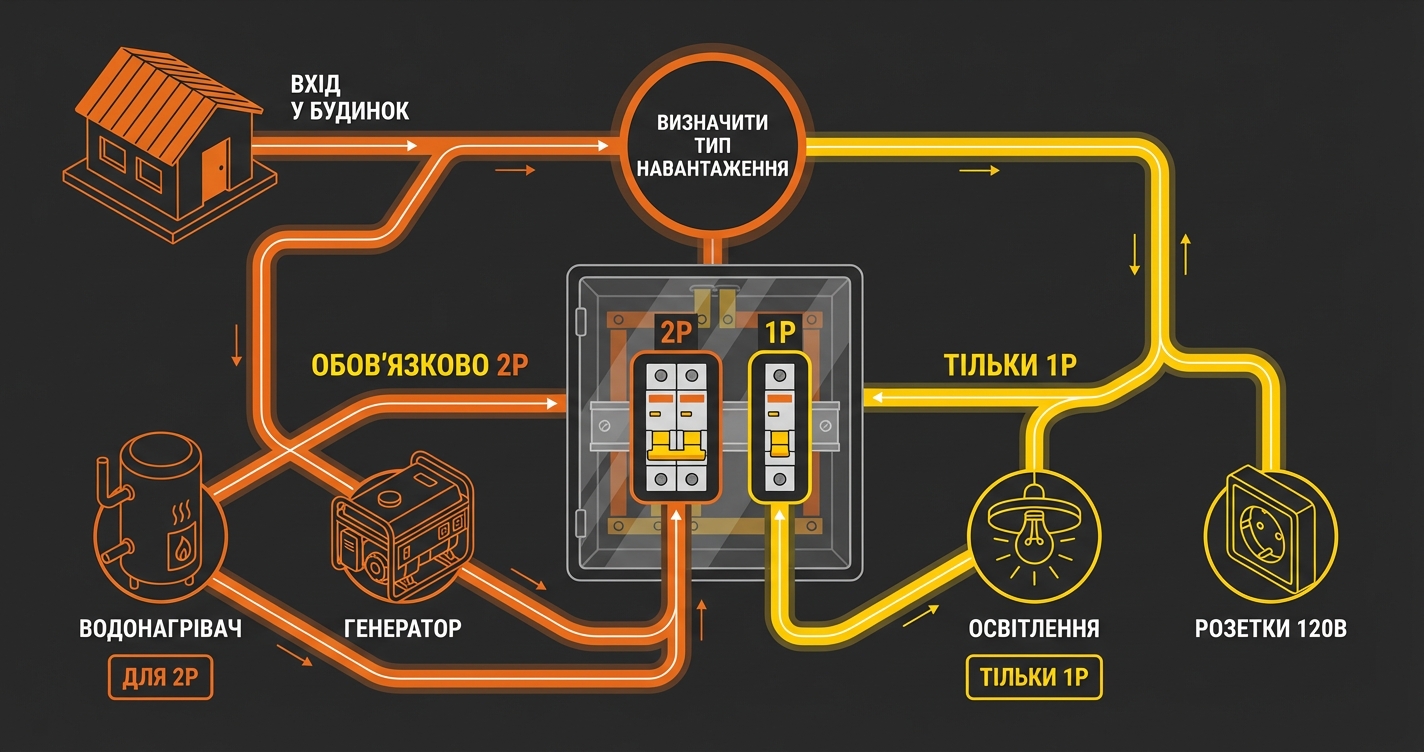
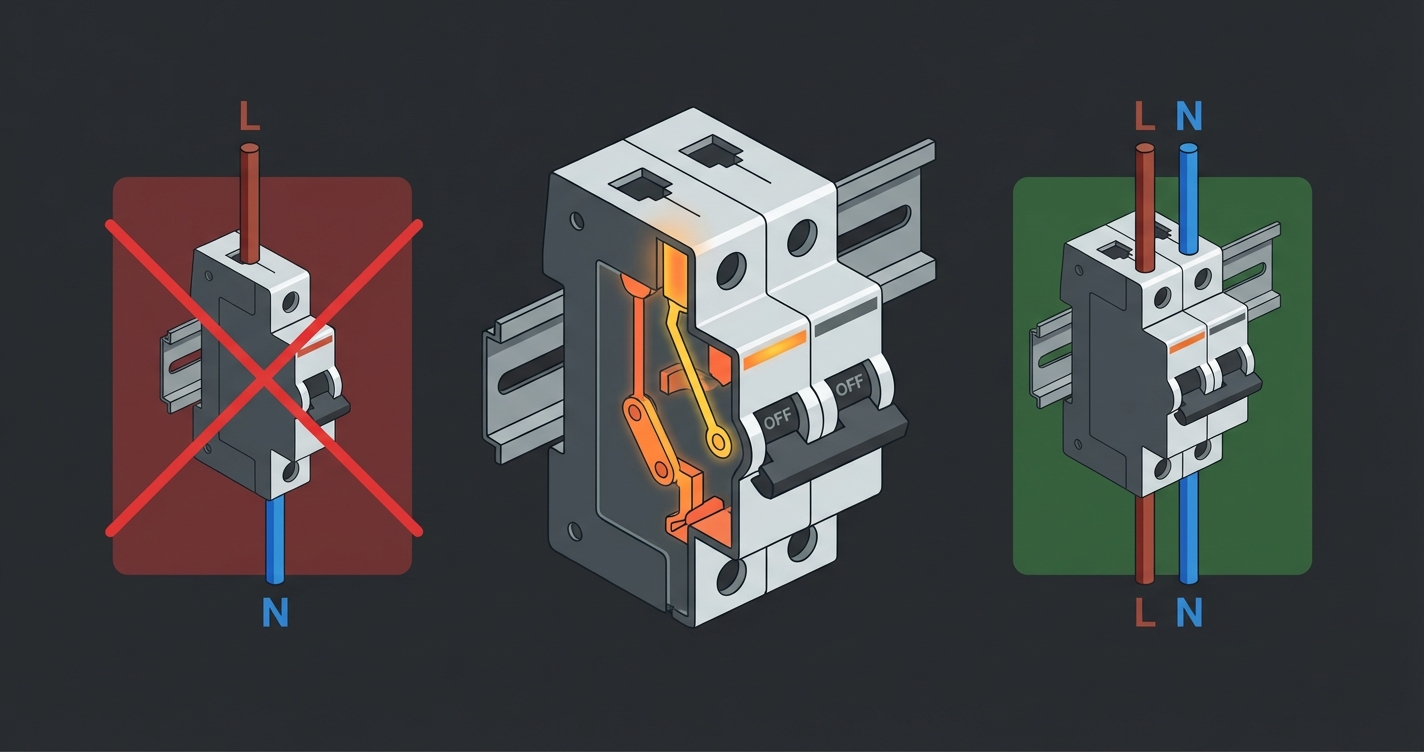
And the wrong number of poles (e.g., breaking only the neutral — should the neutral be broken by a breaker?) leaves the live phase on the appliance, creating an electric shock risk.
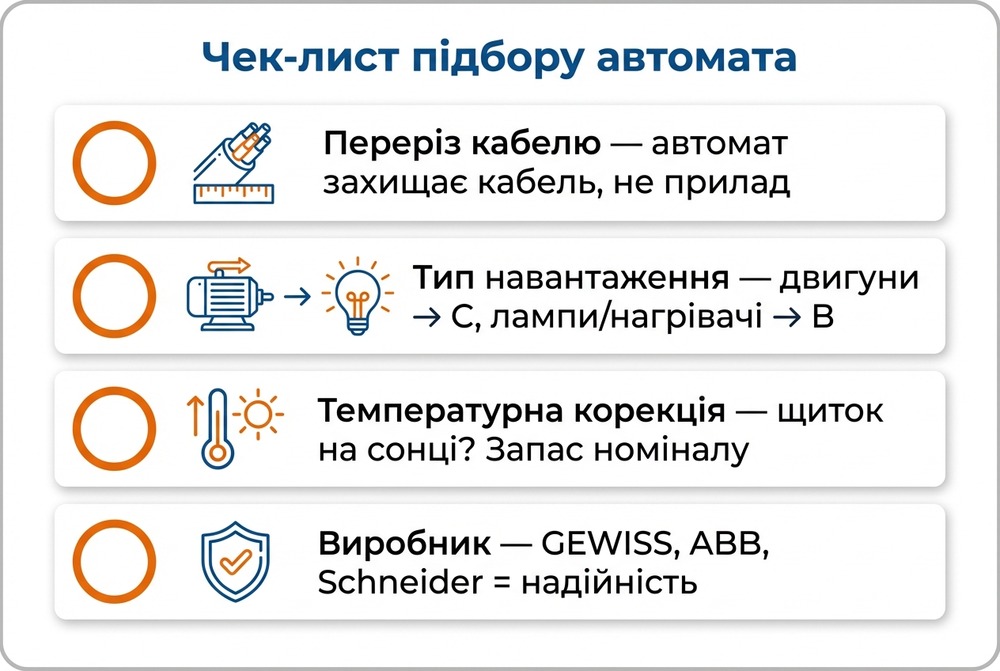
Quick Circuit Breaker Selection Checklist
Follow this algorithm, developed based on UEC experience:
Main Rule:
The breaker protects the cable, not the appliance. Find out the cross-section.
- Cable is the foundation. The breaker protects the cable, not the iron. Find out the cross-section.
- Load type. Have motors? Go with C. Only lamps and heaters (resistive load)? B is fine.
- Temperature correction. Panel in the sun? Go with a higher rating or a special industrial series.
- Manufacturer. Don't skimp on safety. GEWISS, ABB, Schneider — these are reliability standards.
When Replacement Is Necessary: How to Choose Reliable Protection
Signs That Repair Is Impossible
If the breaker has ever smoked, if the toggle is loose and doesn't have a noticeable "click," if the terminals show burn marks — immediate replacement is needed. The contact surfaces inside are already destroyed.
What to Choose? (Engineer's Recommendation)
As an official GEWISS representative, I've seen these breakers tested for overcurrent interruption. Their housings withstand thermal impacts that turn cheap alternatives into drops of plastic.
- For apartments: GEWISS MTC 45 (4.5 kA) or MT 60 (6 kA) series.
- For houses/main supply: UEC or GEWISS MTHP (10 kA).
- Special conditions: Selective circuit breakers for cottage main panels.
Reliable Brand Selection Criteria
| Criterion | How to Check | Why It Matters |
|---|---|---|
| Weight | A quality breaker is heavier (more copper/silver) | Thermal capacity and contact life |
| Rivets | Should be hollow/solid (at least 4–6) | Housing geometry during short circuit |
| Marking | Laser engraving, clear diagrams | Counterfeit protection |
Can't Solve the Problem Yourself?
Electricity doesn't forgive mistakes. If you're unsure about the cause of false tripping, don't risk your property. A qualified technician will measure loop impedance, check insulation condition with a megohmmeter, and professionally tighten the contacts. Often, calling a specialist is cheaper than the consequences of burnt wiring.
Frequently Asked Questions (FAQ)
❓ Can "false tripping" be normal?
No. A properly functioning breaker in a properly functioning network should work for years without tripping. Any tripping is a signal of deviation from the norm (contact, temperature, current).
❓ Can I simply replace B with C to stop the tripping?
You can, but only after calculating the short-circuit currents. If your line is too long (private sector), a "C" breaker may not detect a short circuit at the end of the line and fail to trip instantly.
❓ Why is the breaker hot but not tripping?
The breaker housing operating temperature can reach 60°C at full load. But if it's hot and the load is low — this is a sign of a poor terminal contact. This is a fire hazard [1].
❓ What's more dangerous: an oversized rating or the "wrong" curve?
An oversized rating (e.g., 25A on a 2.5 mm² wire). The "wrong" curve usually leads to inconvenience (frequent tripping), while an oversized rating leads to wire insulation melting without protection triggering.
❓ If only one outlet trips — is the breaker to blame?
No. The breaker protects the entire line. If problems occur at one point, most likely the outlet mechanism itself or the appliance connected to it is faulty.
❓ How does breaker tripping differ from RCD/RCBO tripping?
A circuit breaker protects against overcurrents (short circuit, overload). An RCD protects against leakage current (electric shock to a person, insulation damage). If you have an RCD installed, the cause of tripping may be moisture in the outlet, not the vacuum cleaner's power.