
Article Contents
Circuit Breaker Characteristics B, C, D: Explained, Differences, and How to Choose the Right One


Key Takeaways: A Quick Summary
Characteristic B, C, or D refers to short circuit protection, not overload protection. For an apartment and home, in 95% of cases, the best choice is type C.
Use Type B for separate lighting lines or outlets without powerful appliances, whereas Type D is strictly an industrial option for equipment with high inrush currents.
Warning! Never choose a circuit breaker following the "bigger is better" principle. It is dangerous.
When selecting and installing electrical equipment, always follow the current Electrical Installation Rules and national standards. If you are unsure of your choice, be sure to consult a qualified electrician.
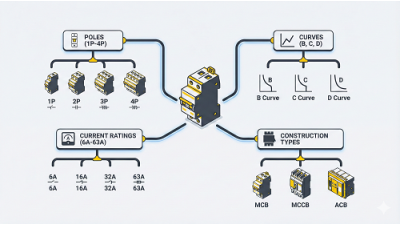
The time-current characteristic of a circuit breaker, known as the tripping curve, is a key parameter determining how quickly the device responds to current excess. It provides protection not only against prolonged overload, when the current increases gradually, but also against instantaneous short circuits. It is the **B, C, D** breaker characteristics that describe their sensitivity to such surges: **B** is the most sensitive, **C** is universal, and **D** is designed for heavy loads.
As a practicing engineer, I have repeatedly encountered cases where the wrong choice of characteristic led to frequent nuisance tripping or, worse, fire due to untimely disconnection. In this article, I will explain everything in simple terms, relying on my own experience and technical standards, so that you can confidently navigate the range of quality equipment and make the right choice for the safety of your home.

Warning! Working with electrical equipment is life-threatening!
All work within the electrical panel must be performed solely by qualified electricians with the power switched off. Before starting work, be sure to de-energize the line and verify the absence of voltage using a measuring instrument.
What is the Time-Current Characteristic (TCC) and How Does It Work?
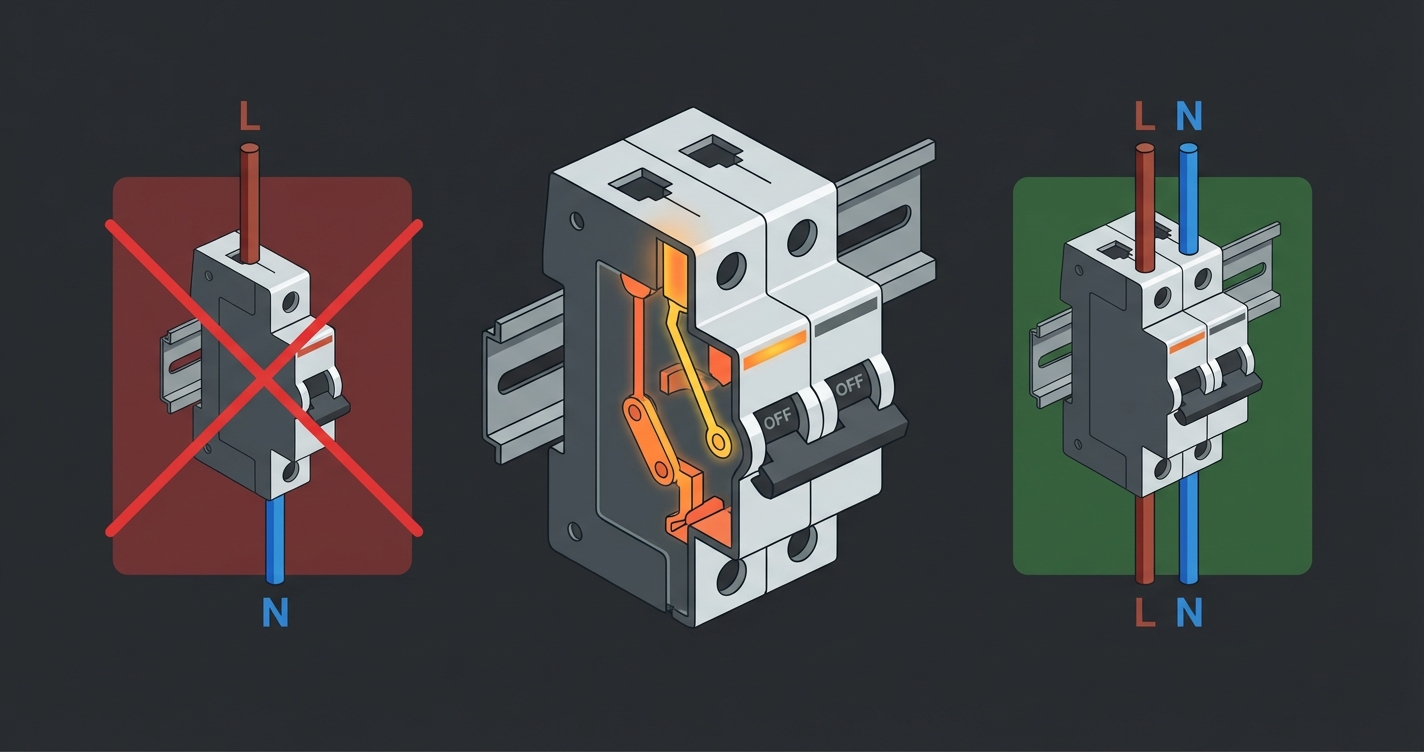
The time-current characteristic (TCC) is a graphical representation of the circuit breaker's tripping time versus the current flowing through it. It demonstrates how quickly the device will open the circuit when the rated current is exceeded. The circuit breaker design includes two key protection elements: the thermal release (bimetallic strip), which reacts to prolonged overload, and the electromagnetic release (solenoid), which trips instantly upon a sharp current surge during a short circuit. The letters B, C, and D describe specifically the sensitivity of the electromagnetic release. In my experience, in residential projects where I used modular equipment, a correct understanding of the TCC allowed avoiding up to 80% of nuisance tripping issues.
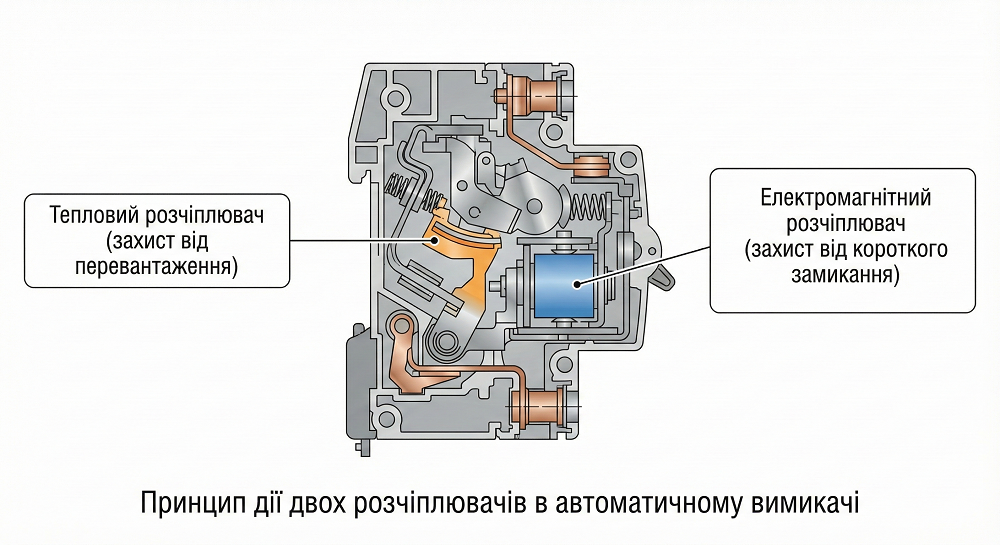
Operating principle of two releases in a circuit breaker
Graphical Representation and Decoding of Time-Current Characteristics
The time-current characteristic is visually represented on a graph, where the vertical axis displays the tripping time (t), and the horizontal axis displays the multiple of the rated current (I/In). The sloping part of the curve corresponds to the operation zone of the thermal release, which reacts to prolonged but slight overload. The vertical section of the graph is the zone of instantaneous action of the electromagnetic release, which ensures protection against short circuits.
As noted by Electrical Technology, the classification of circuit breakers into types is based precisely on their tripping curves, which indicate the multiple of the rated current at which they trip instantly. This approach ensures a balance between reliable equipment protection and avoiding unnecessary disconnections. In my experience, visualizing this graph helps clients understand why different tasks require breakers with different characteristics.
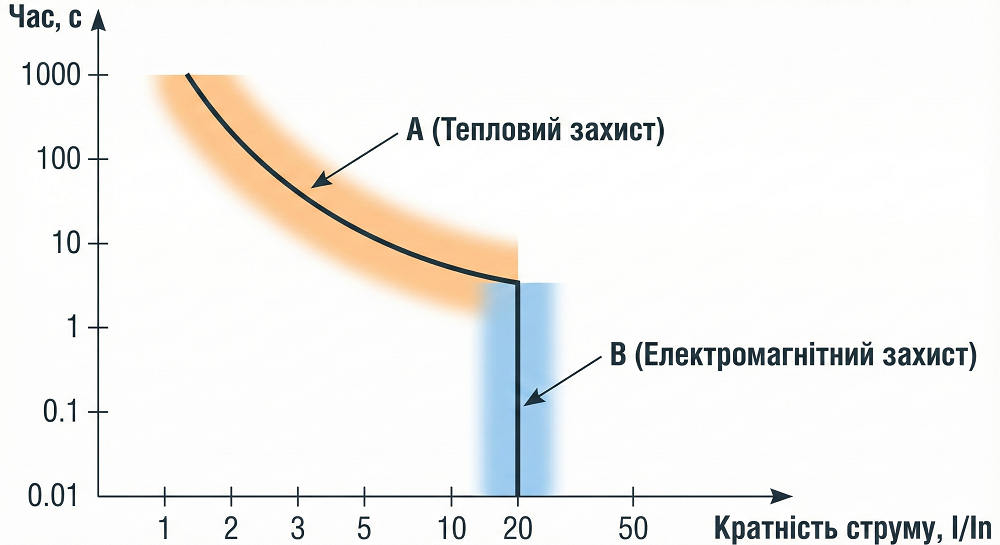
General view of the circuit breaker tripping curve
Comparative Table of Circuit Breaker Characteristics Types B, C, D
This table will help you quickly understand the key differences between types B, C, and D, which is crucial for making the right choice. In my experience, in the vast majority of residential projects, for example, when equipping panels with UEC equipment, characteristic C covers almost all tasks, guaranteeing reliability without unnecessary costs.
Main Differences of B, C, D in Table Format
| Characteristic | Type | Tripping Current Multiple (I/In) | Main Application | Typical Load Examples |
|---|---|---|---|---|
| Sensitive | B | 3-5 | Lighting, outlets without powerful appliances | LED fixtures, incandescent lamps, computer equipment |
| Universal | C | 5-10 | Household appliances, offices, general needs | Refrigerators, washing machines, air conditioners, outlet groups |
| Industrial | D | 10-20 | Motors, transformers, welding machines | Electric motors, compressors, pumps, industrial machine tools |
Visual Comparison of Curves B, C, and D
In addition to the table, the graph with superimposed B, C, and D curves clearly demonstrates the difference in sensitivity. Curve D is significantly shifted to the right, allowing it to withstand the highest inrush currents without nuisance tripping. Understanding the differences between type B, C, and D breakers is fundamental for designing a safe network.
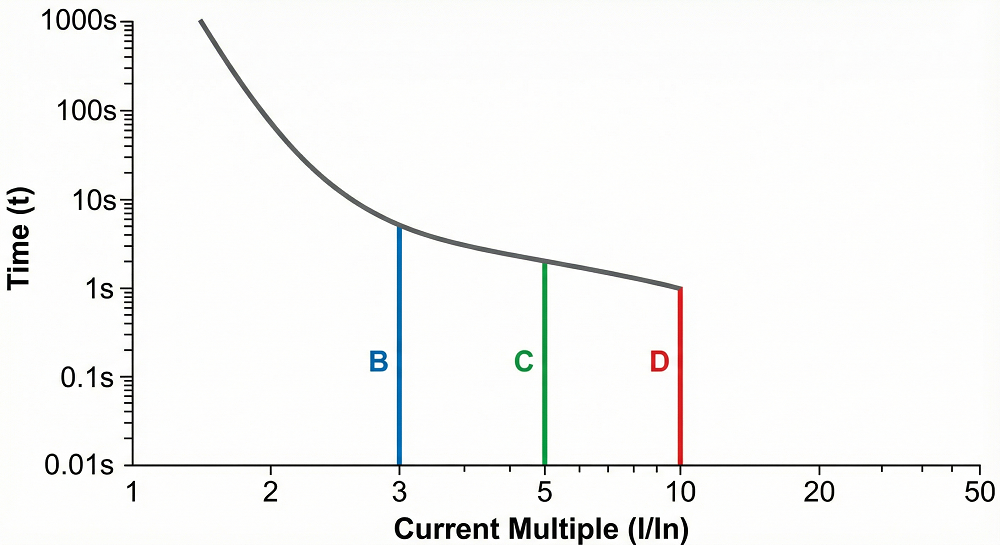
Comparison of electromagnetic release tripping zones for types B, C, and D
"Type D MCBs trip at 10-20 times rated current and are primarily used in industrial environments for heavy-duty applications, such as large motors, X-ray machines, and welding equipment." — RS Components Guide, 2025
Selection and Application of Circuit Breaker Types B, C, D
Each characteristic type is designed for specific tasks. In my projects, regardless of the equipment brand, I always start by analyzing the load type to avoid common mistakes. You can read more about the types of circuit breakers and their classification in a separate article.
Characteristic B — For Sensitive Lines Without Inrush Currents
Tripping Multiple and Purpose
A type B circuit breaker trips at a short-circuit current that is 3-5 times its rated current (3-5 In). It is designed to protect long cable lines and loads that do not have significant inrush currents, providing fast and reliable protection.
Where It Is Applied
This type is ideal for residential premises for separate lighting lines (LED lamps, chandeliers) or outlets to which appliances with electric motors are not connected. For example, in my practice for an apartment in a new building in Kyiv, I used type B breakers for lighting lines, which prevented overheating of small cross-section cables. To find out which breaker to choose for outlets and lighting, refer to our detailed guide.
Characteristic C — The Universal Standard for Home and Office
Tripping Multiple and Purpose
A type C circuit breaker trips at a short-circuit current 5-10 times higher than the rated one (5-10 In). This is the "golden mean" that covers most household and commercial needs, withstanding moderate inrush currents.
Where It Is Applied
This is the most common choice for outlet groups in apartments, houses, and offices. It reliably protects lines connecting household appliances with small motors (refrigerators, washing machines, air conditioners), as well as computers and other office equipment. For instance, in a case with panel installation for an office using GEWISS equipment, the C-characteristic allowed withstanding the simultaneous startup of several dozen computers without nuisance tripping.
Characteristic D — For Equipment with High Inrush Currents
Tripping Multiple and Purpose
This is the "least sensitive" type of breaker, which trips at a short-circuit current 10-20 times higher than the rated one (10-20 In). Its main task is to withstand high short-term inrush currents of powerful equipment without tripping unnecessarily.
Where It Is Applied
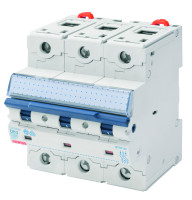
Its sphere is industry, workshops, and garages. It is used to protect three-phase electric motors, machine tools, welding machines, transformers, and powerful compressors. In one of my industrial projects, where UEC power breakers rated at 1600 A were used, it ensured the stable operation of the power line for a group of compressors.
How to Choose the Right Characteristic: A Step-by-Step Algorithm
This algorithm is based on my engineering practice and the requirements of the standard DSTU EN 60898-1:2015. Before choosing the characteristic, it is important to correctly determine the rating, which can be read in the article "how to calculate a circuit breaker by power and current".
Evaluate Your Load Type
Determine what will be connected to the line:
- Active (resistive): lighting, electric heaters. Characteristic B or C usually suits.
- Inductive: appliances with motors (refrigerators, air conditioners, pumps). Characteristic C or D usually suits.
Account for Possible Inrush Currents
At the moment of startup, the motor consumes 5-7 times more current than in operating mode. If an overly sensitive type B breaker is used for a line with an air conditioner, it will nuisance trip every time it is switched on.
Check Cable Cross-Section Compliance
Always remember: the circuit breaker protects the cable first and foremost. You cannot install a "coarser" breaker (e.g., C instead of B) if the cable cross-section is insufficient. This can lead to wiring overheating and fire even before the breaker trips.
Ensure Selectivity
Simply put, selectivity means that in the event of a short circuit on the final line (for example, in a socket), the breaker of that specific line should trip, not the input breaker for the entire apartment. To do this, the breaker closer to the load must have a lower rating or a more sensitive characteristic.
«The most common mistake I see on sites is installing type D breakers in an apartment "just in case". This creates a false sense of reliability, but in reality, such a breaker may not trip during a real short circuit in a domestic network, which will lead to wiring ignition».
— I warn as a practicing engineer.
Common Mistakes to Avoid
❌ Mistake 1: Using a Type D Breaker in an Apartment
The short-circuit current in a domestic network may simply not reach the tripping threshold of a type D breaker. As a result, the wiring will burn, but the breaker will not. More details on the consequences of incorrect characteristic selection.
❌ Mistake 2: Installing a Type B Breaker on a Motor Line
This guarantees constant nuisance tripping every time the refrigerator or air conditioner starts, which has been proven in practice repeatedly.
❌ Mistake 3: Ignoring the Breaker Rating (Amps)
The characteristic (B, C, D) and the rated current (16A, 25A) are two different but equally important selection parameters.
❌ Mistake 4: Ignoring Breaking Capacity (kA)
For housing, 4.5 kA or 6 kA is usually sufficient, but industrial facilities require higher values. Read more about this in the article "what is the breaking capacity of a circuit breaker".
Frequently Asked Questions (FAQ)
Can I install a type D breaker in an apartment "just in case"?
It is strictly not recommended. The short-circuit current in your domestic network may turn out to be insufficient for the instantaneous tripping of a type D breaker. As a result, until disconnection occurs, the wiring may overheat and catch fire.
What happens if I install a type C breaker instead of B on a lighting line?
In most cases, nothing terrible will happen, and the type C breaker will perform its function correctly. However, characteristic B provides better protection for long lighting lines with thin cables, as it is more sensitive.
How does the characteristic differ from the breaker rating (e.g., C16 vs D16)?
The rating (16A) is the current that the breaker can pass for a long time without tripping. The characteristic (C or D) is the sensitivity to short-term current surges during a short circuit. Both C16 and D16 protect against overloads above 16A equally, but D16 will withstand a significantly higher inrush current without false tripping.