
Article Contents
380V Three-Phase Circuit Breaker: Calculation, Selection, and Installation


Key Takeaways
A 380V circuit breaker (three-phase) is a switching device that protects the electrical network and three-phase equipment from overload and short circuits by monitoring all three phases simultaneously.
Calculation formula: I = P / (√3 × U × cos φ). Ignoring cos φ can result in up to 20% error.
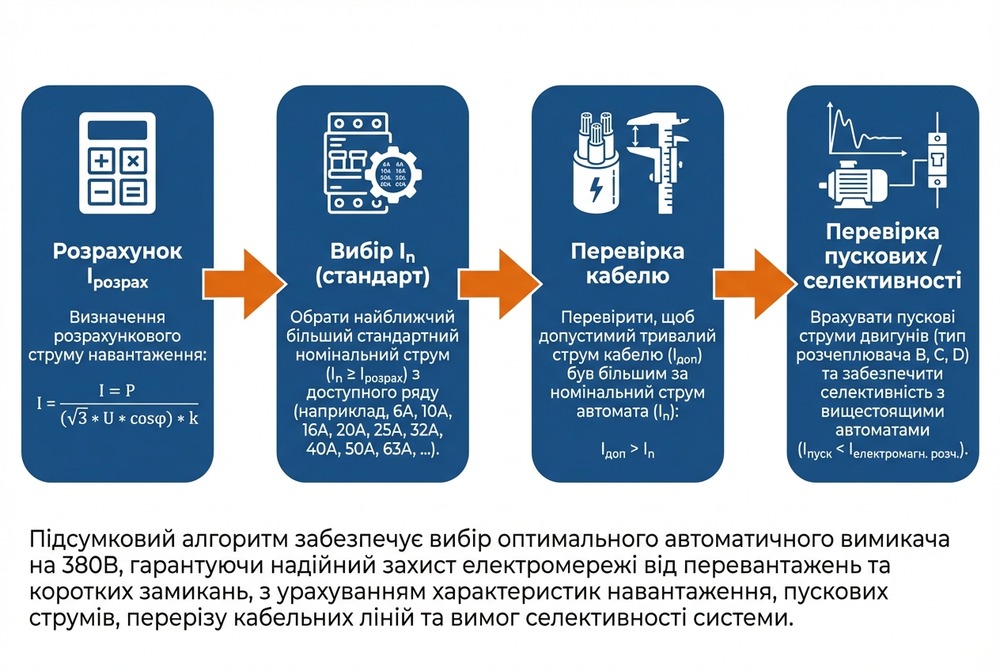
Key principle: the circuit breaker protects the cable, not the appliance. The rating is chosen following: Icalc ≤ Irated breaker ≤ Icable capacity.
Hello, I'm Oleh Lukianchuk, a technical training engineer at UEC with 12 years of experience in electrical engineering and automation systems diagnostics.
In this article, we'll cover how to properly calculate and select a circuit breaker for a 380V three-phase network: from the calculation formula to cable verification and selectivity.

Warning! Working with electrical equipment is life-threatening!
All work in the electrical panel must be performed only by qualified electricians with the power disconnected. Before starting work, be sure to de-energize the line and verify the absence of voltage with a measuring device.
Three-Phase 380V Circuit Breaker Catalog
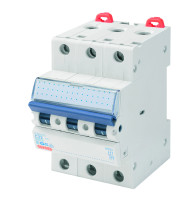
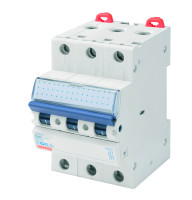
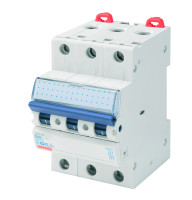
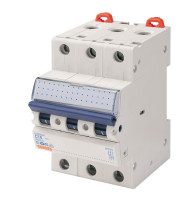
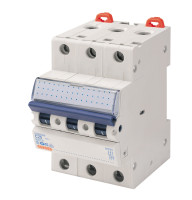
If you already know the parameters, here you can buy a 380V circuit breaker for your needs. We have the full standard range of rated currents in stock: 16A, 25A, 32A, 40A, 63A and powerful industrial solutions. We offer only proven brands: UEC, GEWISS, and the price depends on the breaking capacity and series.
Products
Popular Selections and Useful Links
To dive deeper into the nuances, I recommend reviewing our specialized materials:
- How to choose the number of poles (3P or 4P)
- Time-current characteristic (B, C, D): what is it?
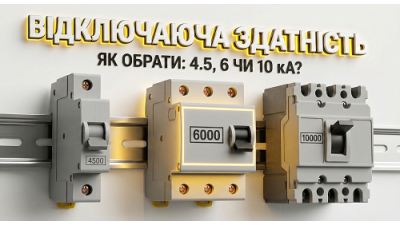
- What is breaking capacity 4.5kA, 6kA, 10kA
- Modular circuit breakers: classification
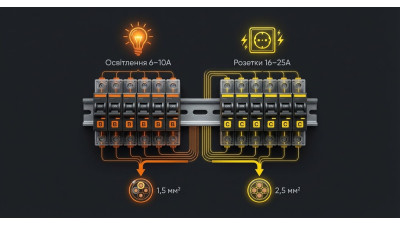
- Which breaker to choose for outlets and lighting
Online Calculator for Three-Phase 380V Breaker Selection
For quick selection, we at UEC developed this tool. Three-phase breaker calculation is based on the total power of your loads. Simply enter the total power (kW) and specify the voltage to select a breaker of the appropriate rating.
⚠ Important: The calculator provides an approximate rating. The final choice must always consider cable cross-section, motor inrush currents, and PUE/IEC requirements.
Three-Phase 380V Breaker Calculator
How to Calculate a 380V Breaker by Power: Formula & Example
Many people mistakenly simply divide power by voltage, as with a regular outlet. For a three-phase network, this doesn't work. How to calculate a 380V breaker correctly? You need to factor in the "square root of three" and the power factor (cos φ).
Main formula:
Three-phase breaker calculation formula:
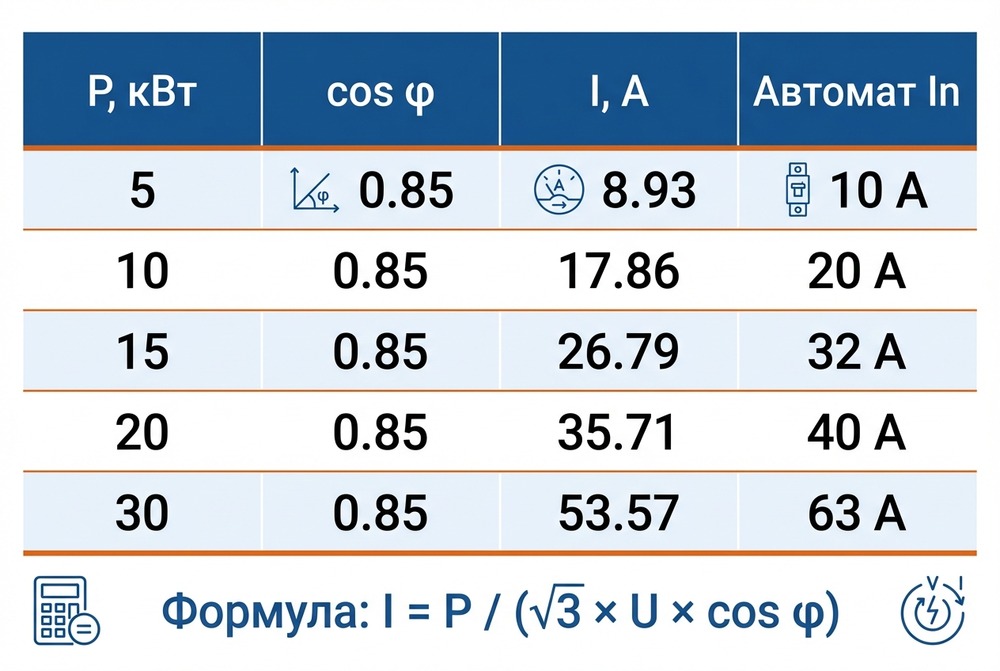
I = P / (√3 × U × cos φ)
Where:
- P — load power (in Watts, W);
- U — line voltage (380 V);
- √3 ≈ 1.732 (constant for three-phase network);
- cos φ — power factor (for heaters ≈ 1.0, for electric motors ≈ 0.8–0.9).
Ignoring cos φ can result in up to 20% error, which is enough for false tripping. Research by Electrical Technology confirms: the breaker rating should be 25% higher than the calculated current for continuous loads [5].
Calculation Example
You have an electric boiler or motor with a power of 15 kW.
- Convert kW to W: 15 × 1000 = 15,000 W.
- Assume average cos φ = 0.9.
- Calculate: I = 15,000 / (1.732 × 380 × 0.9) ≈ 25.36 A.
Conclusion: The calculated current is 25.36 A. The nearest standard rating is 25 A, but it will operate at the limit. For reliable operation (especially for a motor), the next step up is recommended — 32 A, provided your cable can handle this load.
Step 1 — Collect the Load Power (and Determine the Type)
Before calculating, determine what exactly you're connecting. Electric motors and heaters behave differently.
Step 2 — Calculate the Current Using the Formula
Step 3 — Select a Standard Rating and "Anchor" the Choice to the Cable
The engineer's golden rule:
The circuit breaker protects the cable, not the appliance.
Therefore, the selected rating (In) must be greater than the calculated load current (Icalc), but must be less than the maximum allowable cable current (Icable).
Types and Characteristics of 380V Breakers: How to Choose the Right One
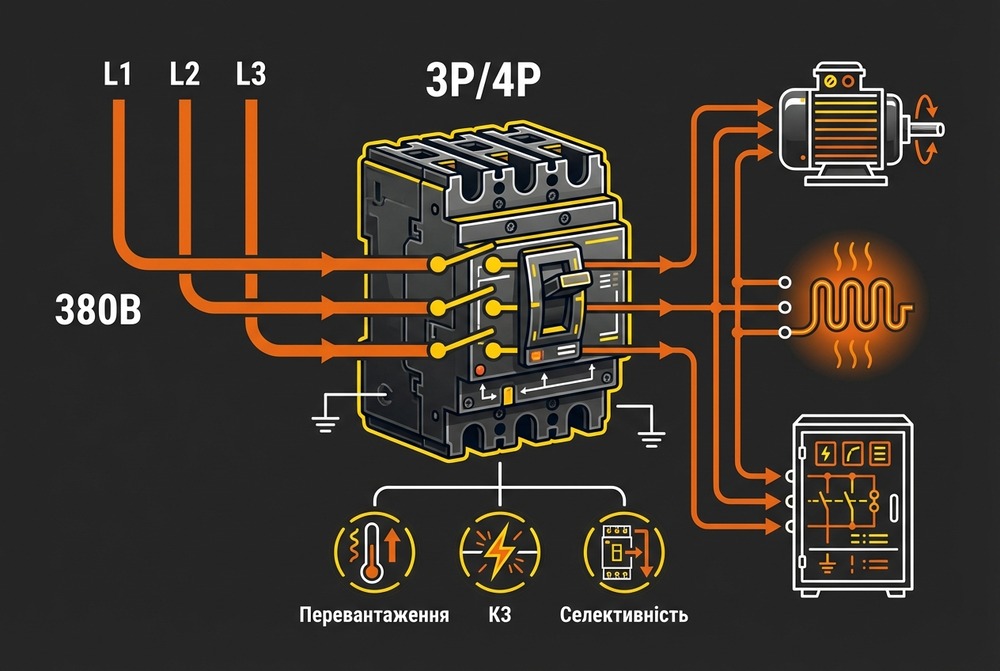
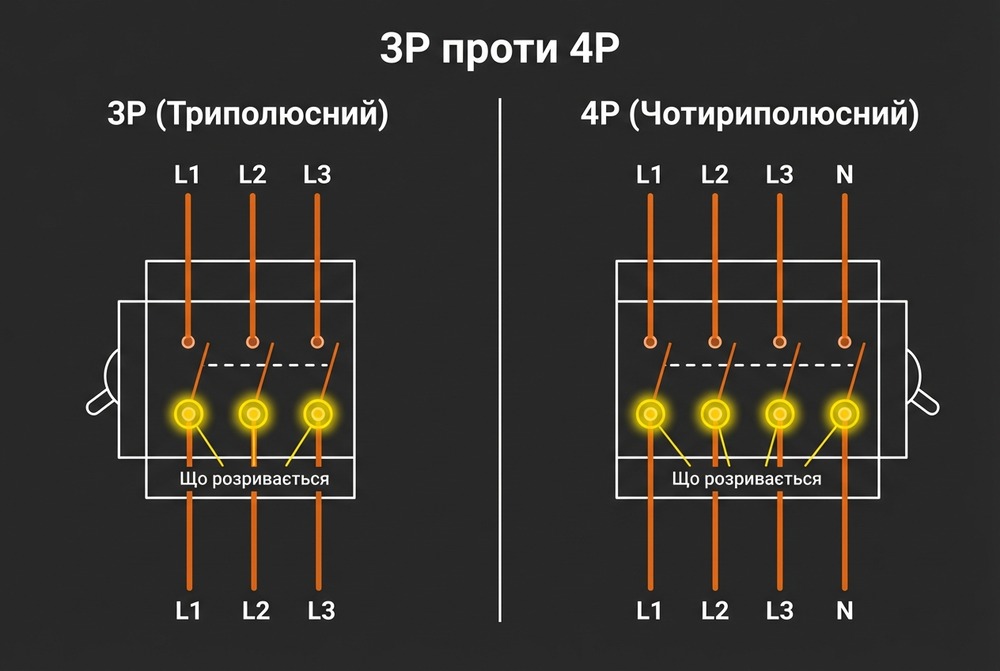
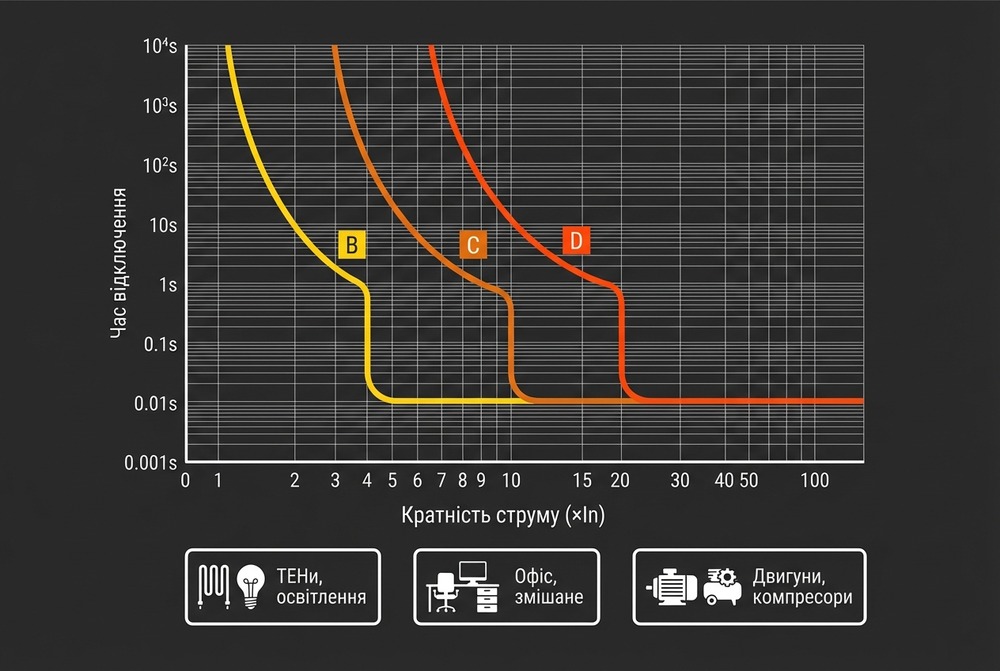
Besides amperage, it's critically important to choose the right characteristics: trip curve type (B, C, D) and number of poles (3P or 4P). A mistake here will cost you constant tripping when starting a machine, or worse — a burned neutral.
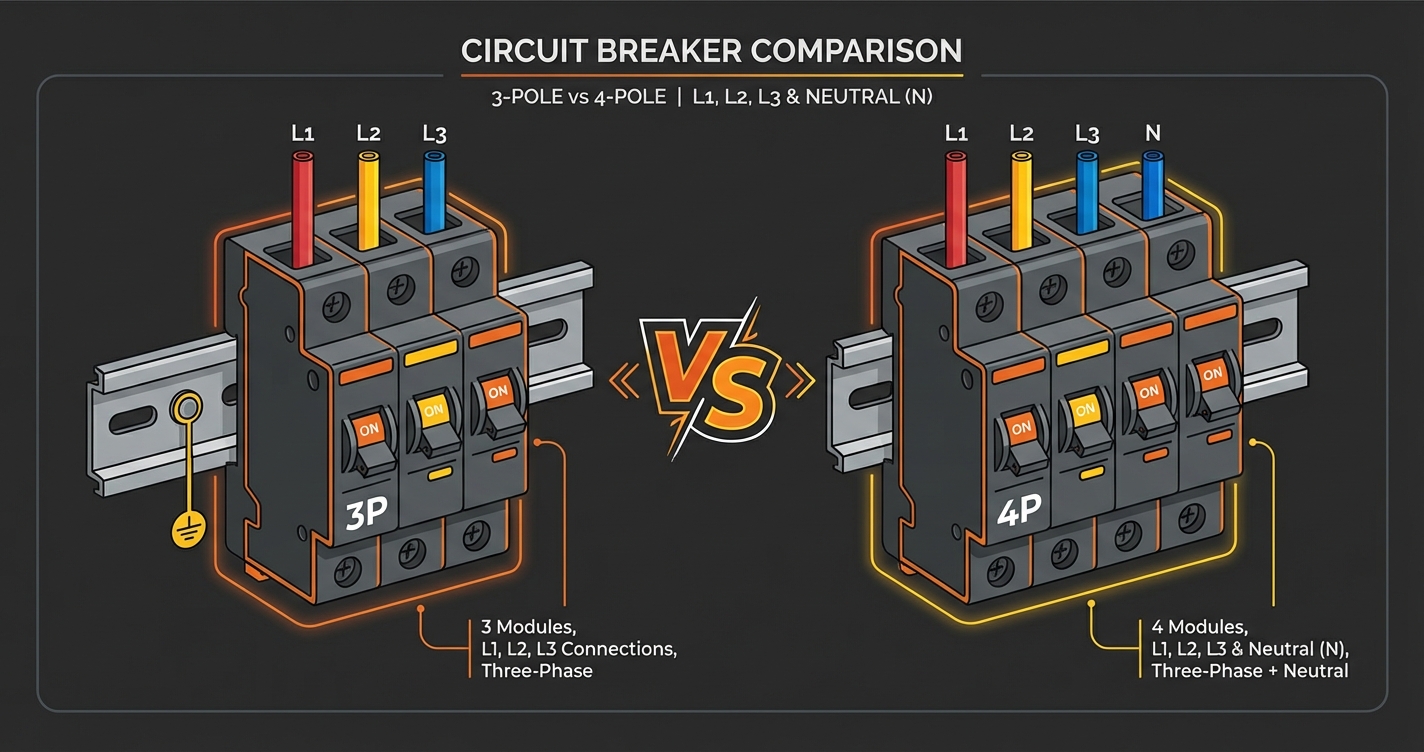
3P (Three-Pole)
Disconnects only phases L1, L2, L3. This is the standard for connecting electric motors where neutral is not used or is used only for control. More details in the article about choosing three-pole and four-pole breakers.
4P (Four-Pole)
Disconnects three phases + working neutral (N). Required for building entry (especially with TT or TN-C-S grounding systems) to completely cut off potential from the facility during a fault. Also necessary when load across phases is unbalanced [1].
Curve B (3-5 In)
For long lines and resistive loads (heaters, lighting).
Curve C (5-10 In)
Universal option. Suitable for most mixed loads (office, home, light machinery) [4].
Curve D (10-20 In)
For powerful electric motors, transformers, and pumps with heavy starting. For example, in a workshop we used D-curve breakers specifically for protecting compressors, because a "C-curve" would trip on startup [2][5].
Read more about the differences between B, C, D characteristics in our guide.
Breaking Capacity (kA) and When 6kA/10kA Is Needed
It shows the maximum short-circuit current the breaker can interrupt without melting.
- 4.5 kA: Older residential buildings, dachas (far from the substation).
- 6 kA: Standard for modern apartments and private houses [1].
- 10 kA and above: Industrial facilities, main distribution panels, facilities near transformer substations. For industrial facilities, we at UEC recommend no less than 10 kA [6].
Detailed overview: which breaking capacity to choose.
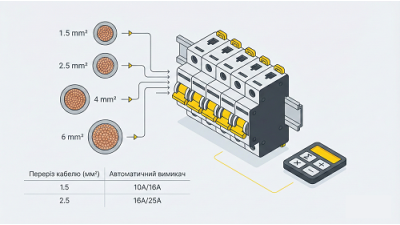
Cable, Cross-Section & Breaker: The Key Check Often Missed
Let me remind you once more: the breaker rating is selected based on the cable. If you install a 40A breaker on a 2.5 mm² wire, the wire will turn into a heating element inside the wall before the breaker even "thinks" about tripping.
Below are approximate ranges for copper cable (when installed in air/cable trays):
| Cu Cross-Section, mm² | Allowable Current (air)* | Max. Breaker |
|---|---|---|
| 1.5 | 18–23 A | 10–16 A |
| 2.5 | 25–30 A | 16–20 A |
| 4.0 | 32–41 A | 25–32 A |
| 6.0 | 40–50 A | 32–40 A |
| 10.0 | 60–80 A | 50–63 A |
| 16.0 | 80–100 A | 63–80 A |
* Data provided for reference. For exact values, consult PUE tables (link to breaker selection table by cross-section) considering the installation method.
Breaker In vs Cable Imax: Two Inequalities (Practical Rule)
Practical rule:
Icalc ≤ Irated breaker ≤ Icable capacity
Correction Factors: Temperature, Grouping, Installation
Operating conditions "eat into" the cable's current-carrying capacity. If cables are bundled in a tray or the workshop temperature is +40°C, the allowable current decreases.
| Factor | Effect on Cable | Solution |
|---|---|---|
| Temperature >30°C | Insulation heats faster (K < 1) | Increase cross-section or reduce breaker rating |
| Bundled installation | Mutual cable heating (K ≈ 0.7–0.85) | Account for in cross-section calculation |
| Installation in conduit/wall | Impaired heat dissipation | Allowable current 10-15% lower than in air |
Motor Inrush Currents: How to Avoid False Trips
Asynchronous motors consume 5–7 times their rated current during startup. If you select a breaker based only on rated power (e.g., curve C), it will interpret the startup as a short circuit and disconnect the line.
"When frequently starting powerful equipment, it's more important not just to 'get more amps' (that's dangerous for the cable), but to choose the right trip characteristic D."
— Oleh Lukianchuk, UEC Engineer.
For motors, we recommend using motor circuit breakers or breakers with D characteristic. Also don't forget about using star-delta starting schemes to reduce inrush currents [6].
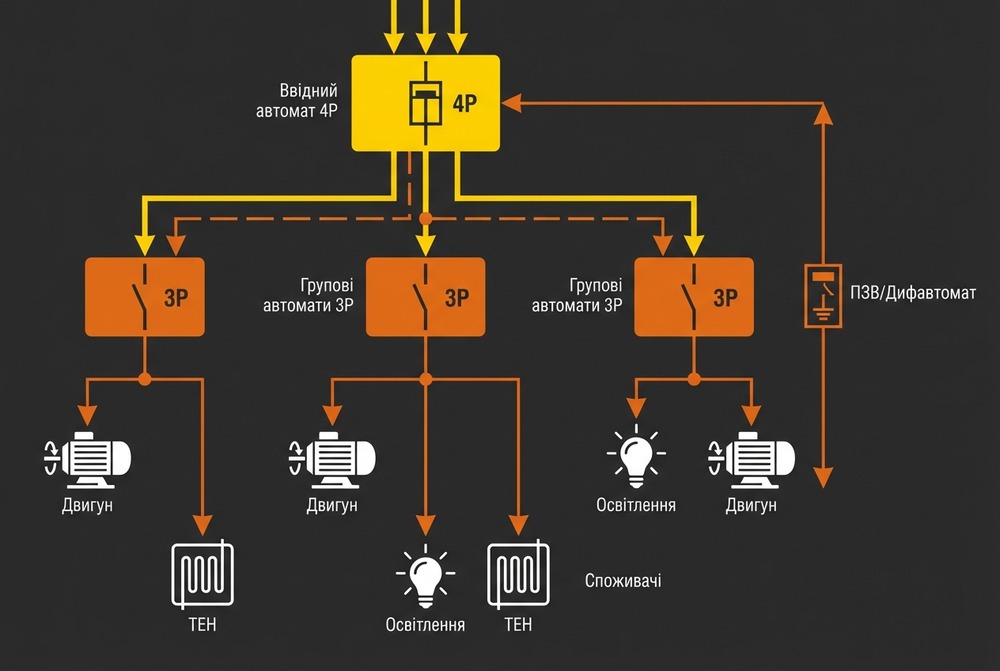
Selectivity and RCD Coordination (So Only the Faulty Circuit Trips)
A properly designed panel is built on a hierarchy principle. If a short circuit occurs on a machine, only that machine's breaker should trip — not the entire workshop or the building's main breaker.
To ensure selectivity:
- The main breaker rating should be 1.6–2 times higher than the group breaker.
- Use selective main breakers (with time delay) if specified in the project [8].
Also don't forget about RCD coordination: the breaker protects against overcurrent, while the RCD protects against leakage current. They work as a pair.
Common Mistakes When Choosing a 380V Breaker (Self-Check Checklist)
I often see projects where the same mistakes are repeated. Check yourself in 2 minutes:
Click on an item to mark it as checked:
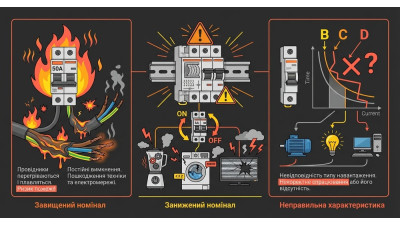
Also read: What happens if you choose the wrong breaker rating.
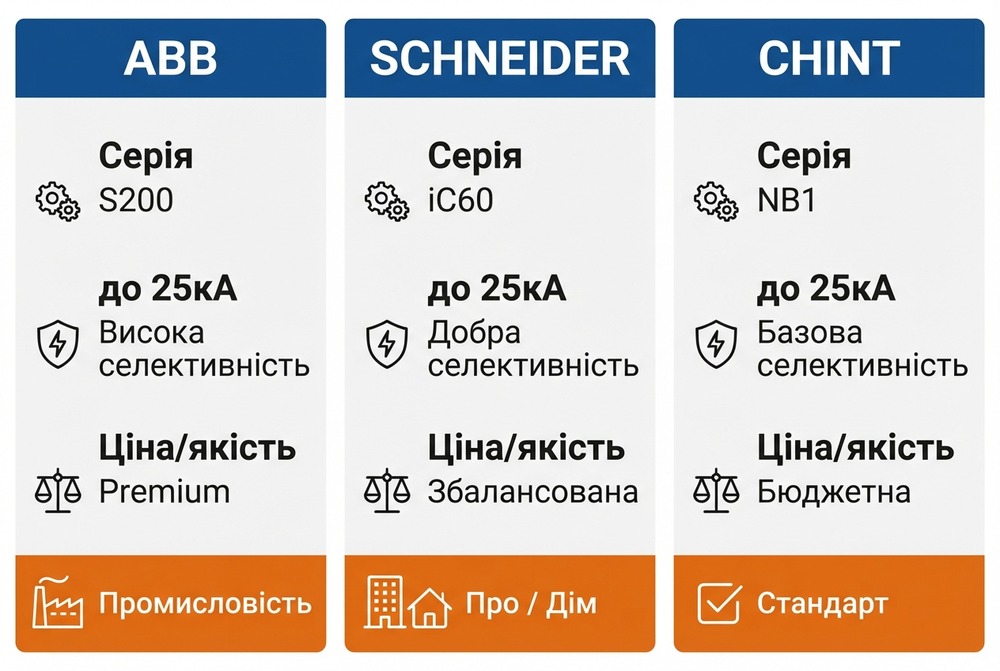
Popular Three-Phase (380V) Breaker Manufacturers & How to Choose a Brand
At UEC, we work with different segments, and here's our market perspective for 2025:
| Brand | Series | Application | Features |
|---|---|---|---|
| ABB | S200 / S800 | Industrial / Pro | Benchmark reliability, high kA (up to 25kA), for industrial use [6]. |
| Schneider | Acti9 / Resi9 | Pro / Home | Excellent selectivity, wide range of accessories [8]. |
| CHINT | NB1 / NXB | Pro / Standard | Global giant, optimal price-to-quality ratio [5]. |
We recommend brands based on your budget and technical requirements, without hiding alternatives.
Frequently Asked Questions
❓ Which breaker to choose for a 15 kW 380V private house entry?
According to the calculation (see above), the current is approximately 22.8–25 A. Typically, the power supply company (per technical conditions) limits the entry to a 25 A (3-phase) breaker. This allows consuming approximately 16 kW of active power. Choose a 3-pole (or 4-pole for TN-C-S) breaker with a breaking capacity of at least 6 kA [1].
❓ Can single-phase breakers be used in a three-phase network?
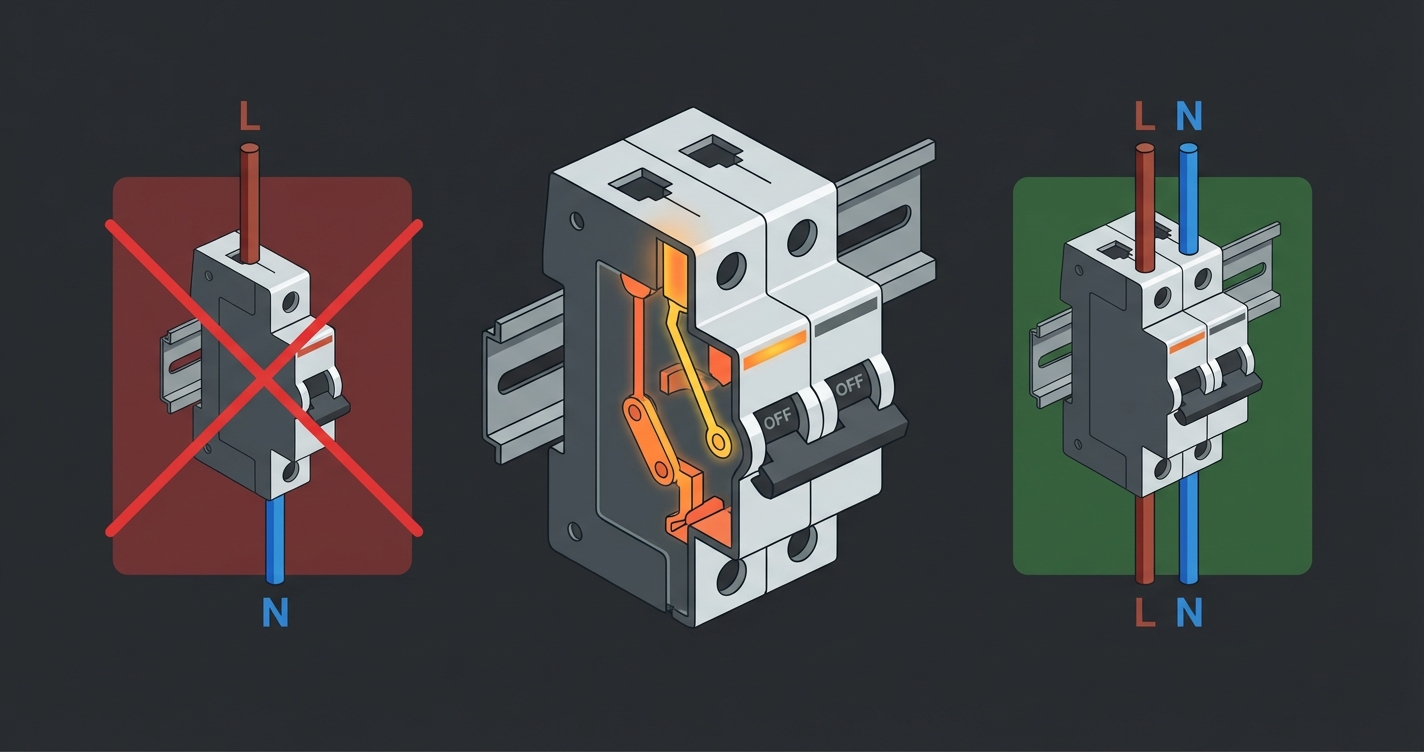
Categorically no for protecting three-phase equipment (motors). Three single-phase breakers have no mechanical linkage. If one trips, the motor will continue running on two phases (incomplete phase mode), overheat, and burn out [brief Q9]. The only exception is if each phase powers separate independent single-phase groups, and you have a separate general 3-phase main breaker.
❓ What cable cross-section is needed for a 25A 380V breaker?
For copper cable (VVGng), the optimal cross-section is 4 mm² (allowable current ~36A). You can use 2.5 mm² (allowable ~27A), but that's "cutting it close," and when installed in a wall or bundled, it may not be sufficient. It's better to have cable capacity headroom.
❓ What happens if you oversize the breaker rating?
You'll deprive the line of protection. The cable will start melting before the breaker trips. This is the most common cause of electrical fires. Read more about the consequences here.
Regulatory Documents and Sources
In preparing this material, we relied on current standards and documentation. You can verify the calculations yourself:
- PUE (Electrical Installation Rules): section 3.1.4 (selection of protection devices) and Tables 1.3.4-1.3.5 (allowable conductor currents).
- DSTU IEC 60898-1:2005: Circuit breakers for overcurrent protection for household use.
- DSTU EN 60947-2: Low-voltage switchgear and controlgear. Part 2. Circuit breakers.
At UEC, we always rely on manufacturers' technical documentation and current standards. In case of discrepancies, project requirements and the power supply company's requirements take priority.