
Article Contents
How Many Poles to Choose for a Circuit Breaker: 1P or 2P?


Key Takeaways
A 1P (single-pole) circuit breaker protects only one conductor (the phase) and is the standard for regular lighting circuits in dry areas. A 2P (double-pole) breaker disconnects both the phase and neutral simultaneously, ensuring complete de-energization of the circuit.
When to choose 2P: for main breakers, water heaters, and washing machines — this is critically important to prevent electric shock from leakage currents or wiring errors in the network.
Hi, I'm Oleg Lukyanchuk, Technical Training Engineer at UEC. Over 12 years of work — from maintaining railway automation systems to implementing electrical engineering standards at UEC — I've seen dozens of panels where cutting corners on an "unnecessary" pole led to hours of troubleshooting or, worse, electrical injuries.
In this article, we'll explore when a single terminal is sufficient and when breaking the neutral is absolutely essential.
Understanding Pole Configuration: What Do 1P, 1P+N, 2P, 3P, and 4P Mean?
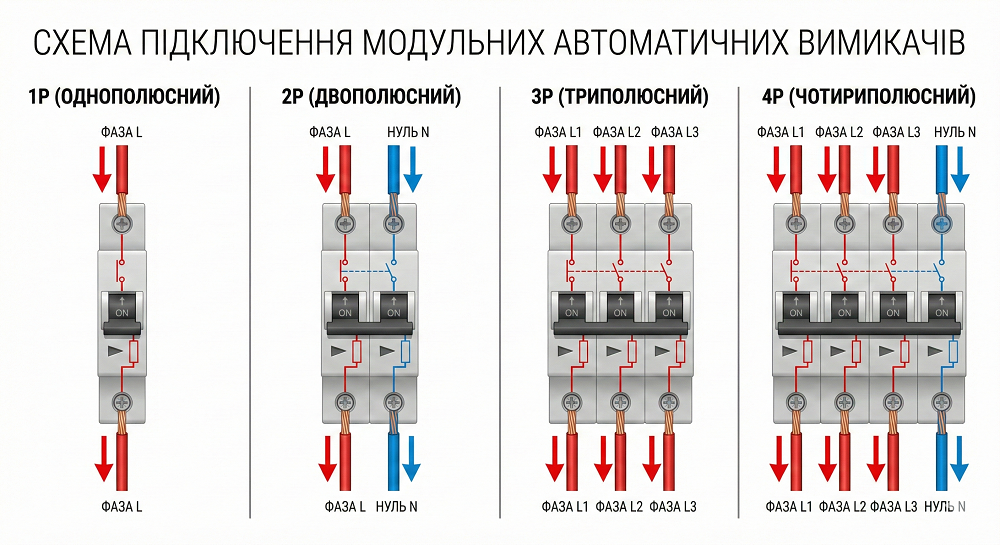
A pole in a circuit breaker is, simply put, a channel through which current flows and is controlled. The number of poles determines how many wires the breaker can physically disconnect during a fault. If you're planning a renovation and wondering how to choose the right number of poles for a circuit breaker, remember this simple hierarchy:
- 1P — controls only the phase (L).
- 1P+N — controls the phase (L) and mechanically disconnects the neutral (N) when tripped, but protection (thermal/electromagnetic) is only on the phase.
- 2P — has two fully protected poles (or one protected + one switching pole, but in a wider housing).
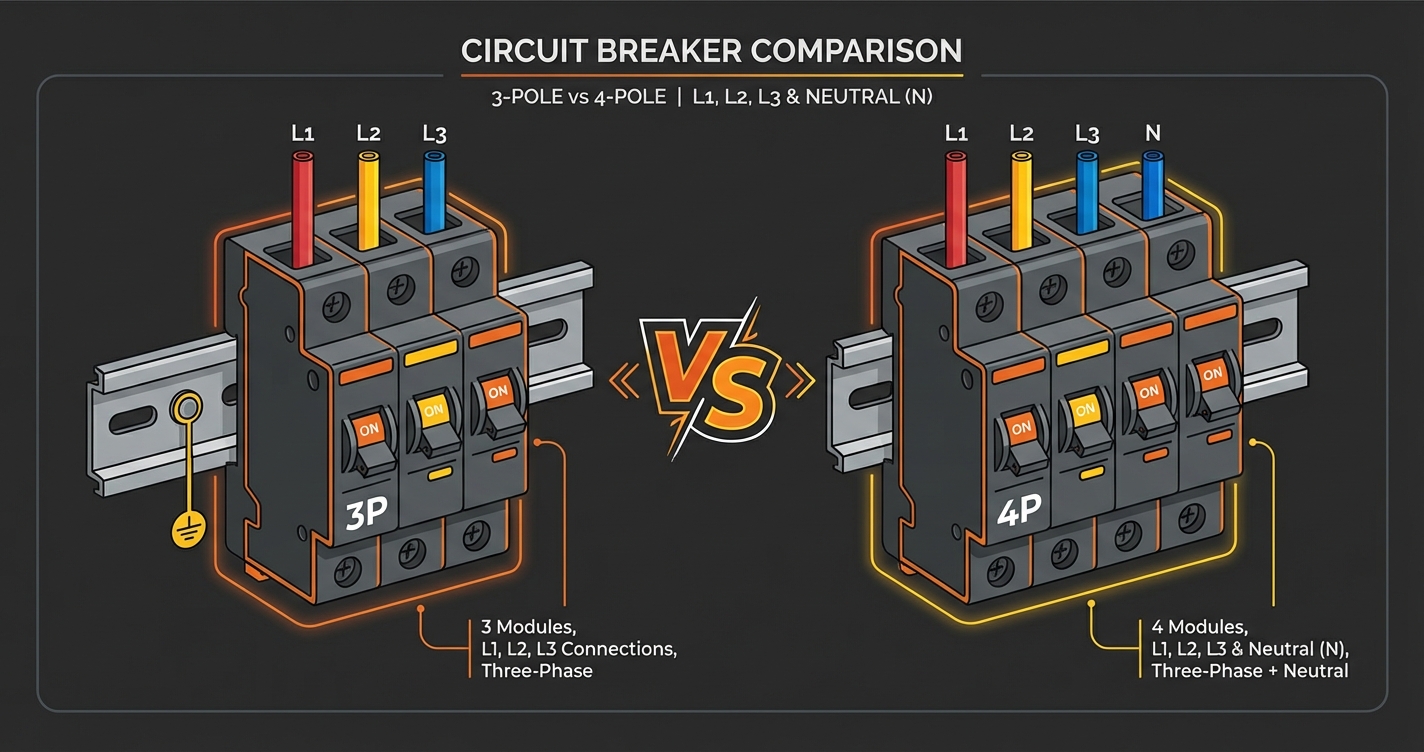
- 3P and 4P — used for three-phase networks (380 V).

Warning! Working with electrical equipment is life-threatening!
All work in an electrical panel must be performed only by qualified electricians with the power disconnected. Before starting any work, always de-energize the circuit and verify the absence of voltage with a measuring instrument.
What Is a Single-Pole (1P) Circuit Breaker and Where Is It Used?
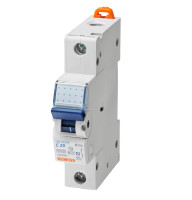
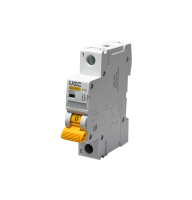
A single-pole circuit breaker is a classic choice for residential panels. It occupies one module (18 mm) on a DIN rail. Its main function is to protect the cable from overheating by disconnecting the phase conductor.
From my experience designing circuits for UEC partners, 1P is ideal for:
Lighting circuits: lamps, LED strips.
Room outlets: bedrooms, living rooms, where small appliances are connected (TV, chargers).
Dry areas: where the risk of human contact with water and electricity is minimal.
As experts at Peerless Electronics note: "Single-pole breakers have one pole and are designed to interrupt the current flow in a single, ungrounded (hot) conductor" [Peerless Electronics, 2024].
Selection rule: if you're hesitating between 1P and 2P — for regular dry areas, 1P is a sensible space-saving standard.
What Is a Double-Pole (2P) Circuit Breaker and When Is It Necessary?
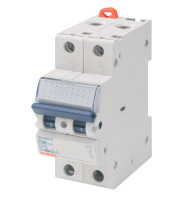
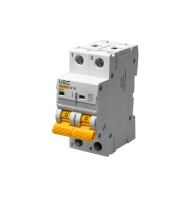
A double-pole circuit breaker is a device two modules wide (36 mm) with a single tripping mechanism. The key feature: during a fault on the phase, it "pulls" the neutral wire along with it, completely isolating the circuit.
I strongly recommend 2P for:
Main breaker: to de-energize the entire apartment with one switch.
High-power loads: electric stoves, tankless water heaters.
"Wet" zones: water heater, washing machine, bathroom outlets.
According to OOHMAGE: "Such breakers are designed to interrupt current flow in two conductors simultaneously", which is critical for safety during maintenance [OOHMAGE, 2024]. This is especially relevant if you're selecting a breaker for outlets and lighting in the bathroom.
The Compromise: 1P+N Circuit Breakers (Compact Solutions)
There's a hybrid option — 1P+N breakers in a single-module housing (18 mm). It seems like the perfect solution: you get neutral disconnection without losing space in the panel. But there's a catch.
In such compact series (for example, some Schneider or Hager lines), the contact mechanism is compressed. The N pole switches with a slight delay on closing and leads on opening, but the arc chute on the neutral is often absent or simplified.
My conclusion: for residential use, 1P+N is acceptable, but for high loads, I prefer honest two-module 2P breakers in UEC projects — they're more reliable during high-current short circuits.
Comparing Circuit Breakers: The Key Difference Between 1P and 2P
To make an informed decision, take a look at this table. It's based on real installation cases we've reviewed at UEC seminars.
| Criterion | 1P (Single-Pole) | 2P (Double-Pole) |
|---|---|---|
| What it disconnects | Phase (L) only | Phase (L) and Neutral (N) simultaneously |
| Safety during fault | Basic (sufficient for dry areas) | Maximum (complete isolation) |
| Space in panel | 1 module (18 mm) | 2 modules (36 mm) |
| Price | Budget-friendly | More expensive (~+80-100%) |
| Ideal application | Lighting, room outlets | Main entry, water heater, stove |
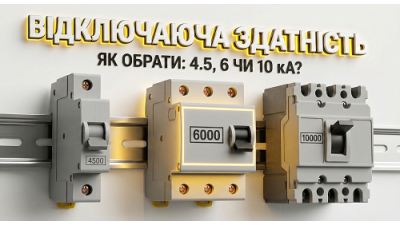
Remember that besides pole configuration, the breaking capacity of the breaker is also important — the ability to withstand short-circuit current without destruction.
Why Is It Important to Disconnect the Neutral?
This question is often ignored by "old school" electricians. Why do I and the electrical installation codes recommend disconnecting the neutral?
Diagnosing Leakage
The problem with 1P breakers
Imagine this situation: an RCD (residual current device) trips on an outlet group. If you have 1P breakers installed, turning off the breaker doesn't disconnect the neutral. If the insulation damage is on the neutral wire (N touching ground PE), the RCD will keep tripping even with the breaker turned off.
The 2P solution
To find the problem with 1P, you'll have to disassemble the panel and disconnect the neutrals from the busbar. With a 2P breaker, you simply turn off circuits one by one and locate the fault in a minute.
Protection from "Foreign" Potential
What's the danger
During substation faults or a neutral break in the riser (burned-out neutral), a dangerous potential (voltage) can appear on your neutral wire. If you have a 1P breaker, even in the off position, your equipment and you remain at risk.
What experts say
Eaton emphasizes in their technical guide: "An abnormal circuit condition in any one pole will cause all poles to open simultaneously," which guarantees complete isolation from the hazard source [Eaton, Consulting Application Guide].
Read more about the nuances of neutral switching in our article: should you disconnect the neutral with a circuit breaker.
Usage Scenarios: Practical Recommendations for Apartments and Houses
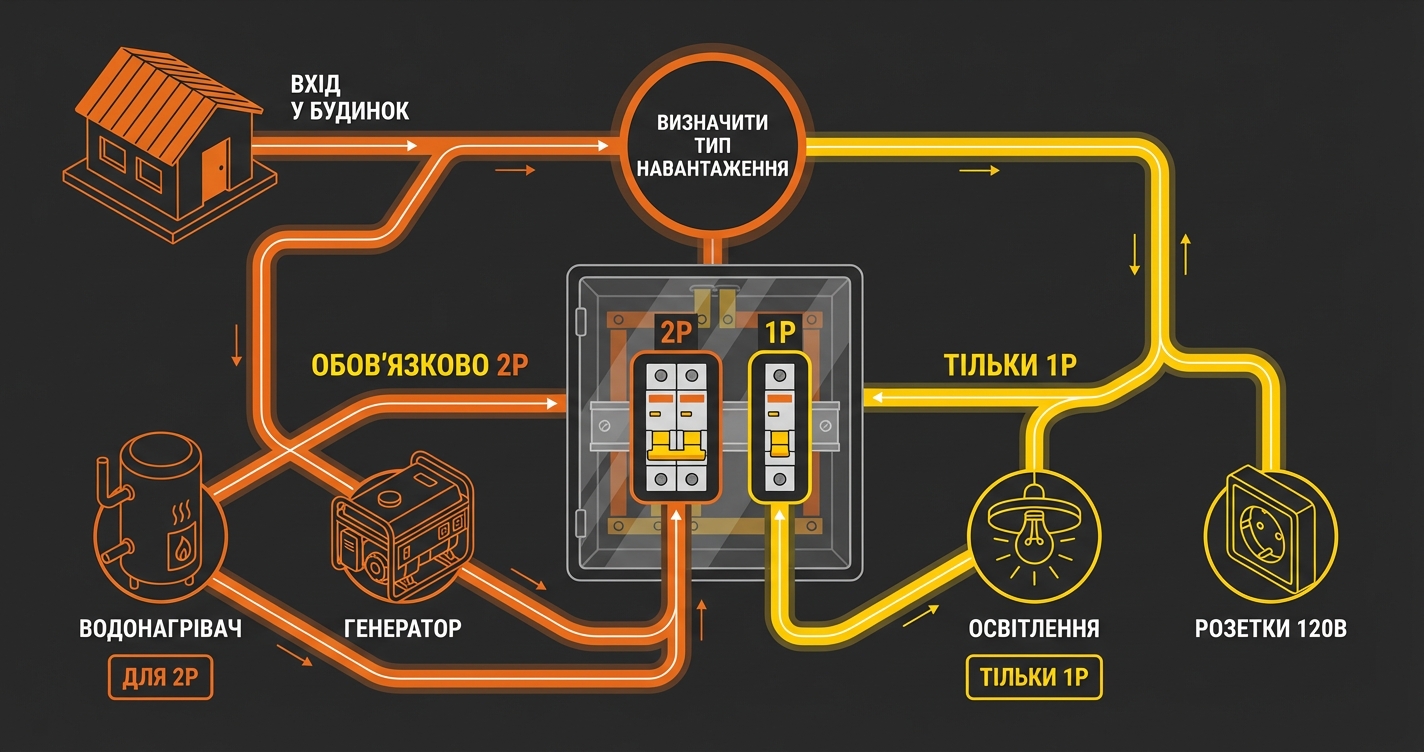
There's no universal recipe of "install 2P everywhere," as this would double your budget and panel size. A sensible balance is needed. Here's a scheme we often use at UEC for typical apartments.
Main Breaker: Why Is 2P the Standard?
The main disconnect switch or breaker is the primary safety point. How to choose a circuit breaker for a home or apartment main entry? Definitely 2P (for 220 V). Using 1P at the main entry is a serious mistake. If the utility electrician swaps phase and neutral in the building panel (which happens more often than you'd expect), with a 1P breaker turned off, your entire apartment wiring will remain energized with phase voltage. A 2P breaker eliminates this risk by disconnecting both conductors.
Branch Circuit Protection (Outlets and Lighting)
Lighting and room outlets — feel free to use 1P, the risk is minimal, and space savings are significant. Air conditioner, refrigerator — 1P is sufficient if the circuit is protected by a common RCD. Washing machine, water heater, dishwasher — 2P is recommended (or RCBO). Water + electricity = high-risk zone. It's better to pay extra for safety here.
Three-Phase Network (380V): Choosing Between 3P and 4P
For private homeowners, the situation is a bit more complex. Use 3P only for loads that don't require a neutral (for example, a three-phase pump motor or machine tool). 4P is mandatory for the house main entry where a system with a working neutral is used (most modern cottages). This allows disconnecting 3 phases and neutral with one action. According to Weisho Elec research, this is critical for protection against phase imbalance under asymmetric loads.
.png)
Impact of Grounding System (TN-C, TN-S) on Selection
A bit of technical detail that saves lives.
If you live in older housing stock ("Khrushchyovka", "panel building"), where there's no grounding and only two wires come to the panel (TN-C system), be careful. In such systems, the functions of the working neutral (N) and protective conductor (PE) are combined in a single PEN wire.
Iron rule: Breaking the PEN conductor before its separation into N and PE is strictly prohibited. If you install a 2P breaker and it breaks the PEN, all the housings of your appliances (refrigerator, washing machine) could become energized through their own power filters. In such older networks, 1P is often installed at the main entry, or 2P only after the PEN separation point.
In modern buildings (TN-S, TN-C-S), neutral and ground are separated, so using 2P and 4P breakers is safe and the recommended standard.
Common Questions and Fatal Installation Mistakes
❌ Can you link two 1P breakers with a handle tie (jumper)?
No, this is strictly prohibited! Mechanical linking of handles does not ensure synchronized operation of the internal trip mechanisms. During a short circuit, one breaker may trip while the other remains on, leading to phase imbalance or fire.
❌ Can you install a 3P breaker on a single-phase network?
Technically yes, using one pole. But it's impractical: you're wasting three times the panel space and money for nothing. It's better to select the right breaker rating for a 220V network.
❌ What happens if you swap phase and neutral when connecting a 1P?
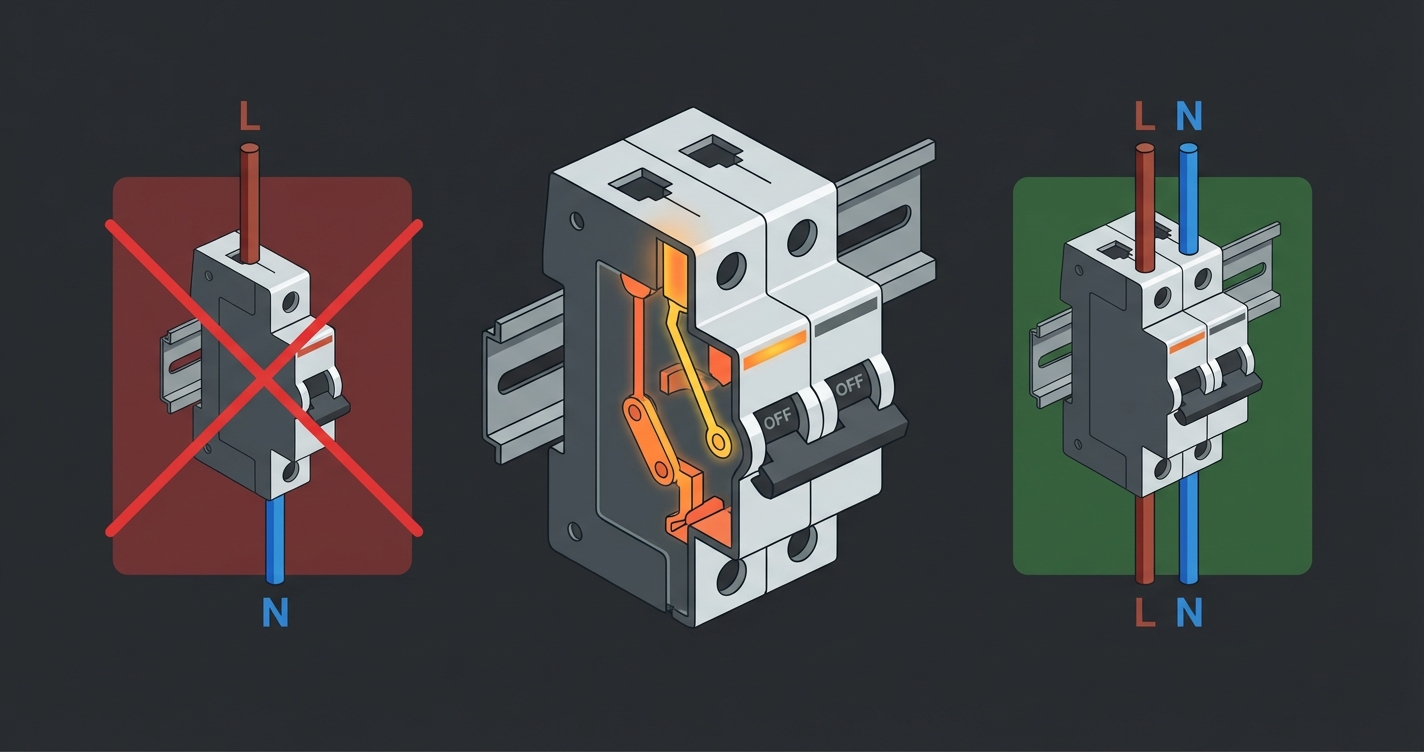
The breaker will work and protect the circuit from overload. But when you turn it off, it will break the neutral while the phase remains on the appliance. For example, when changing a light bulb, you could touch the socket contact that's still energized and receive an electric shock.